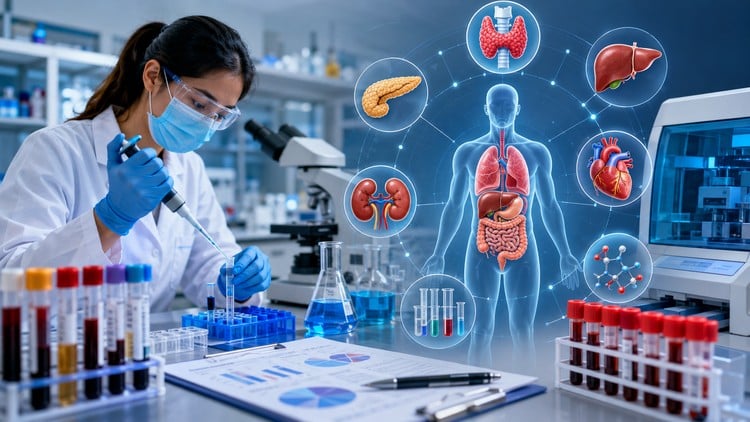
Master Laboratory Testing and Clinical Interpretation
What You Will Learn:
- Clinical Laboratory Statistics
- Preanalytical Variables & Specimen Integrity
- Myocardial Infarction & Heart Failure
- Renal Disease & Urinalysis
Overview: Bridging the Gap Between Benchwork and Bedside
I’ve spent the better part of a decade troubleshooting automated analyzers and screaming at high-volume chemistry lines, and if there’s one thing I’ve learned, it’s that a tech is only as good as their clinical intuition. This course, “Clinical Chemistry: Principles and Practice,” isn’t just another dry academic slog. It’s designed to transform you from a “button pusher” into a critical thinker who actually understands the metabolic chaos happening inside those specimen tubes. While many beginner to advanced programs focus purely on the “how,” this one dives deep into the “why,” bridging the massive gap between raw data and patient outcomes.
What I appreciated most was the focus on the diagnostic mindset. In the modern lab, we’re often drowning in data but starving for insight. This course cuts through the noise, teaching you to look at a comprehensive metabolic panel not just as a list of numbers, but as a narrative of a patient’s physiological state. It moves past the rote memorization of reference ranges and forces you to consider the biological variability and clinical significance of every shift in an analyte. It’s about job-ready skills that actually matter when a physician calls the lab asking for an interpretation of a weird creatinine clearance result.
Prerequisites
You don’t need a PhD to get through this, but you shouldn’t walk in cold, either. A solid foundation in general chemistry and basic human biology is non-negotiable. If you don’t know your way around a mole or the basic structure of a cell, you’re going to struggle. More importantly, you need a high level of attention to detail and a basic comfort level with algebra. If you’ve spent some time in a clinical setting—even as a phlebotomist or a lab assistant—you’ll have a significant leg up because you’ll already understand the frantic pace of the healthcare environment. This is a certification prep level course, so come prepared to work.
Skills & Tools
This course leans heavily into the industry-standard tools that define the modern laboratory. You aren’t just reading about theories; you’re learning the mechanics of high-throughput clinical chemistry analyzers and the software that drives them. Key skills you’ll walk away with include:
- Quality Control Mastery: You’ll learn to navigate Levey-Jennings charts and apply Westgard Rules like a pro, ensuring your hands-on labs yield accurate, reproducible data.
- Analytical Troubleshooting: Gain the ability to identify interference—like hemolysis, icterus, or lipemia—before the results ever hit the doctor’s desk.
- Data Correlation: Learn to correlate urinalysis findings with blood chemistry to build a complete picture of renal disease.
- LIS Proficiency: Understanding how Laboratory Information Systems integrate with clinical data to streamline real-world projects and reporting.
Career Benefits & Job Roles
If you’re looking for career growth, this is your ticket. Clinical chemistry is the backbone of any hospital lab, and specialized knowledge here makes you indispensable. Completing this course significantly boosts your readiness for ASCP or AMT certification, which is the gold standard for getting hired in high-tier institutions. It’s not just about getting your foot in the door; it’s about moving up the ladder.
Potential job roles for graduates include:
- Medical Laboratory Scientist (MLS): Performing complex testing and supervising lab operations.
- Point-of-Care Testing (POCT) Coordinator: Managing decentralized testing at the patient’s bedside.
- Quality Assurance Officer: Ensuring the lab meets rigorous CLIA and CAP standards.
- Field Service Engineer: Working for companies like Roche or Beckman Coulter to maintain industry-standard tools.
Pros
- Practical Application: This isn’t just theory. The course uses real-world projects and case studies that mimic the high-pressure environment of a Level 1 trauma center lab.
- Certification Focused: The curriculum is perfectly aligned with major board exams, making it an excellent resource for certification prep.
- Comprehensive Scope: It covers the spectrum from beginner to advanced topics, ensuring that even seasoned techs find “ah-ha!” moments regarding specimen integrity and myocardial infarction biomarkers.
Cons
The section on clinical laboratory statistics is a total grind. Look, I get it—you need to understand mean, standard deviation, and coefficient of variation to run a lab—but the delivery here can be incredibly dry. If you aren’t a “math person,” you’re going to need to double down on your coffee intake to power through the standard deviation calculations and validation protocols. It’s necessary evil, but it’s the least “fun” part of the curriculum by a long shot.