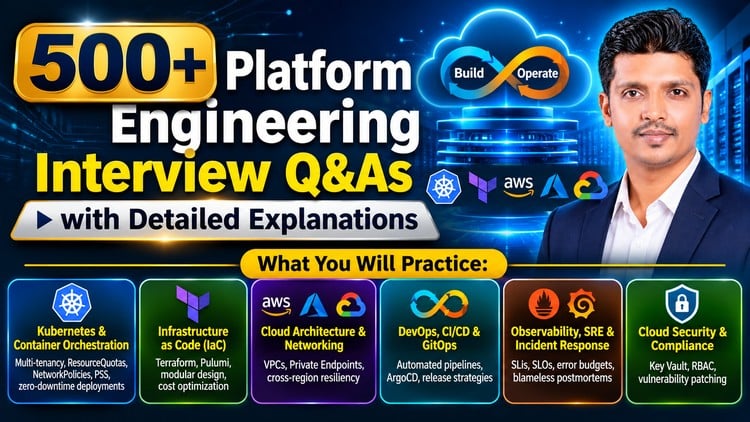
Master Kubernetes, Terraform, AWS, Azure, CI/CD, Observability & Cloud Security with 500+ real-world interview Q&A.
What You Will Learn:
- Master 500+ scenario-based Platform Engineering interview questions covering Internal Developer Platforms (IDP), Backstage, K8s, and IaC.
- Diagnose control plane failures, Crossplane/ACK CRD controllers, GitOps sync drift, and platform API rate-limiting bottlenecks.
- Architect golden paths, self-service developer portals, RBAC policy-as-code (Kyverno/OPA), and multi-tenant environment isolation.
- Pass technical screens, live system architecture rounds, and platform design interviews for senior Platform & Infrastructure roles
The Reality Check: Why This Practice Set Matters
Let’s be honest for a second—the transition from DevOps to Platform Engineering isn’t just a title change; it’s a massive shift in how we think about infrastructure. While DevOps was about breaking down silos, Platform Engineering is about building internal products that developers actually enjoy using. If you’ve been scrolling through job boards lately, you’ve probably noticed that “knowing AWS” isn’t enough anymore. Companies are looking for people who can architect Golden Paths and manage Internal Developer Platforms (IDP).
I recently went through the ‘500+ Platform Engineering Interview Questions Practice Set’, and I have some thoughts. This isn’t your typical “definitions” list that you can find on a random blog post. It’s designed for those of us who have lived through a 3 AM PagerDuty alert and need to prove we can build systems that don’t fall over. If you’re aiming for career growth in the cloud-native space, you need more than just industry-standard tools; you need the architectural mindset that these 500+ questions force you to adopt. It’s a grueling but necessary mental workout for anyone serious about senior Platform & Infrastructure roles.
Prerequisites for Success
You shouldn’t walk into this practice set as a total greenhorn. While it covers beginner to advanced levels, you’ll get the most value if you already have:
- A solid grasp of Linux internals and containerization (Docker is a must).
- Hands-on experience with at least one major cloud provider (AWS, Azure, or GCP).
- Basic familiarity with Infrastructure as Code (IaC) principles, specifically Terraform or OpenTofu.
- An understanding of the software development lifecycle (SDLC) and where CI/CD pipelines usually break.
Skills & Tools: What You’re Actually Mastering
This course is less of a tutorial and more of a certification prep powerhouse. It dives deep into the tech stack that defines the modern platform. You aren’t just learning how to use these tools; you’re learning how they interact in a complex, multi-tenant environment.
- Orchestration & Control Planes: Mastering Kubernetes, including CRD controllers like Crossplane and ACK.
- Developer Experience: Setting up Backstage and building self-service portals that don’t compromise security.
- GitOps & Automation: Tackling GitOps sync drift and managing state at scale with ArgoCD.
- Policy as Code: Implementing RBAC and governance using Kyverno or OPA to ensure your platform is “secure by design.”
- Observability: Moving beyond simple metrics to understand platform API rate-limiting bottlenecks and distributed tracing.
Career Benefits & Job Roles
The market for Platform Engineers is red hot right now. Why? Because companies are tired of their developers spending 40% of their time fighting with YAML. By mastering these job-ready skills, you position yourself as the “force multiplier” in a tech organization. This practice set is a direct path toward roles like Senior Platform Engineer, Cloud Architect, or Site Reliability Engineer (SRE).
The career growth potential here is massive. We’re talking about moving into high-total-compensation (TC) roles at companies that operate at “hyperscale.” Because the questions focus on real-world projects and scenario-based troubleshooting, you’ll be able to walk into a live system architecture round and talk about multi-tenant environment isolation with actual confidence, not just buzzwords.
The Pros: Where This Course Shines
- Deep Scenario-Based Learning: The questions aren’t just “what is a pod?” Instead, they ask how you’d diagnose a control plane failure during a massive scale-up. This mirrors the high-pressure technical screens of top-tier tech firms.
- Focus on the IDP: Most courses ignore the “Internal Developer Platform” aspect. This one puts Backstage and Golden Paths front and center, which is exactly what hiring managers are currently obsessed with.
- Architectural Rigor: It teaches you to think about policy-as-code and security-left shifts. These are the “senior” level nuances that separate a junior admin from a high-level architect.
- Comprehensive Coverage: 500+ questions is a lot. It covers the niche stuff—like Crossplane controllers and API rate-limiting—that usually catches people off guard in interviews.
The Cons: An Honest Critique
The biggest drawback is that this is a practice set, not a hands-on lab environment. If you’re the type of learner who needs to click buttons in a sandbox to understand a concept, you’ll need to supplement this course with your own real-world projects or a home lab. It tells you the “what” and the “why” in great detail, but you’ll have to go to the official documentation or a terminal to practice the “how” for some of the more complex Kubernetes configurations. It’s an intensive mental exercise, but it requires self-discipline to research the areas where your knowledge is thin.
Final Verdict
If you’ve got an interview coming up for a senior Platform or Infrastructure role, this is the best investment you can make. It moves past the fluff and gets straight into the gritty details of platform design. It’s not just about passing the interview; it’s about becoming the kind of engineer who can actually build and defend these systems in production. Use it to bridge the gap between “knowing the tools” and “mastering the platform.”