A step by step the Matlab codes for BER estimations of different Comm. systems like OFDM and NOMA Comm. systems
What you will learn
How to estimate the Bit-Error-Rate (BER) performance of different modulation schemes like BPSK, QPSK, 16QAM, 64QAM, and 256QAM over an Additive White Gaussian Noise (AWGN) channel?
How to generate and add a Rayleigh fading channel based on the Jakes model?
How to mitigate the Rayleigh fading channel effect using different linear equalizer schemes?
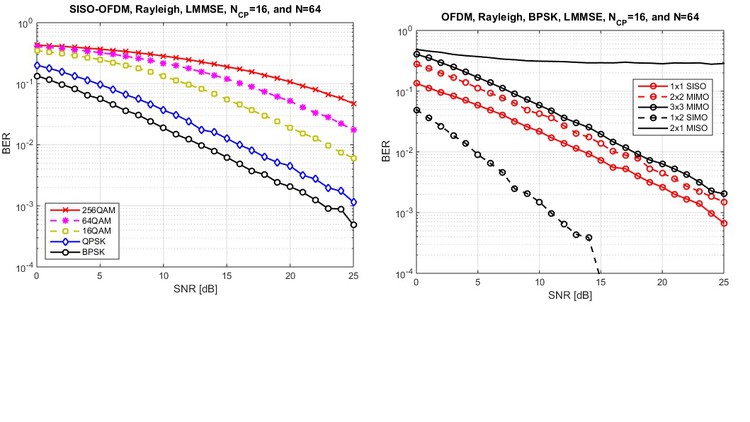
How to estimate the Bit-Error-Rate (BER) performance over Single-Input-Single-Output Orthogonal Frequency Division Multiplexing (SISO-OFDM) communication system over a Rayleigh fading channel?
How to extend this work for different Multiple-Input-Multiple-Output (MIMO) configurations like 2×2, and 3×3 MIMO-OFDM communication systems over a Rayleigh fading channel?
A general code for BER estimation in case of Nt×Nr configuration for OFDM communication system over a Rayleigh fading channel will be presented, where Nt, is the number of transmitting antennas, and Nr is the number of receiving antennas.
Finally, the BER estimation for Non-Orthogonal Multiple Access (NOMA), which used in the 5G communication systems will be presented.
Overview: From Theory to Throughput
If you’ve spent any time in the telecommunications world, you know there’s a massive, often frustrating gap between reading about Shannon’s limit in a textbook and actually building a simulation that doesn’t crash. Most courses leave you stranded with theoretical equations, but this Matlab course for wireless communication engineering is a different beast entirely. It’s designed for those of us who need to see the Bit-Error-Rate (BER) curves actually plotting on the screen to believe the math.
What I found particularly refreshing here isn’t just the focus on standard modulation like BPSK or QPSK, but the deep dive into industry-standard tools for 5G and beyond. We’re talking about moving past basic AWGN (Additive White Gaussian Noise) scenarios into the “messy” reality of Rayleigh fading channels. The course treats OFDM and NOMA (Non-Orthogonal Multiple Access) not just as buzzwords, but as functional codebases you can tweak. If you’re looking for hands-on labs that mirror the daily grind of a wireless systems engineer, this is where you start. It’s about building a robust simulation framework that scales—taking you from a simple SISO setup to complex MIMO configurations without losing the plot.
Prerequisites
- Foundational MATLAB Syntax: You don’t need to be a coding wizard, but you should know your way around matrices and basic loops.
- Basic Signal Processing: A working knowledge of Fourier Transforms and what “signal-to-noise ratio” actually means will save you a lot of rewinding.
- Undergraduate Communication Theory: Familiarity with the concepts of modulation and digital transmission is essential to appreciate the real-world projects provided.
Skills & Tools
- MATLAB & Simulink Environment: Mastering the industry-standard tools for algorithm development.
- Channel Modeling: Implementing the Jakes model for realistic fading simulations.
- Linear Equalization: Coding Zero-Forcing (ZF) and Minimum Mean Square Error (MMSE) schemes to combat inter-symbol interference.
- Matrix-Level Programming: Writing efficient code for Nt×Nr MIMO configurations, which is a massive career growth booster.
- Performance Metrics: Generating professional-grade BER vs. Eb/No plots for 256QAM and other high-order modulations.
Career Benefits & Job Roles
Completing a course like this is essentially certification prep for the real world. In an era where 5G deployment is peaking and 6G research is heating up, having a portfolio of hands-on labs is what gets you past the technical interview. This isn’t just “academic” work; these are job-ready skills that apply directly to roles such as Wireless System Architect, DSP Engineer, or RF Simulation Analyst.
Companies like Qualcomm, Nokia, and Apple aren’t looking for people who can recite formulas; they want engineers who can model a 3×3 MIMO-OFDM system and explain why the BER is spiking. By mastering these beginner to advanced MATLAB techniques, you position yourself as a technical lead who can bridge the gap between hardware constraints and software simulation.
Pros
- Step-by-Step Logic: The course doesn’t dump a 500-line script on you. It builds the OFDM chain piece by piece, which is vital for debugging and deep understanding.
- Scalability: The general code provided for Nt×Nr configurations is worth the price of admission alone. It’s a “plug-and-play” framework that you can use for your own real-world projects or thesis work.
- High-Order Modulation Focus: Many tutorials stop at 16QAM. Seeing the implementation for 256QAM provides a much more realistic look at modern high-throughput systems.
- Jakes Model Integration: Using a realistic fading model instead of just random variables makes the Rayleigh fading simulations actually useful for professional design.
Cons
- Mathematical Intensity: While the coding is “step-by-step,” the underlying math of linear equalizers and MIMO detection can be quite steep. If you’re a complete novice to linear algebra, you might find yourself hitting the “pause” button frequently to look up matrix inversion properties.