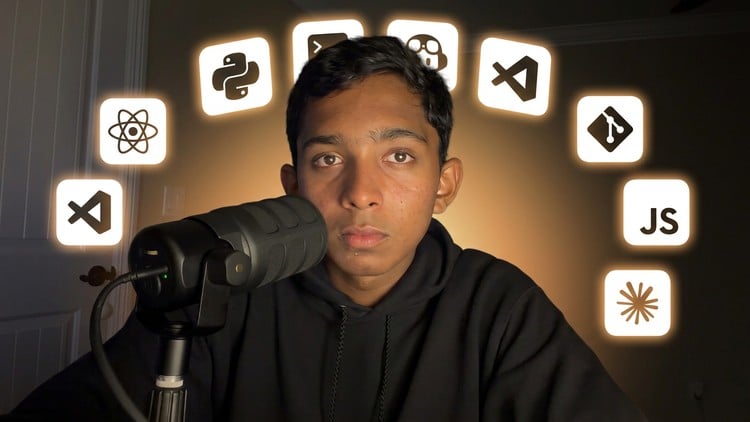
Build websites, web apps & AI-powered tools using ChatGPT, Claude & Cursor — no coding experience needed.
What You Will Learn:
- Build fully working apps by describing them in plain English using AI tools — no coding syntax to memorize
- Set up and use the exact vibe coding toolkit: Claude, Cursor, and ChatGPT, all on free plans
- Write effective AI prompts using a repeatable formula, and confidently debug errors when the AI gets it wrong
- Deploy a real app to a live, shareable URL and add it to your portfolio or resume
The Shift from Syntax to Strategy: Why “Vibe Coding” Matters
I’ve spent over a decade staring at IDEs, fighting with missing semicolons, and navigating the labyrinth of stack traces. When I first heard the term vibe coding, I’ll admit I rolled my eyes. It sounded like another flash-in-the-pan buzzword. But after diving into this course, I’ve realized it represents a fundamental paradigm shift in how we approach software engineering. This isn’t just about “not coding”; it’s about elevated technical literacy. The course reframes the developer’s role from a manual laborer of logic to an architect of intent.
What sets this curriculum apart is that it doesn’t treat AI as a mere autocomplete tool. Instead, it teaches you how to orchestrate a symphony of industry-standard tools like Cursor and Claude to build functional, high-performance web applications. The “vibe” isn’t just a mood—it’s the ability to articulate complex logic in plain English so clearly that the AI can execute it flawlessly. For an experienced pro, seeing beginner to advanced concepts condensed into a weekend of hands-on labs was eye-opening. We are moving toward a world where the speed of thought is the only bottleneck in production.
Who Can Actually Do This? (Prerequisites)
The beauty of this course is the low barrier to entry, but don’t mistake “no coding” for “no thinking.” To get the most out of these modules, you don’t need a CS degree, but you do need a logical mindset. You should be comfortable navigating a computer and have a clear idea of a problem you want to solve. Whether you’re looking for certification prep or just want to build a side hustle, the only real prerequisite is curiosity and the patience to iterate. If you can explain a recipe or give clear driving directions, you have the foundational logic required to succeed here.
The Modern Stack: Skills & Tools You’ll Master
The course focuses on what I call the “Holy Trinity” of modern AI development. You won’t just be chatting with a bot; you’ll be building a professional portfolio using a sophisticated workflow. Key areas covered include:
- Prompt Engineering Mastery: Learning the repeatable formulas to get Claude 3.5 Sonnet and ChatGPT to generate clean, scalable code without the hallucination “bloat.”
- The Cursor IDE: Mastering the fork of VS Code that has become the gold standard for AI-native development. You’ll learn how to index your codebase so the AI has full “context awareness.”
- Rapid Prototyping & Deployment: Taking an idea from a blank screen to a live, shareable URL. This is where job-ready skills are forged—moving past the “it works on my machine” phase.
- Debugging via Dialogue: This is the most critical skill. When the “vibe” goes wrong, the course teaches you how to feed errors back into the AI to self-correct, a vital part of real-world projects.
Career Benefits & Job Roles
In today’s market, career growth is tied directly to your efficiency. Companies are no longer just looking for people who can write Python; they want “AI-augmented” professionals who can do the work of a three-person team. By mastering these AI-powered tools, you position yourself for several emerging roles:
- Product Managers: Build MVP (Minimum Viable Products) yourself to prove a concept before requesting engineering budget.
- Marketing Operations: Create internal AI-powered tools to automate data workflows without waiting on the IT ticket queue.
- Solopreneurs & Founders: Drastically reduce your burn rate by handling the initial full-stack development solo.
- Technical Generalists: Enhance your resume by showing you can bridge the gap between business requirements and technical execution.
The Pros: Why This Course Hits the Mark
- Zero-Cost Entry: I love that the instructor sticks to free plans. You don’t need to drop $100/month on subscriptions just to learn the basics, making this highly accessible.
- Practical Output: This isn’t theoretical. By the end, you have a real-world project. In a sea of “tutorial hell,” having a functional app to show for your time is a massive win for portfolio development.
- Focus on “The Why”: The course does a great job explaining the logic behind the prompts. It builds computational thinking, which is a transferable skill regardless of which AI tool becomes popular next year.
The Honest Cons: Where It Gets Tricky
The biggest “gotcha” with vibe coding—and something the course touches on but can’t fully solve—is the Black Box Problem. When you build an app without understanding the underlying JavaScript or Python, you are essentially a pilot who doesn’t know how the engine works. If the AI gets stuck in a recursive error loop, or if you want to implement a highly specific, niche security protocol, the “vibe” might fail you. To truly reach a “senior” level, you will eventually need to peek under the hood, but for 90% of web apps, this course gets you there faster than any traditional bootcamp ever could.