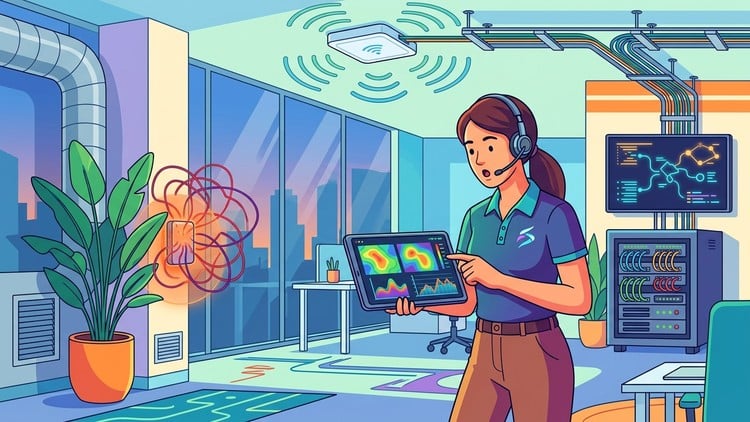
Master wireless networking with realistic practice questions and detailed explanations for the CWNT 2026 certification.
What You Will Learn:
- How to solve real-world wireless network problems and fix dropped connections quickly.
- The strict rules of 802.11 standards, including Wi-Fi 7, 6 GHz channels, and roaming.
- Ways to protect enterprise networks using WPA3 security and block rogue access points.
- Steps to design, plan, and survey a brand new wireless network before buying hardware.
- How to calculate radio power, understand antenna gain, and find hidden interference.
Why This Practice Set Actually Matters for Your Wireless Career
Look, I’ve been in the networking game for over a decade, and if there’s one thing I’ve learned, it’s that “knowing” Wi-Fi and passing a high-stakes certification prep exam are two entirely different beasts. The 2026 CWNT Professional exam isn’t just another multiple-choice hurdle; it’s a grueling test of whether you can actually handle high-density enterprise environments without making a mess of the spectrum. I jumped into these practice tests expecting the usual fluff, but I was pleasantly surprised. Most resources just regurgitate the 802.11 manual, but this course feels like it was written by someone who has actually climbed a ladder and mounted an AP in a Faraday-cage-style warehouse.
What sets this apart is the focus on the “why” behind the “what.” In the current market, career growth in IT infrastructure is tethered to your ability to handle the 6 GHz spectrum and the complexities of Wi-Fi 7. This course doesn’t just ask you what a 320 MHz channel is; it forces you to think about the contention overhead and whether your legacy clients are going to fall off the map. It’s an honest, no-nonsense bridge between being a “Wi-Fi enthusiast” and a job-ready wireless professional who can walk into a boardroom and explain why the real-world projects are over budget due to hidden RF interference.
Prerequisites
- A rock-solid understanding of the OSI model, specifically Layers 1 and 2—if you don’t know your MAC from your PHY, start elsewhere.
- Basic familiarity with industry-standard tools like Wireshark or simple spectrum analyzer apps.
- At least six months of hands-on labs or field experience; this is definitely a beginner to advanced trajectory, but the “beginner” part assumes you’ve at least configured a basic router before.
- A basic grasp of IP subnetting and VLANs, as wireless doesn’t live in a vacuum.
Skills & Tools You’ll Master
- RF Physics & Math: You’ll move past guessing and start calculating radio power, link budgets, and understanding exactly how antenna gain impacts your coverage footprint.
- Enterprise Security: Deep dives into WPA3 security protocols and the practical implementation of 802.1X/EAP for enterprise networks.
- Protocol Analysis: Learning to read the “air” by identifying management, control, and data frames to fix dropped connections.
- Site Survey Logic: Developing the job-ready skills to use predictive modeling software and heatmaps effectively before a single cable is pulled.
- Spectrum Management: Finding and neutralizing non-Wi-Fi interference like microwave ovens, Bluetooth bleed, and rogue access points.
Career Benefits & Job Roles
Let’s talk money and titles. Earning a CWNT certification is a major signal to recruiters that you aren’t just a “cable guy.” This course prepares you for roles like Wireless Network Engineer, Network Architect, or Senior Systems Administrator. Because it covers industry-standard tools and the latest Wi-Fi 7 standards, you become an immediate asset for companies undergoing digital transformation. The career growth potential here is massive; we’re talking about moving from a generalist role into a specialized niche where you’re the one designing the enterprise networks for hospitals, stadiums, and tech hubs. It’s about building a portfolio of real-world projects that prove you can handle the “invisible” side of the infrastructure.
Pros
- Hyper-Realistic Scenarios: The questions aren’t just definitions; they are “The CEO’s laptop keeps dropping in the lobby, what’s the first thing you check?” type of troubleshooting scenarios.
- Deep-Dive Explanations: Every wrong answer includes a detailed breakdown of why it’s wrong, which is where the real learning happens during certification prep.
- Future-Proofed Content: It’s one of the few sets I’ve seen that actually treats Wi-Fi 7 and the 6 GHz band as a primary concern rather than an afterthought.
- Emphasis on Design: It forces you to think about capacity planning and antenna gain, preventing the common mistake of just “blasting” more power to fix a bad signal.
Cons
- Brutal Difficulty Spike: Some of the RF math questions feel a bit like a physics final exam; if you aren’t prepared to do some mental gymnastics with decibels, the first few practice tests might be a massive ego check.