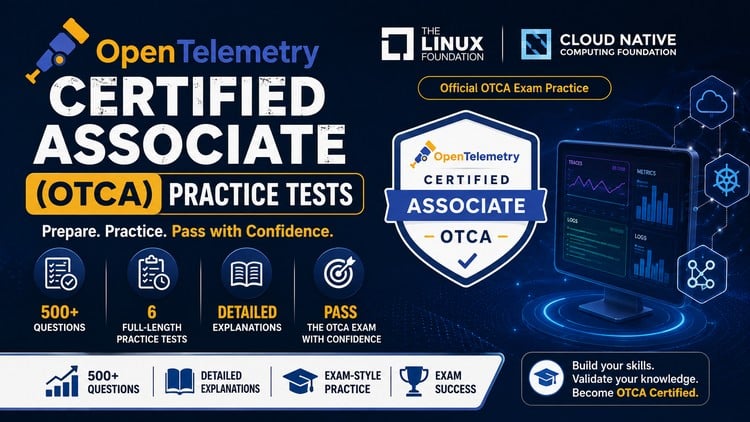
Pass the OTCA exam with 6 realistic practice tests, 500+ questions, and detailed explanations | Golden Kubestronaut
What You Will Learn:
- Master the official OTCA exam objectives through realistic practice tests.
- Build a strong understanding of OpenTelemetry concepts, architecture, and observability.
- Learn tracing, metrics, logs, context propagation, and telemetry pipelines.
- Identify knowledge gaps with 500+ exam-style questions and detailed explanations.
- Gain confidence by practicing with full-length mock exams that simulate the real OTCA exam.
- Improve your readiness to pass the OpenTelemetry Certified Associate (OTCA) certification exam.
Overview: Beyond the Observability Hype
Let’s be honest: the cloud-native world is currently obsessed with observability, and for good reason. We’ve moved past the days of just “checking the logs” when a service goes down. If you’re eyeing the OpenTelemetry Certified Associate (OTCA), you already know that OpenTelemetry (OTel) is the second most active CNCF project after Kubernetes. It’s the industry-standard tool for the future. But passing the exam? That’s a different beast. I recently spent some time digging through the ‘OpenTelemetry Certified Associate (OTCA) Practice Tests 2026’ by Golden Kubestronaut, and it’s a refreshing departure from the low-effort brain dumps that usually flood the market.
What sets this course apart isn’t just the sheer volume of questions—though 500+ is a massive number—it’s the logic behind the “why.” Most certification prep materials tell you what the answer is; this course explains why the other three options are technically incorrect in a production environment. It covers the 2026 objectives, which is crucial because OTel is evolving at breakneck speed. If you are tired of proprietary vendor lock-in and want to master a vendor-agnostic way to handle tracing, metrics, and logs, this is where the rubber meets the road. It feels less like a dry academic exercise and more like a rigorous drill for real-world projects.
Prerequisites: What Do You Actually Need?
You don’t need to be a Go or Java wizard to get value here, but don’t walk in totally cold. To get the most out of these practice tests, you should have a baseline understanding of cloud-native architecture. If you know your way around a Kubernetes cluster and understand the basic concept of a microservice, you’re in a good spot.
Ideally, you’ve at least played with a basic hands-on lab or tried to instrument a simple “Hello World” app. This course is designed to take you from a beginner to advanced level of theoretical understanding, but it assumes you aren’t brand new to the command line. A basic grasp of how data flows from an application to a backend (like Prometheus or Jaeger) will help you visualize the “context propagation” questions that often trip people up on the actual exam.
Skills & Tools You’ll Master
This isn’t just about passing a test; it’s about building job-ready skills that actually translate to a modern DevOps or SRE role. By the time you finish the sixth mock exam, you’ll have a granular understanding of:
- The OpenTelemetry Collector: You’ll learn how to configure receivers, processors, and exporters without breaking the pipeline.
- Context Propagation: This is the “secret sauce” of OTel. You’ll master how trace IDs move across service boundaries.
- The Three Pillars: Deep dives into how OTel unifies tracing, metrics, and logs into a single specification.
- OTLP (OpenTelemetry Protocol): Understanding the wire protocol that is becoming the universal language of telemetry.
- Sampling Strategies: Knowing when to use head-based vs. tail-based sampling to save on cloud costs while maintaining visibility.
Career Benefits & Job Roles
Earning the OTCA isn’t just a badge for your LinkedIn profile; it’s a signal to recruiters that you understand the modern telemetry pipeline. As companies migrate away from expensive, proprietary observability suites, they are looking for engineers who can implement OTel to keep costs down and flexibility high.
If you are aiming for roles like Site Reliability Engineer (SRE), Platform Engineer, or Cloud Architect, this certification is a major differentiator. It shows you can handle the complexity of distributed systems. In terms of career growth, specialized knowledge in OTel is currently a high-demand niche. Being the person who can “fix the observability gap” makes you incredibly valuable during high-stakes troubleshooting sessions and long-term architectural planning.
Pros of the Course
- Realistic Exam Simulation: The questions aren’t just “what is OTel?” They are situational. “You have X problem in your collector, which processor do you use?” This mimics the actual OTCA difficulty perfectly.
- Deep-Dive Explanations: Every answer is backed by documentation references. It turns a “wrong” answer into a learning moment rather than just a frustration.
- Updated for 2026: The OTel spec changes. This course keeps pace with the latest stable releases, ensuring you aren’t learning deprecated attributes or old configuration syntax.
- High Volume of Questions: With 6 full tests, you won’t start memorizing the questions by the second round. There is enough variety to keep your brain engaged.
The Cons: A Reality Check
The only real downside—and this is common with practice test courses—is that it is 100% text-based. If you are looking for a video walkthrough of someone setting up a collector in real-time, you won’t find it here. These are practice tests, not a guided tutorial. You’ll need to supplement this with the official documentation or your own hands-on labs if you want to see the code in action. It’s the ultimate “final step” in your certification prep, but it shouldn’t be your *only* resource if you’ve never touched an OTel config file before.