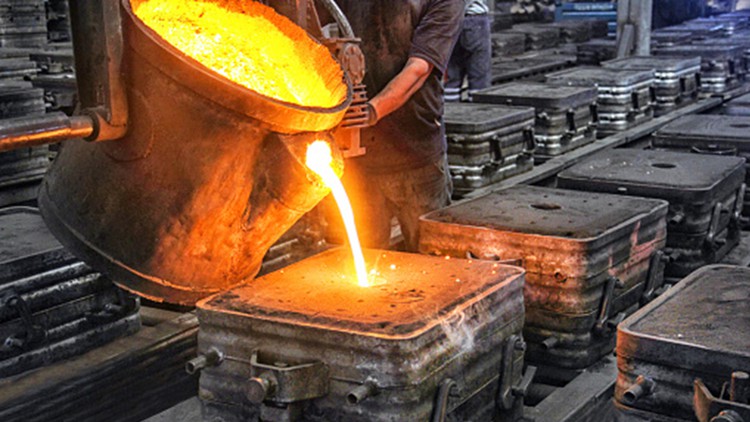
Get certified by the American Foundry Society (AFS) to advance your career in metal casting as professionalist.
What you will learn
Discover the fascinating world of metal casting and its crucial role in modern manufacturing
Explore the different types of metal casting, from the traditional ingot casting to the more modern shape casting techniques
Learn about the various molds used in metal casting, including the open, closed, expandable, and permanent molds, and understand their impact on casting process
Dive deep into the heating process of metal and discover the secrets to pouring molten metals into molds like a pro
Gain a comprehensive understanding of Bernoulli & Continuity Law and learn how to apply it to control the pouring of molten metal with ease
Understand the behavior of molten metals and alloys during solidification and cooling, including the critical concept of shrinkage and contraction during the co
Discover the different casting methods used in metal casting, including sand casting, permanent mold casting, and die casting
Learn how to identify and troubleshoot common casting defects and understand their root causes and possible solutions
Master the inspection methods used in metal casting to ensure high-quality and defect-free products
Gain insights into the various metals used in the metal casting process, and understand which metals are best suited for different casting methods
Explore the product design considerations for metal casting and understand how to design products that are optimized for the casting process.
Description
Metal casting is a critical process that has been used for centuries to create metal parts and objects. Today, it is an essential part of the manufacturing industry, and understanding the process is crucial for engineers, designers, and manufacturers.
If you are looking to gain a comprehensive understanding of metal casting, look no further than this in-depth video course. You will learn the fundamentals of metal casting, including the different types of metal casting, such as ingot casting and shape casting. You will also gain a deep understanding of the various types of molds used in metal casting, including open, closed, expandable, and permanent molds.
Heating the metal for pouring into molds is a crucial aspect of metal casting, and in this course, you will learn about the analysis of pouring molten metals into molds, including pouring temperature, pouring rate, and turbulence. You will also learn about the Bernoulli & Continuity Law and how fluidity affects the pouring of molten metal.
The behavior of molten metals and alloys during solidification and cooling is also an important concept to understand. In this course, you will learn about the shrinkage and contraction of molten metals during the cooling process.
This course covers various casting methods like sand casting, permanent mold casting, and die casting for metals, along with casting defects and their solutions, inspection methods for metal casting, metals used for the metal casting process, and product design considerations for metal casting.
Enrolling in this course is perfect for anyone looking to gain a deeper understanding of metal casting and its importance in the manufacturing industry. With our engaging and informative content, you will feel confident that you are getting the maximum knowledge available on this topic. Start your journey towards mastering the art of metal casting and maximizing organic traffic from Google today by enrolling in this course!
Content
Introduction
Alright, let’s talk brass tacks about the ‘Metal Casting: Techniques, Materials, and Product Design-AFS’ course. As someone who’s been around the block a few times in manufacturing, I can tell you that metal casting isn’t just some archaic process; it’s a bedrock of modern industry. This AFS-certified program isn’t just another online lecture series; it’s a solid commitment to developing serious job-ready skills in a field that consistently demands precision and expertise.
Overview
If you’re eyeing a deeper dive into how everything from engine blocks to intricate aerospace components come into being, this course from the American Foundry Society is a significant credential. It goes way beyond just showing you pretty pictures of molten metal. What truly sets it apart is its comprehensive approach, bridging the gap between fundamental scientific principles and practical application. It’s designed to transform your understanding from simply knowing that metal is poured into a mold, to appreciating the nuanced engineering behind every successful casting. You’ll be exploring the entire lifecycle, from initial material selection and mold design considerations right through to the complex thermodynamics of solidification. This isn’t just about making castings; it’s about understanding the “why” and “how” that underpins robust, high-quality manufacturing processes. It’s an investment in understanding a critical industrial art and science, and a direct pathway to enhanced career growth for any professional in materials science, manufacturing engineering, or product development.
Prerequisites
From my perspective, this course is quite accessible for a broad range of individuals, positioning itself as a journey from beginner to advanced. You don’t necessarily need a metallurgy degree or years of foundry experience to start. However, a foundational understanding of basic physics and chemistry would certainly give you a leg up, especially when diving into concepts like Bernoulli’s Principle or the thermodynamics of phase changes. More importantly, what you absolutely need is a genuine curiosity about manufacturing processes and a willingness to engage with both theoretical concepts and their practical implications. If you’re a mechanical engineer, materials scientist, or even a product designer looking to understand manufacturing constraints, you’re in the right ballpark.
Skills & Tools
Upon completing this program, you won’t just have a certificate; you’ll have a robust toolkit of conceptual and applied skills. You’ll gain a sophisticated understanding of various casting techniques, empowering you to select the most appropriate method for specific material properties and product geometries. Expect to master the principles behind mold selection – discerning when to use an expandable versus a permanent mold is a critical design choice that impacts cost, quality, and production volume. The course emphasizes critical thinking around the heating and pouring processes, ensuring you understand not just the mechanics but the critical parameters for controlling flow dynamics using principles like the Bernoulli & Continuity Law. This knowledge is crucial for mitigating common casting defects. Furthermore, you’ll develop an keen eye for the behavior of molten metals during solidification, learning to predict and manage issues like shrinkage and contraction—a cornerstone of producing defect-free components. While it may not directly teach you specific CAD software, the insights into product design considerations for casting will make you far more effective when using any industry-standard tools for design for manufacturability (DFM).
Career Benefits & Job Roles
The immediate and most significant benefit of this course is the official certification prep provided by the American Foundry Society (AFS). This isn’t just a badge; it’s a globally recognized credential that signals serious expertise. For any professional, this translates directly into enhanced career growth. You’ll be equipped for roles such as a Foundry Engineer, where you’ll optimize casting processes and troubleshoot production issues; a Metallurgist specializing in casting alloys; a Quality Control Inspector ensuring product integrity; or even a Process Engineer designing efficient manufacturing lines. For Product Designers, understanding casting constraints opens doors to creating more innovative and manufacturable parts. The deep dive into materials and process control positions you perfectly for advancing in roles focused on advanced manufacturing, materials science, and even research and development within the foundry industry. This certification gives you a competitive edge in a specialized, yet vital, sector.
Pros
- Industry-Recognized AFS Certification: This is hands down the biggest pro. The American Foundry Society is *the* authoritative body for metal casting. Earning their certification instantly elevates your professional standing and demonstrates a commitment to excellence. It’s a direct pathway to showing employers you’re serious about this field and possess a validated skill set.
- Comprehensive & Foundational Curriculum: The course effectively covers the spectrum from the very basics (like different mold types and the heating process) to advanced physics concepts (Bernoulli & Continuity Law) and critical material behaviors (solidification, shrinkage). This blend ensures a holistic understanding, catering to learners from beginner to advanced, providing both theoretical depth and practical relevance for real-world projects.
- Focus on Core Engineering Principles: Unlike some superficial courses, this program doesn’t shy away from the fundamental physics and metallurgy that govern successful casting. Understanding principles like fluid dynamics and solidification kinetics is crucial for truly mastering the process and troubleshooting effectively, leading to genuine job-ready skills rather than just procedural knowledge.
- Direct Applicability to Product Design: The inclusion of “Product Design” isn’t an afterthought. By understanding the manufacturing implications of casting, designers can create better, more efficient, and cost-effective parts from the outset. This cross-disciplinary insight is incredibly valuable in today’s integrated engineering environments.
Cons
- Limited Explicit Hands-On Application: While the course does an excellent job explaining *how* to perform various techniques and *why* certain principles apply, as an online offering, it inherently lacks direct, physical hands-on labs. For a skill as tactile and experience-driven as metal casting, practical application, even simulated, would significantly enhance the learning experience and solidify conceptual understanding. While it prepares you for a professional setting, the direct operational experience will need to be gained elsewhere.