Comprehensive MCQ Review for Electrical Testing Technician
What You Will Learn:
- Understand high voltage testing
- Interpret exam-style scenarios
- Apply maintenance principles
- Improve multiple-choice accuracy
Overview
Let’s be real for a second: you can be the best hand in the field, capable of wiring a complex protection scheme in your sleep, and still absolutely choke when you’re staring at a proctored exam screen. I’ve seen seasoned techs—guys who can troubleshoot a transformer differential relay blindfolded—fail their certification prep because they weren’t ready for the mental gymnastics of multiple-choice questions. That’s exactly where the MCQ Drill Course for Electrical Testing and Commissioning steps in. It’s not a “fluff” course that rehashes basic Ohm’s law for the tenth time. Instead, it’s a high-pressure, high-yield training ground designed to bridge the gap between “knowing the job” and “passing the test.”
The beauty of this course is that it doesn’t just give you the answers; it forces you to think like an examiner. Most electrical testing technician exams are designed to trip you up with “distractors”—those answers that look right if you’re rushing but are fundamentally flawed. This drill course focuses on the nuances of switchgear maintenance, insulation resistance testing, and protective relaying through the lens of logic. It moves you from a beginner to advanced understanding of how to dissect a question, eliminate the junk, and find the solution based on industry-standard tools and safety protocols. If you’re tired of feeling like a deer in headlights when faced with a NETA or NICET style scenario, this is the mental conditioning you need.
Prerequisites
This isn’t a “day one” course for someone who doesn’t know a resistor from a capacitor. To get the most out of these drills, you should have a solid foundation in basic electrical theory. You don’t need to be an engineer, but you should understand AC/DC circuits and be familiar with the National Electrical Code (NEC) or equivalent safety standards. Ideally, you’ve spent some time on-site or in hands-on labs where you’ve at least seen a circuit breaker or a current transformer. The course expects you to know the lingo so it can focus on the application of that knowledge in exam-style scenarios.
Skills & Tools
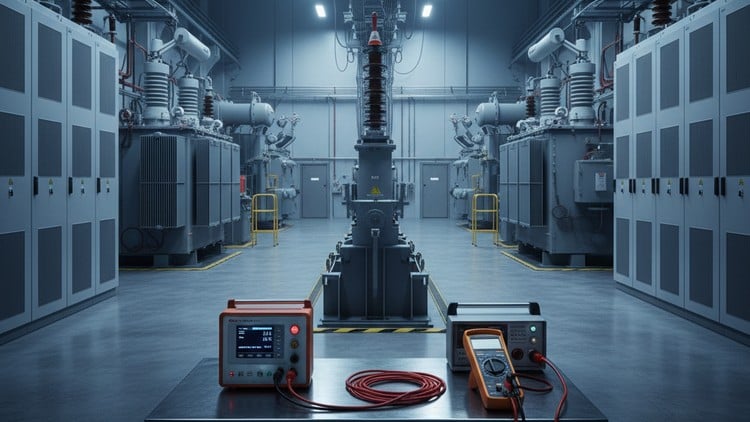
While this is a digital drill platform, it trains you on the theoretical application of some serious industry-standard tools. You’ll be analyzing data and scenarios involving:
- Insulation Resistance Testers (Megger): Understanding voltage selection and temperature correction factors.
- Transformer Turns Ratio (TTR) Meters: Interpreting deviation percentages and tap changer positions.
- Low Resistance Ohmmeters (Ductor): Evaluating contact resistance in high-voltage breakers.
- Oil Dielectric Strength Testers: Applying ASTM standards to transformer oil analysis.
- Protection Relay Test Sets: Logical troubleshooting of trip curves and timing tests.
By the end, you aren’t just memorizing facts; you’re building job-ready skills that allow you to walk onto a site and understand exactly why a specific test is required for commissioning.
Career Benefits & Job Roles
In this industry, career growth is almost entirely tied to your certification level. Passing your next exam isn’t just about a piece of paper; it’s about a significant pay bump and more responsibility. Completing this drill course puts you on the fast track for roles such as:
- Electrical Commissioning Technician: Ensuring new substations are job-ready and safe for energization.
- Field Service Engineer: Managing real-world projects and high-voltage maintenance contracts.
- Substation Maintenance Lead: Overseeing crews and ensuring compliance with NFPA 70B standards.
- Protection and Control (P&C) Technician: specializing in the most complex parts of the grid.
Employers are desperate for techs who can demonstrate job-ready skills and pass their certification prep on the first try. This course is a direct investment in your billable rate.
Pros
- Elite Distractor Analysis: The course doesn’t just tell you why “C” is right; it explains why “A” and “B” were designed to trick you. This is the secret sauce for multiple-choice accuracy.
- Massive Topic Breadth: It covers everything from ground grid testing to medium-voltage cable splicing theory, ensuring no “blind spots” in your knowledge.
- Realistic Pressure: The timed drills mimic the fatigue of a four-hour proctored exam, which is vital for building the stamina needed for certification prep.
- Logic over Memorization: It emphasizes the “why” behind high voltage testing procedures, which helps the info stick long after the exam is over.
Cons
The only real downside is the lack of video demonstrations. If you are a 100% visual learner who needs to see a real-world project being performed on camera to understand it, the text-and-scenario-heavy nature of these drills might feel a bit dry. It’s a rigorous “workout” for your brain, not a documentary, so be prepared to put in the mental sweat.