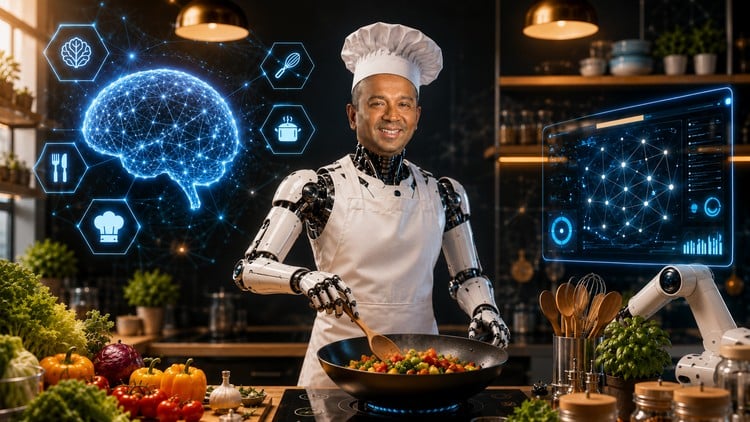
Learn AI, Agents, RAG, and Architectures Using Simple Food and Kitchen Analogies Anyone Can Understand
What You Will Learn:
- Understand the fundamentals of AI using simple kitchen and food analogies anyone can follow.
- Explain the difference between AI, software, automation, narrow AI, general AI, training, and inference.
- Understand how data, models, compute, and prompts work together to produce AI outputs.
- Learn how Large Language Models work, including tokens, context windows, prompting, and hallucinations.
- Apply prompt engineering techniques such as zero-shot prompting, few-shot prompting, system prompts, structured prompts, and step-by-step reasoning.
- Understand how AI tools, APIs, plugins, and function calling allow AI systems to take action beyond simple text generation.
- Show more
Overview: Why This Isn’t Just Another Dry AI Course
Let’s be real: the internet is currently drowning in “AI experts” who just learned what a GPT was six months ago. If you’re like me, you’ve probably scrolled past a hundred courses promising to turn you into a “Prompt Engineer” in twenty minutes. Cooking Up AI: From Basics to Agentic Systems is a different beast entirely. Instead of hitting you over the head with heavy linear algebra or boring documentation, it uses a kitchen analogy that actually sticks. I’ve been in the tech game for a while, and I can tell you that the hardest part of career growth in the age of generative AI isn’t learning the code—it’s mastering the mental models.
This course treats an LLM like a talented but literal-minded sous-chef. It’s an “anti-textbook” approach that moves you from beginner to advanced concepts without the usual academic fluff. What I appreciated most was the transition from basic chat interactions to Agentic AI. We’re moving away from just “talking to a bot” and toward building systems that can actually execute tasks, call APIs, and reason through complex workflows. If you want to understand the plumbing behind industry-standard tools, this is where you start. It’s about building a foundation that won’t become obsolete the next time OpenAI drops a new model.
Prerequisites
You don’t need a PhD in Data Science for this one. In fact, you don’t even really need to be a coder, though a little technical curiosity helps. If you know how to follow a recipe and you’ve used a computer for more than just checking email, you’re qualified. It’s designed for anyone looking to gain job-ready skills, whether you’re a project manager, a developer, or a curious professional looking to future-proof your career.
Skills & Tools You’ll Master
- Foundational AI Logic: Understanding the “ingredients” like compute, models, and data.
- LLM Mechanics: Deep dives into tokens, context windows, and why the “chef” sometimes hallucinates (and how to stop it).
- Advanced Prompt Engineering: Mastering few-shot prompting, system prompts, and structured reasoning to get high-quality outputs.
- Retrieval-Augmented Generation (RAG): Learning how to give your AI a “cookbook” of private data so it doesn’t just guess.
- Agentic Architectures: Moving beyond text to function calling and API integrations—the secret sauce of real-world projects.
- Automation vs. Agency: Knowing when to use a simple script and when to deploy a full Agentic system.
Career Benefits & Job Roles
The job market is shifting fast. Companies aren’t just looking for people who can use ChatGPT; they want people who can build Agentic systems that solve business problems. This course is a solid piece of certification prep for anyone looking to pivot into roles like AI Product Manager, AI Implementation Specialist, or Analytics Lead. By focusing on hands-on labs and the mechanics of RAG, you’re positioning yourself for career growth in a niche that is currently starved for talent. You’ll leave with the ability to speak the language of engineers while understanding the strategic implementation of industry-standard tools. It’s about moving from being an AI user to an AI architect.
Pros
- Brilliant Analogies: The kitchen/chef framework makes complex architectures feel intuitive. When you think of a context window as a “prep table,” it finally clicks.
- Agent-Focused: Most courses stop at prompting. This one pushes into Agentic systems and function calling, which is where the real money and innovation are right now.
- No-Nonsense Delivery: It skips the hype and focuses on the limitations. Understanding hallucinations and data privacy is just as important as knowing how to write a prompt.
- Hands-on Practicality: The focus on real-world projects ensures you aren’t just watching videos—you’re building a framework for how AI actually works in a production environment.
Cons
- The “Newness” Factor: Because the AI field moves at lightning speed, some of the specific UI screenshots in hands-on labs for third-party tools might look slightly different by the time you login, though the core logic remains 100% solid.