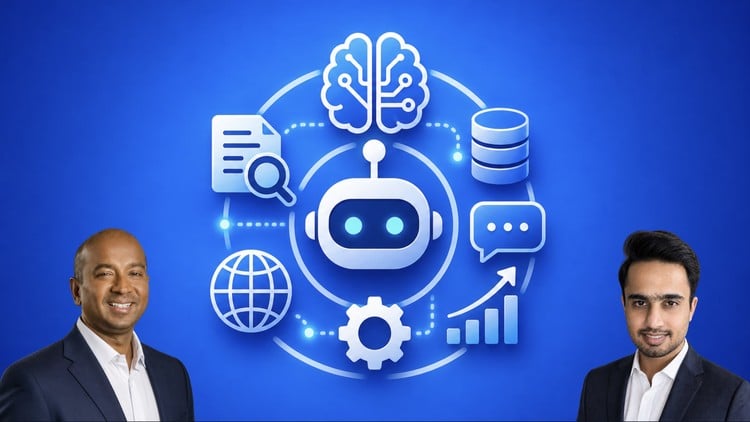
Build autonomous AI agents with Python, Ollama, tools, memory, RAG, research, and multi-agent workflows
What You Will Learn:
- Understand how AI agents differ from traditional chatbots and standard LLM applications.
- Build a personal AI assistant in Python using Ollama and Streamlit.
- Connect Python applications to local language models through Ollama.
- Design effective system prompts, agent roles, and instruction patterns.
- Create structured outputs using Pydantic and JSON schemas.
- Build agents that can break complex goals into smaller, actionable tasks.
- Show more
The Reality Check: Moving Beyond Chatbots
Let’s be honest for a second—the tech world is currently drowning in “AI hype.” Every other week, there’s a new library or a “game-changing” wrapper that promises to automate your entire life. As someone who has spent years in the trenches of software development, I’ve learned to be skeptical of anything that claims to make you an expert in a week. However, 7 Days Certified AI Agents with Python: Autonomous Apps actually managed to cut through the noise by focusing on what actually matters: agentic reasoning rather than just API calling.
The core insight this course offers—and why I think it’s worth your time—is the fundamental shift from “Linear AI” to “Iterative AI.” Most developers are still stuck building basic RAG (Retrieval-Augmented Generation) pipelines that follow a straight line: User asks, AI searches, AI answers. This course breaks that mold. It treats the LLM as a reasoning engine, not just a text generator. You’re not just building a bot; you’re building a system that can pause, think, use a tool, and then decide if its own answer is actually good enough. That is the industry-standard approach that separates a hobbyist from a Generative AI Engineer.
Prerequisites for Success
Don’t let the “7-day” timeline fool you into thinking this is for absolute coding newbies. To get the most out of these hands-on labs, you need a solid foundation in Python. You don’t need to be a Senior Dev, but you should be comfortable with asynchronous programming, decorators, and basic data structures. A passing familiarity with how Large Language Models work (tokens, context windows, and temperature) will save you from a lot of head-scratching. This is a beginner to advanced journey, but the “beginner” part assumes you already have your code editor configured and know your way around a terminal.
The Stack: Skills & Tools
What I appreciated most was the refusal to rely solely on expensive proprietary APIs. The course leans heavily into Ollama, which is a massive win for anyone concerned about data privacy or API costs. Here is the primary toolkit you’ll be mastering:
- Ollama: For running high-performance models like Llama 3 or Mistral locally on your machine.
- Pydantic: This is the secret sauce for job-ready skills. You’ll learn how to force an unstructured LLM to return strictly formatted JSON schemas that won’t break your production code.
- Streamlit: For spinning up rapid prototypes and real-world projects that actually have a UI you can show to stakeholders.
- Multi-Agent Frameworks: Learning how to coordinate between a “Researcher” agent and a “Writer” agent to achieve complex goals.
- Tool Use (Function Calling): Teaching your Python scripts to actually execute code or fetch live data based on the AI’s decision-making.
Career Benefits & Job Roles
We are currently seeing a massive pivot in the job market. Companies aren’t just looking for “Prompt Engineers” anymore; they want AI Solutions Architects who can build autonomous systems that reduce operational overhead. Completing this certification prep places you in a prime position for roles like AI Automation Specialist, Machine Learning Engineer, or Full-Stack AI Developer. By focusing on autonomous apps, you’re gaining career growth insurance. While basic coding tasks are being automated, the ability to architect complex, multi-agent workflows is becoming a high-value, high-salary niche. These are real-world projects you can actually put on a portfolio to prove you can handle the complexities of agentic memory and state management.
The Pros
- Local-First Philosophy: By using industry-standard tools like Ollama, the course teaches you how to build without being tethered to a credit card-draining OpenAI subscription. This is huge for enterprise developers dealing with sensitive data.
- Structural Integrity: The emphasis on Pydantic and structured outputs is a breath of fresh air. It moves AI development away from “vibe-based engineering” and into predictable, testable software engineering.
- Aggressive Pace: The 7-day structure is intense, but it forces you to stop overthinking and start shipping. The hands-on labs are designed to produce a working artifact every single day.
The Cons
- Hardware Requirements: While the course is “local-first,” your experience will vary wildly depending on your GPU. If you’re trying to run these autonomous apps on an older laptop without at least 16GB of RAM (or an M-series Mac), you might find the local inference speeds frustratingly slow, which can break the flow of the multi-agent workflows.
Final thoughts: If you’re tired of surface-level tutorials and want to understand how to actually “wire” an AI’s brain to perform tasks autonomously, this is one of the most practical deep dives available right now. It’s a job-ready curriculum that respects your time and focuses on the architecture of the future.