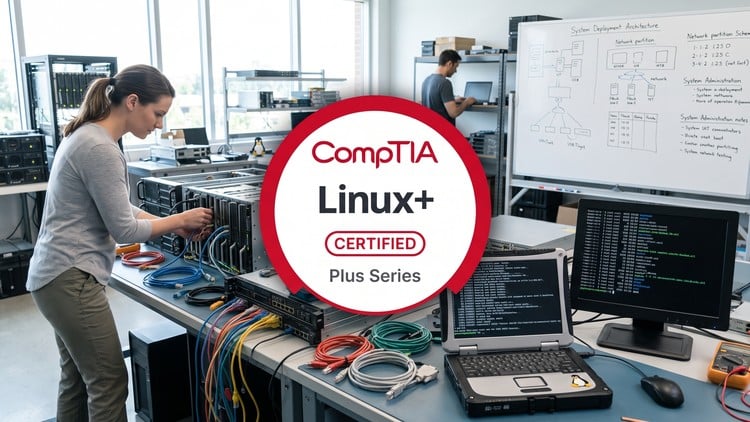
1250 questions and comprehensive breakdowns, structured into domain-specific examinations.
What You Will Learn:
- System Management
- Services and User Management
- Security
- Automation, Orchestration, and Scripting
- Troubleshooting
The Gritty Reality of Passing the XK0-006
Let’s be real: CompTIA exams aren’t just about knowing your way around a terminal; they’re about surviving a gauntlet of tricky phrasing and scenario-based curveballs. I’ve spent years in the trenches of enterprise infrastructure, and if there’s one thing I’ve learned, it’s that “knowing Linux” and “passing the Linux+ exam” are two very different animals. The CompTIA Linux+ XK0-006 V8: Practice Tests course is essentially a 1,250-question simulation of that reality. It’s a massive, somewhat intimidating repository of certification prep material that focuses heavily on the shift from traditional sysadmin tasks to modern, cloud-native environments.
What I found most striking about this specific version is how it mirrors the industry’s pivot toward the “Everything as Code” philosophy. While the previous XK0-005 was a solid step forward, the V8 material pushes you deeper into the mindset of an engineer who doesn’t just fix a server but automates the fix across an entire cluster. This isn’t just about memorizing flags for tar or chmod anymore. These practice tests force you to think about how industry-standard tools interact within a DevOps pipeline. The sheer volume of questions—over a thousand—ensures you aren’t just memorizing the test bank; you’re actually learning to recognize patterns in how Linux systems fail and how to remediate them at scale.
Prerequisites
While this course is billed as a path from beginner to advanced, I’d suggest coming in with some skin in the game. You should have a baseline understanding of the command line—if you don’t know the difference between a pipe and a redirect, go spend a week in a VM first. Ideally, you’ve touched the CompTIA A+ or Network+ curriculum, or you’ve spent six months tinkering with a home lab. This isn’t a “teaching” course in the traditional sense; it’s an assessment tool. You need enough foundational knowledge to understand why an answer is correct when you read the detailed breakdowns provided after each quiz.
Skills & Tools You’ll Master
The curriculum is designed to sharpen job-ready skills that actually translate to a paycheck. You’ll dive deep into:
- Git Version Control: Managing configuration files and collaborating on scripts.
- Containerization: Building and managing Docker containers and understanding pod orchestration basics.
- Infrastructure as Code (IaC): Writing and debugging Ansible playbooks and Terraform files.
- Advanced Scripting: Moving beyond basic Bash scripts into complex automation and error handling.
- Hardening & Security: Implementing SELinux policies, managing firewalld, and auditing system logs for intrusions.
- Kernel Management: Tuning sysctl parameters and managing modules for performance optimization.
Career Benefits & Job Roles
Passing the Linux+ isn’t just a badge for your LinkedIn profile; it’s a signal to recruiters that you can handle real-world projects without hand-holding. In a market where cloud-computing dominates, Linux is the bedrock. This certification is a primary driver for career growth for those looking to move out of Help Desk roles and into mid-tier engineering positions. Common job titles that benefit from this level of mastery include:
- Systems Administrator: Managing the backbone of enterprise infrastructure.
- DevOps Engineer: Bridging the gap between development and operations through automation.
- Cloud Architect: Designing scalable environments in AWS, Azure, or GCP.
- Site Reliability Engineer (SRE): Ensuring high availability and performance of critical services.
- Cybersecurity Analyst: Securing Linux-based servers against modern threat vectors.
Pros
- Depth of Explanation: It’s not just “A is the right answer.” The course explains why B, C, and D are wrong, which is where the real hands-on labs style of learning occurs. It helps you build a mental map of the system’s architecture.
- Domain-Specific Focus: If you’re a wizard at troubleshooting but suck at scripting, you can hammer the specific domain exams until your weak spots are gone. It’s highly efficient certification prep.
- Current Content: It reflects the XK0-006’s heavy emphasis on automation and orchestration, which is vital because older study guides are becoming obsolete in the era of Kubernetes and serverless tech.
- Volume: With 1250 questions, the chance of you seeing the same question twice in a way that allows for “lazy memorization” is low. It keeps you on your toes.
Cons
- Dry Interface: Let’s be honest—grinding through 1,250 questions is a slog. There are no flashy videos or gamified rewards here; it is a raw, academic-style drill that requires significant self-discipline and career-focused motivation to complete.