Master Arduino UNO Starting From Zero – Learn with Hands-on Activities and Many Arduino Projects.
⏱️ Length: 4.5 total hours
⭐ 4.37/5 rating
👥 46,123 students
🔄 June 2024 update
Add-On Information:
Note➛ Make sure your 𝐔𝐝𝐞𝐦𝐲 cart has only this course you're going to enroll it now, Remove all other courses from the 𝐔𝐝𝐞𝐦𝐲 cart before Enrolling!
-
Course Overview
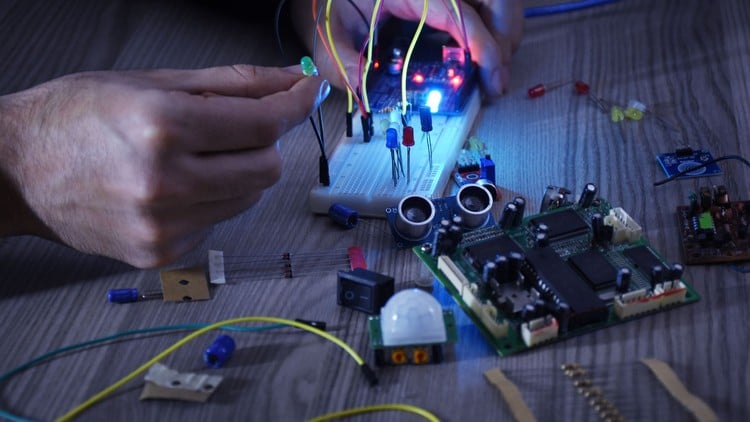
- Dive headfirst into the exciting world of physical computing and rapid prototyping with this intensive Arduino UNO bootcamp.
- Designed meticulously for absolute beginners, this course demystifies the process of interfacing electronics with software, making complex concepts approachable and engaging.
- Experience a guided journey from fundamental concepts of microcontrollers to constructing sophisticated, interactive systems using the globally popular Arduino UNO platform.
- Emphasis on a pragmatic, project-based learning approach ensures immediate application of theoretical knowledge into tangible, working creations, fostering hands-on mastery.
- Quickly grasp core principles through focused, bite-sized modules and build confidence in bringing your innovative hardware and software ideas to life.
- Leverage the recently updated June 2024 curriculum to stay current with contemporary best practices and relevant applications in microcontroller development.
-
Requirements / Prerequisites
- No prior coding or electronics experience is necessary whatsoever. This course is expertly crafted to start completely from scratch, assuming zero foundational knowledge.
- A desktop or laptop computer (Windows, macOS, or Linux) capable of running the free Arduino IDE (Integrated Development Environment).
- A stable internet connection for accessing course materials, downloading necessary software, and troubleshooting resources.
- The desire to learn, experiment, troubleshoot hardware and software challenges, and cultivate a “maker” mindset.
- Access to an Arduino UNO board and a basic electronics starter kit (e.g., breadboard, jumper wires, LEDs, various resistors, basic sensors, and simple actuators). A detailed component list will be provided within the course.
-
Skills Covered / Tools Used
- Microcontroller Programming Fundamentals: Master the essential C/C++ syntax and structures tailored specifically for the Arduino platform, enabling precise control over connected hardware.
- Digital and Analog I/O Control: Learn to effectively read inputs from a diverse range of sensors and accurately control outputs to various actuators and indicators.
- Circuit Prototyping and Design: Develop practical proficiency in breadboarding techniques, understanding component datasheets, and assembling robust, functional electronic circuits safely.
- Sensor Interfacing and Data Acquisition: Gain practical experience connecting, calibrating, and extracting meaningful data from a wide array of environmental, motion, and light sensors.
- Actuator Management and Control: Command different types of motors (e.g., servo, DC), relays, buzzers, and display elements to create dynamic and responsive projects.
- Basic Data Communication: Explore fundamental serial communication methods essential for debugging your code, monitoring sensor data, and exchanging information with other devices.
- Real-world Problem Solving & Debugging: Cultivate strong analytical reasoning and systematic troubleshooting skills, crucial for successful hardware-software integration.
- Introduction to Connectivity Concepts: Understand the foundational principles behind linking physical devices to networks, a cornerstone for exploring the Internet of Things (IoT).
- Tools Utilized: The official Arduino IDE, a breadboard, a comprehensive set of various electronic components (e.g., resistors, capacitors, transistors, diodes, LEDs), jumper wires, and multimeters (optional but highly recommended for advanced circuit diagnostics).
-
Benefits / Outcomes
- Develop a Solid Foundation: Establish a strong conceptual and practical base for delving into more advanced embedded systems, robotics, and complex electronics projects.
- Unlock Creative Potential: Gain the essential technical skills and confidence to transform your abstract ideas into functional, interactive prototypes and innovative inventions.
- Enhance Problem-Solving Acumen: Sharpen your logical reasoning, critical thinking, and systematic troubleshooting abilities through engaging, hands-on hardware and software challenges.
- Build a Project Portfolio: Accumulate a collection of tangible, impressive, and fully functional projects that powerfully demonstrate your acquired Arduino proficiency.
- Kickstart Your IoT Journey: Acquire the foundational knowledge and practical skills required to understand and begin building smart devices for home automation and other connected applications.
- Gain Confidence in Hardware-Software Integration: Effectively bridge the crucial gap between writing code and controlling physical electronics, a highly sought-after interdisciplinary skill.
- Prepare for Advanced Robotics: Lay the critical groundwork for exploring more complex robotic platforms, autonomous systems, and advanced control mechanisms.
- Foster a Maker Mindset: Embrace the rewarding spirit of creation, experimentation, continuous learning, and community engagement in the vibrant world of DIY electronics.
-
PROS
- Highly Practical & Project-Oriented: Maximizes learning through direct application and building, rather than abstract theoretical discussions.
- Beginner-Friendly Approach: Expertly crafted to onboard individuals with absolutely zero prior experience in coding or electronics, ensuring a smooth learning curve.
- Excellent Student Satisfaction: A robust 4.37/5 rating from over 46,000 students signifies proven learning effectiveness and high course quality.
- Up-to-Date Content: Recently updated in June 2024, guaranteeing relevance and adherence to current best practices in the field.
- Rapid Skill Acquisition: The “bootcamp” format is optimized for quickly gaining functional proficiency and practical competence in Arduino.
- Comprehensive Introductory Scope: Covers a broad range of fundamental topics from basic hardware control to introductory IoT concepts.
- Tangible Outcomes: Finish the course with several impressive, functional projects, including an advanced robotic car, ready to showcase your abilities.
-
CONS
- The relatively compact 4.5-hour duration means the course maintains a brisk pace, which might necessitate additional self-paced research or practice for those desiring deeper theoretical explanations beyond the practical implementations.
Learning Tracks: English,IT & Software,Hardware