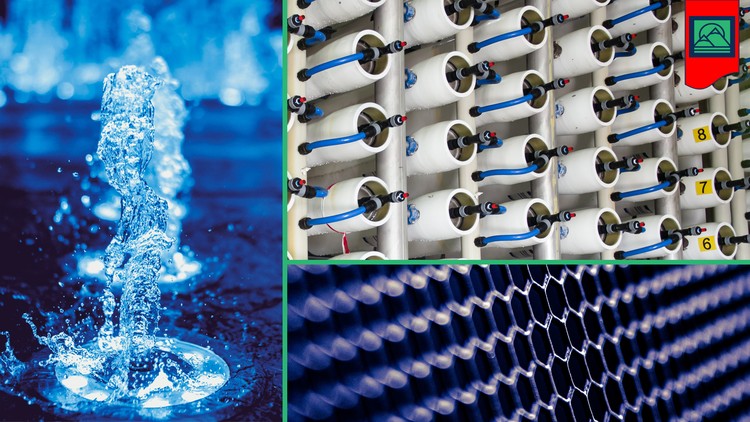
An Innovative Solution for a Thirsty World
Why take this course?
🌊 Seawater Desalination Explained: An Innovative Solution for a Thirsty World
Course Headline:
Dive into the world of water sustainability with our comprehensive online course on Seawater Desalination. Discover how this critical technology is addressing global water scarcity challenges, and learn about the environmental, social, and governance implications of desalination. 🌍💧
Course Description:
Welcome to “Seawater Desalination Explained,” your gateway to understanding one of the most significant innovations in water treatment technology. As our planet faces unprecedented challenges related to water supply, desalination stands out as a beacon of hope for millions. This course will guide you through the intricacies of non-conventional desalination technology, specifically focusing on reverse osmosis – an innovative approach to managing our precious water resources sustainably.
What You’ll Learn:
- Introduction: Why Do We Need Desalination? 🤓
- Understanding the global context of water scarcity and the urgency for desalination solutions.
- The Scale of Desalination Globally 🌎
- Exploring how much desalination is being utilized worldwide and its significance in various regions.
- Health Benefits and Necessities of Seawater Desalination ✅
- Discussing the importance of treating seawater for safe consumption.
- Membrane Filtration: The Heart of Reverse Osmosis 🏭️
- Learning about membrane filtration and its role in desalination processes.
- Membrane Fouling: A Major Challenge ⚠️
- Identifying the issues associated with membrane fouling and its impact on desalination efficiency.
- Pretreatment: The First Line of Defense 🛡️
- Understanding the purpose and processes of pretreatment in protecting desalination systems.
- Reverse Osmosis Desalination: How It Works 💦✨
- A detailed walkthrough of the reverse osmosis process and its advantages.
- Post-treatment: Final Steps to Safe Drinking Water 🚿
- Learning about the post-treatment stages following reverse osmosis.
- Energy Consumption and Cost of Desalination 💡💰
- Examining the energy requirements and financial considerations of reverse osmosis desalination.
- Environmental Impacts of Reverse Osmosis Desalination 🌱
- Assessing the environmental footprint of desalination plants and strategies for mitigation.
- Conclusion: A Sustainable Future with Desalination 🌟
- Summarizing key takeaways and reflecting on the future of desalination in a sustainable world.
Course Highlights:
- Tailored for beginners and non-specialists, providing an accessible introduction to reverse osmosis desalination.
- No artificial intelligence was used in the course development – ensuring original content crafted by human expertise.
Who Is This Course For?
This course is designed for:
- General learners interested in water management, conservation, and treatment.
- Individuals seeking to understand the health, engineering, sustainability, and ESG aspects of desalination.
- Students and professionals in related fields who wish to broaden their knowledge without delving into engineering designs and calculations.
Important Notes:
- The course is not intended for engineers or researchers looking for complex design or calculation data for desalination facilities.
- It provides a high-quality, concentrated educational experience on the general principles of reverse osmosis desalination, fouling, pretreatment, post-treatment, and environmental impacts.
Join us on this journey to explore one of the most critical water treatment technologies of our time. By the end of this course, you’ll have a comprehensive understanding of how reverse osmosis desalination works, its energetic, economic, and environmental considerations, and its role in addressing global water challenges. 🌊🎓
Keywords: Water Management, Water Conservation, Water Treatment, Health, Engineering, Sustainability, ESG, Desalination, Membrane Fouling, Reverse Osmosis.
An Innovative Solution for a Thirsty World: My Take on the Intro to Desalination Course
Let’s be real for a second: we talk a lot about the “energy transition” in tech and engineering circles, but we often overlook the most critical resource on the planet—water. I’ve spent years navigating different sectors of the industrial tech world, and I’ve seen plenty of “green” courses that are 90% fluff and 10% substance. However, the Introduction to Seawater Desalination course actually cuts through the noise. It tackles the “water-energy nexus” head-on, providing a roadmap for how we’re going to keep the taps running as climate volatility increases.
What I appreciated most about this curriculum wasn’t just the “how-to” of turning salt water into fresh water, but the “why.” We are currently facing a global infrastructure shift. This course isn’t just a biology lesson; it’s a deep dive into the engineering challenges of the 21st century. It positions desalination not as a niche science project, but as a massive industrial frontier. If you’re looking for job-ready skills in a sector that is essentially recession-proof, this is a solid place to start your career growth journey.
The course flow moves from the macro to the micro—starting with the global water crisis and ending with the granular physics of membrane technology. It’s a beginner to advanced trajectory that doesn’t feel overwhelming, even when you start looking at the energetic and economic aspects of high-pressure pumping systems. It’s an honest look at a complex industry that is finally getting the tech-investment it deserves.
Prerequisites
You don’t need to be a chemical engineer to get value out of this, but you shouldn’t go in totally cold either. Here is what I’d suggest having under your belt:
- Basic Chemistry & Physics: A fundamental understanding of solutes, pressure, and energy will make the RO (Reverse Osmosis) modules much easier to digest.
- Analytical Mindset: You’ll be looking at flow rates and energy consumption metrics, so being comfortable with data is a plus.
- Sustainability Interest: A genuine curiosity about water conservation and management helps put the technical labs into context.
Skills & Tools
The course does a great job of introducing you to industry-standard tools and concepts that you’ll encounter on any modern utility site. By the end of the modules, you’ll be familiar with:
- Reverse Osmosis (RO) Membrane Systems: Understanding the heart of the plant, including flux rates and salt rejection.
- Pre-treatment Methodologies: Learning about coagulation, flocculation, and ultrafiltration—essentially the “guards” that protect the expensive membranes.
- Energy Recovery Devices (ERDs): This is where the real tech innovation is happening; learning how to recycle pressure to lower operational costs.
- Post-treatment Chemistry: How to remineralize water so it doesn’t eat through municipal pipes—a crucial step for safe water production.
- SCADA & Monitoring Concepts: An introduction to how these plants are automated and managed in real-world projects.
Career Benefits & Job Roles
This isn’t just an academic exercise; it’s certification prep for a real-world career. The desalination market is exploding in regions like the Middle East, California, and Australia, and the demand for skilled professionals is outstripping supply. Here’s where this knowledge can take you:
- Desalination Plant Operator: A hands-on role managing the daily throughput and maintenance of RO systems.
- Sustainability Consultant: Helping corporations and governments integrate desalination into their broader water management strategies.
- Project Manager (Water Infrastructure): Overseeing the construction and commissioning of new plants—a high-stakes, high-reward career growth path.
- Environmental Compliance Officer: Ensuring that brine discharge and energy use meet strict environmental standards.
Pros
- Holistic Technical Scope: It covers the entire lifecycle—from the intake of raw seawater to the final distribution of potable water. You aren’t just learning one “trick”; you’re learning a system.
- Focus on Economics: I loved that they didn’t ignore the bill. Understanding the economic aspects of desalination is vital because, in the tech world, if it isn’t cost-effective, it doesn’t get built.
- High-Level Environmental Context: It honestly addresses the “brine problem” and energy consumption, making the hands-on labs feel grounded in reality rather than a sanitized textbook version of the industry.
Cons
- The Learning Curve: While it’s marketed as beginner to advanced, the transition into the thermodynamics of high-pressure pumps can feel a bit abrupt. If you haven’t looked at a physics equation in ten years, you might need to hit “pause” and do a quick Google refresher to keep up with the energetic calculations.