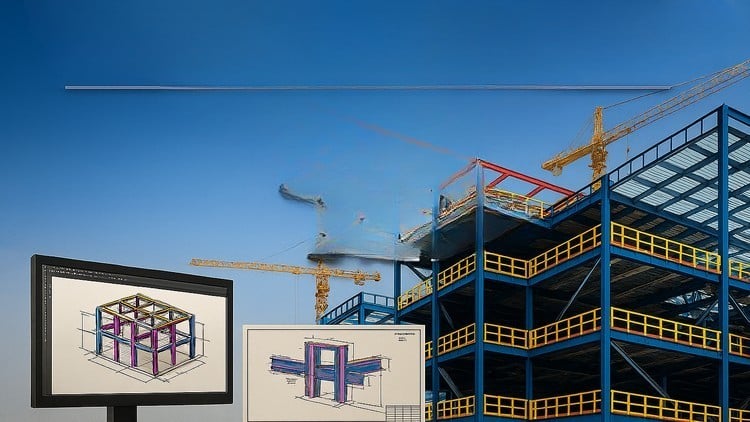
Structural Steel Detailing
What You Will Learn:
- Explain the role and importance of steel detailing in the overall structural design and construction process
- Identify and understand steel members such as beams and columns, including their orientation, labeling, and basic properties as shown on drawings
- Develop confidence in reviewing steel drawings and understanding how individual components come together to form a complete steel structure
- Read and interpret General Arrangement (GA) drawings, including foundation plans, floor plans, elevations, sections, and basic details
- Understand basic beam-to-column and base plate connections, and recognize how these are represented in steel detailing drawings
- Show more
The Truth About Going From “Zero to Hero” in Structural Steel Detailing
Let’s be real for a second: the BIM world is currently flooded with generic “Introduction to Revit” or “Basic CAD” courses that barely scratch the surface of how buildings actually stay standing. If you’ve spent any time on a construction site or in a fabrication shop, you know that the gap between a conceptual architectural model and a job-ready shop drawing is massive. That’s why I was skeptical about the “BIM | Structural Steel Detailing Course | Zero to Hero.” However, after diving through the modules, it’s clear this isn’t just another theory-heavy fluff piece. It’s a deep dive into the literal bones of the AEC industry.
What I appreciate most about this curriculum is that it doesn’t treat steel detailing like a clerical task. It treats it like a craft. In the modern BIM (Building Information Modeling) ecosystem, the detailer is the bridge between the engineer’s vision and the fabricator’s reality. This course targets that specific “missing link” by moving past simple 3D modeling and focusing on the logic of steel. It’s about understanding why a W-shape beam is oriented a certain way and how a base plate actually transfers load to a foundation. For anyone looking to secure career growth in structural engineering or construction management, this is the granular stuff you actually need to know.
Prerequisites: What Do You Actually Need?
While the course claims to go from “Zero to Hero,” I’d argue you’ll get much more out of it if you aren’t starting from a total standstill. You don’t need to be a licensed P.E., but having a fundamental grasp of beginner to advanced geometry and a basic understanding of how to navigate a PC is essential. If you’ve ever looked at a set of blueprints and felt a bit overwhelmed, you’re in the right place. However, if you don’t know the difference between a floor plan and an elevation, you might want to do a quick 30-minute YouTube deep dive on construction basics before hitting the hands-on labs.
Skills & Tools: Mastering the Industry Standard
This course is less about clicking buttons and more about developing the “detailing eye.” You’ll spend a significant amount of time mastering industry-standard tools and learning how to interpret the technical “language” of steel. We’re talking about:
- Navigating General Arrangement (GA) drawings without getting lost in the annotations.
- Understanding the hierarchy of foundation plans and how they dictate the entire steel skeleton.
- Mastering the nuances of beam-to-column connections, which is where most projects succeed or fail in the field.
- Learning the shorthand of certification prep—knowing exactly what symbols mean so you can pass industry exams or technical interviews with confidence.
The focus on real-world projects ensures that you aren’t just learning in a vacuum; you’re seeing how these members are labeled, cut, and shipped.
Career Benefits & Job Roles
If you’re looking for job-ready skills, steel detailing is a fantastic niche. While everyone else is trying to be a generalist BIM Coordinator, specializing in structural steel makes you indispensable to fabrication shops, structural engineering firms, and BIM service providers.
Potential job roles after completing this path include:
- Steel Detailer: Working directly with fabricators to create shop drawings.
- BIM Technician (Structural): Focusing on the high-LOD (Level of Development) modeling of steel frames.
- Structural Drafter: Bridging the gap between design intent and construction documentation.
- Project Coordinator: Using your knowledge of steel lead times and connection complexity to manage schedules.
The career growth potential here is high because the industry is facing a massive shortage of people who actually understand how steel connects.
The Pros: Why This Course Stands Out
- Practicality over Theory: The course skips the academic jargon and gets straight to the “how-to.” It feels like being mentored by a senior detailer who has seen it all.
- Focus on GA Drawings: Many courses ignore General Arrangement drawings, but this course treats them as the “map” they are, teaching you how to read foundations and elevations in tandem.
- Connection Logic: Instead of just showing you a bolt, it explains the relationship between base plates and the structural integrity of the build.
- Hands-on Labs: You aren’t just watching videos; you’re engaging with real-world projects that mimic the pressure and specifications of a real firm.
The Cons: An Honest Critique
The only real drawback is the pacing for absolute novices. If you are truly at “Zero,” the jump from identifying a beam to interpreting complex beam-to-column connections can feel like a vertical climb. I would have liked to see a bit more “remedial” content on the physics of steel (like basic tension and compression) to explain *why* certain connections are used over others, rather than just how they are drawn.
Final Verdict
If you’re tired of surface-level tutorials and want to gain beginner to advanced proficiency in a high-paying niche, this course is a solid investment. It’s tough, detail-oriented, and exactly what you need to move from a hobbyist to a professional in the structural steel space.