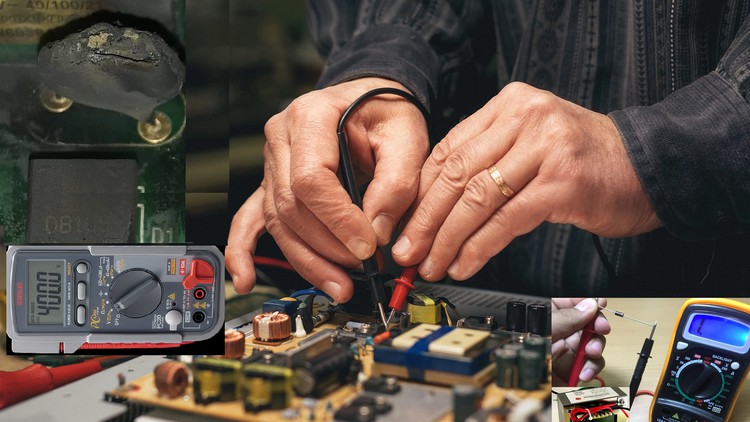
electronics Repair & Troubleshoot
What You Will Learn:
- Understanding how to use Digital Multimeter with safety practice.
- Learn how to measure AC and DC voltage, AC and DC current and resistance(using Digital multimeter)
- Learn how to test faulty resistor, electrical switch, fuse, transformer, capacitor and other electrical component.
- Resistor Colour Code Calculation
- Continuity Test
- Testing Resistor
- Show more
The Real Deal on Mastering the Bench: An Honest Overview
If you’re anything like me, you probably grew up taking things apart and—more often than not—failing to put them back together. In the tech world, there’s a massive gap between “knowing” how a circuit works on paper and actually fixing a dead logic board when the clock is ticking. This course, Learn to Repair & Troubleshoot Electronics Device, isn’t just another dry academic lecture; it feels more like a mentorship under a seasoned bench tech.
What I appreciated most was the shift away from abstract theory toward job-ready skills. Instead of just talking about electrons moving through a conductor, the focus is on the “how” and the “why” of failure. Troubleshooting is a detective’s game, and this course treats it as such. It moves beyond the “swap and pray” method—where you just replace parts until something works—and teaches you how to isolate a fault logically. Whether you’re looking at this as certification prep or just want to stop throwing away “broken” gear, the curriculum bridges that intimidating gap between a beginner to advanced understanding of hardware health.
What You Need Before Diving In
You don’t need a PhD in Electrical Engineering to get started, but you do need a healthy respect for electricity. This isn’t a course where you can just passively watch videos while scrolling on your phone. To get the most out of it, you should have:
- A basic grasp of high-school-level math (mostly for those resistor colour code calculations).
- A genuine curiosity for how hardware functions beneath the plastic casing.
- A small budget to grab your own industry-standard tools, specifically a decent Digital Multimeter (DMM).
- A safety-first mindset—the course emphasizes safety practice heavily, and for good reason.
The Toolkit: Skills & Tools You’ll Master
The star of the show here is undoubtedly the Digital Multimeter. The course does a fantastic job of turning this intimidating box of buttons into an extension of your own senses. You’ll spend significant time in hands-on labs (even if you’re doing them at your kitchen table) learning to probe circuits without blowing a fuse—or yourself.
Beyond the DMM, you’ll dive into the guts of real-world projects, learning how to identify and test the “usual suspects” of electronic failure. We’re talking about components that fail most often: leaky capacitors, blown transformers, and those pesky cracked solder joints that cause intermittent continuity test failures. It’s about building a mental library of component behaviors so that when you see a faulty resistor, you aren’t guessing—you’re measuring and confirming.
Career Benefits & Potential Job Roles
Let’s talk career growth. We live in a throw-away culture, which means someone who actually knows how to repair “unfixable” tech is a rare and valuable asset. Mastering these job-ready skills opens doors that aren’t just limited to fixing cell phones.
By the end of this journey, you’re positioning yourself for roles such as:
- Bench Technician: Working in a dedicated lab repairing consumer or industrial electronics.
- Field Service Engineer: Traveling to client sites to diagnose and fix industry-standard tools and machinery.
- IoT Prototype Developer: Understanding the hardware layer is crucial for anyone building “smart” devices.
- Freelance Repair Specialist: Starting a side hustle or a full-time business in consumer electronics repair.
The Pros: Why This Course Hits the Mark
- Pragmatic Approach: The course cuts the fluff. It doesn’t spend three hours on the history of the vacuum tube; it gets you straight into testing resistors and understanding AC and DC voltage.
- Safety Centric: I’ve seen too many “DIY” videos ignore safety practice. This course respects the dangers of high-current circuits, which is vital for any professional environment.
- Logical Flow: The progression from simple continuity tests to complex component testing feels natural. It builds your confidence incrementally.
- Visual Clarity: The demonstrations on how to use Digital Multimeter functions are clear, with good camera angles that actually show you where the probes go.
The Cons: An Honest Critique
If I have one gripe, it’s that the course can feel a bit fast-paced when it hits the resistor colour code calculation and transformer theory. If you aren’t familiar with basic electronics terminology, you might find yourself hitting the “rewind” button a few times. I would have loved to see a bit more coverage on modern Surface Mount Devices (SMD), as the industry is moving away from the larger through-hole components featured in some of the hands-on labs. However, for a foundational course, the core principles remain the same.
Overall, if you’re serious about moving from a tinkerer to a pro, this is a solid investment in your technical toolkit. It’s honest, it’s practical, and it gives you the job-ready skills needed to actually stand a chance at the repair bench.