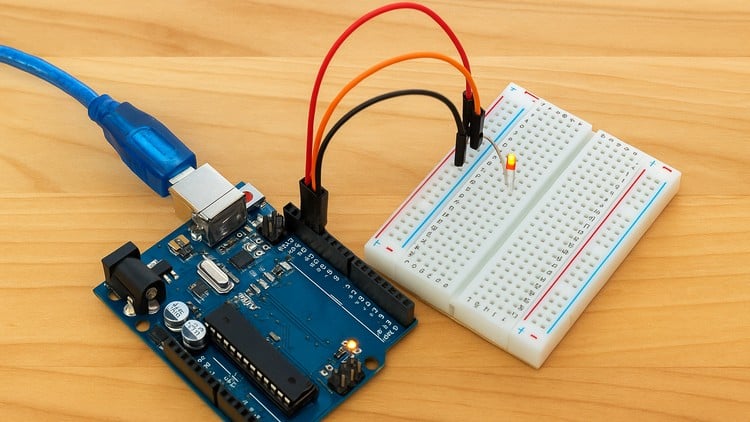
Grasp the core concepts of Arduino hardware, software, and logic before writing a single line of code.
What you will learn
Note➛ Make sure your 𝐔𝐝𝐞𝐦𝐲 cart has only this course you're going to enroll it now, Remove all other courses from the 𝐔𝐝𝐞𝐦𝐲 cart before Enrolling!
Understand the core purpose and internal structure of an Arduino board, including the roles of pins, chips, and components.
Learn how the Arduino IDE works and how code is compiled, uploaded, and executed on the board.
Grasp essential programming concepts like variables, functions, and control flow—without needing to code yet.
Explain how Arduino communicates with the physical world using inputs (sensors) and outputs (LEDs, actuators).
Add-On Information:
- Course Overview
- Focuses on the philosophy of electronics, prioritizing a high-level conceptual understanding over tedious syntax memorization.
- Designed to bridge the gap between curiosity and technical proficiency by demystifying the barrier of entry to the Maker movement.
- Explores the historical context of microcontrollers and why the Arduino ecosystem revolutionized rapid prototyping for non-engineers.
- Employs a logic-first approach that ensures students understand the “why” behind circuit behavior before touching a keyboard.
- Breaks down complex electrical theories into relatable metaphors, making abstract concepts like electron flow tangible.
- Requirements / Prerequisites
- Absolutely zero prior experience in electronics, robotics, or computer science is expected or required.
- A standard desktop or laptop computer (Windows, Mac, or Linux) capable of running basic software utilities.
- A curious mindset and a desire to dismantle the “black box” of modern consumer technology.
- No physical hardware is mandatory for this foundational stage, as the course focuses on theoretical mastery and mental modeling.
- Skills Covered / Tools Used
- Prototyping Logic: Mastering the art of planning circuits and signal paths on paper before physical assembly.
- Schematic Literacy: Learning to interpret basic circuit diagrams and symbols used in global engineering standards.
- Power Management: Understanding the vital differences between voltage, current, and resistance in low-power DC environments.
- Diagnostic Thinking: Developing a structured, step-by-step troubleshooting workflow to identify hardware bottlenecks.
- Safety Protocols: Essential guidelines for handling sensitive electronic components to prevent static discharge or short circuits.
- Benefits / Outcomes
- Foundational Confidence: Eliminate the “imposter syndrome” often felt when starting technical DIY projects.
- Language Fluency: Acquire the specific vocabulary needed to research, discuss, and troubleshoot projects within the global maker community.
- Cross-Platform Utility: The principles learned here are universally applicable to other platforms like Raspberry Pi, ESP32, and Teensy.
- Efficient Learning: Drastically reduce future debugging time by establishing a rock-solid mental model of embedded systems.
- Project Readiness: Transform from a passive consumer of technology into an active creator ready to tackle IoT and robotics.
- PROS
- Low-Stress Entry: Prevents the burnout often associated with jumping into complex C++ coding too early.
- Visual Learning: Uses rich visual aids and diagrams to explain how electricity translates into data.
- Strong Theoretical Base: Ensures that future coding lessons are grounded in a deep understanding of hardware limitations.
- CONS
- Conceptual Focus: Students seeking immediate, hands-on complex programming exercises may find the deliberate pace too slow for their preferences.
English
language