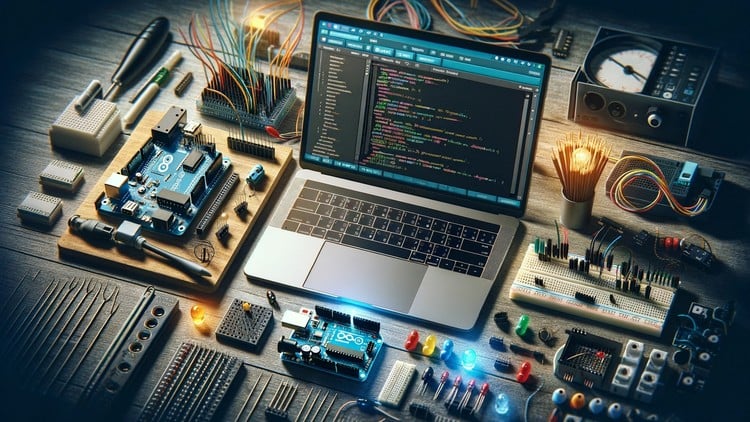
A Comprehensive Guide: Learn to Seamlessly Integrate Arduino with JavaScript & Control it via Your Browser!
⏱️ Length: 2.3 total hours
⭐ 4.04/5 rating
👥 16,624 students
🔄 June 2025 update
Add-On Information:
Note➛ Make sure your 𝐔𝐝𝐞𝐦𝐲 cart has only this course you're going to enroll it now, Remove all other courses from the 𝐔𝐝𝐞𝐦𝐲 cart before Enrolling!
- Course Overview
- Delve into the revolutionary paradigm of bridging the digital web with the tangible physical world through direct browser-based control of Arduino hardware.
- Explore the foundational concepts behind establishing seamless, real-time bidirectional communication channels between JavaScript applications and your Arduino board.
- Understand how modern web standards enable the creation of sophisticated, intuitive graphical user interfaces (GUIs) for interacting with physical electronics, moving beyond traditional desktop applications.
- Uncover the immense potential for creating custom IoT devices, smart home solutions, or interactive installations where web accessibility meets embedded systems.
- Gain a strategic perspective on how this interdisciplinary skill set positions you at the forefront of innovative hardware-software integration and rapid prototyping.
- This course empowers you to transform abstract web code into tangible actions, bringing your creative ideas to life with a unique blend of front-end development and electronics.
- Requirements / Prerequisites
- Basic Familiarity with Arduino: A fundamental understanding of Arduino IDE, uploading sketches, and basic circuit building with components like LEDs and buttons is highly beneficial.
- Introductory JavaScript Knowledge: Prior exposure to JavaScript syntax, variables, functions, and DOM manipulation will allow for a smoother learning experience.
- HTML/CSS Fundamentals: A grasp of structuring web pages with HTML and basic styling with CSS is helpful for interface design.
- A Computer with USB Ports: A desktop or laptop running Windows, macOS, or Linux, capable of installing necessary software and drivers.
- Arduino Board: An authentic or compatible Arduino Uno, Nano, or similar board to follow along with the practical exercises.
- USB A-to-B Cable: Essential for connecting your Arduino board to your computer for programming and communication.
- Standard Electronic Components: A basic starter kit including LEDs, resistors, jumper wires, and a breadboard for hands-on project implementation.
- Skills Covered / Tools Used
- Full-Stack Microcontroller Development: Master the art of designing both the physical Arduino sketch and the controlling web interface, enabling comprehensive end-to-end solutions.
- Serial Communication Protocols: Implement robust serial data exchange between your web application (via a server-side intermediary) and the Arduino board, understanding data framing and parsing.
- Real-time Web Interactions: Develop dynamic web pages that respond instantaneously to sensor data from Arduino and send commands back, leveraging asynchronous JavaScript techniques.
- Custom API Design for Hardware: Learn to structure your web application’s interaction logic to act as a custom API for your Arduino, defining clear command structures and responses.
- Event-Driven Programming for IoT: Apply event listeners and handlers in JavaScript to create highly responsive and interactive web interfaces for controlling physical hardware actions.
- User Interface (UI) Development for Embedded Systems: Design and implement intuitive, browser-based graphical controls such as sliders, buttons, and display elements for your Arduino projects.
- Web-Based Data Visualization: Process and display live data streams from Arduino sensors directly within your browser, enhancing monitoring and diagnostic capabilities.
- Project Scaffolding for Web-Arduino Integration: Understand the architectural patterns and best practices for setting up new projects that bridge web front-ends with Arduino back-ends.
- Debugging Techniques for Integrated Systems: Acquire effective strategies for troubleshooting both hardware connectivity issues and JavaScript communication errors in a unified setup.
- Utilizing Key JavaScript Libraries: Gain practical experience with relevant Node.js packages (e.g.,
serialport,express,socket.ioif implied for real-time) that facilitate communication with serial devices and serve web content.
- Benefits / Outcomes
- Empowerment for Innovative Projects: Unlock the ability to build truly interactive and remotely controllable hardware projects, significantly expanding your creative and professional scope.
- Enhanced Prototyping Capabilities: Accelerate your development cycle for IoT devices and automation systems by rapidly creating web-based control panels without complex native application development.
- Future-Proofed Skill Set: Acquire highly sought-after interdisciplinary skills bridging web development, embedded systems, and physical computing, relevant across numerous industries.
- Creation of Accessible Interfaces: Design and deploy control interfaces for your Arduino projects that are universally accessible via any web browser, on any device.
- Deepened Understanding of System Integration: Gain invaluable experience in integrating disparate technologies, mastering the complexities of communication between software and hardware layers.
- Portfolio-Boosting Projects: Develop tangible, impressive projects that demonstrate a unique blend of technical expertise, ideal for showcasing to potential employers or clients.
- Foundation for Advanced IoT Applications: Lay a strong groundwork for tackling more complex Internet of Things (IoT) challenges, including cloud integration and data analytics with physical devices.
- Mastery of Bidirectional Control: Achieve comprehensive control where your Arduino can both send data to and receive commands from your web interface, enabling sophisticated interactive systems.
- PROS
- Innovative Cross-Disciplinary Learning: Provides a cutting-edge educational experience by fusing popular web development with hands-on physical computing, fostering a versatile and in-demand skill set crucial for modern tech.
- Practical, Project-Oriented Approach: The curriculum is designed around building tangible, real-world applications and interactive systems, ensuring a hands-on learning experience that yields immediately applicable skills and demonstrable projects.
- Universal Browser-Based Accessibility: Empowers learners to create control interfaces that are inherently universal, accessible from any web browser on any device, significantly simplifying the interaction and deployment of hardware projects.
- High Demand Skill Integration: Skillfully integrates two highly sought-after technologies—JavaScript for web development and Arduino for embedded systems—making the acquired expertise exceptionally relevant and marketable across various industries.
- Expands Creative Possibilities: This course dramatically broadens your creative horizons, enabling the development of unique interactive art installations, bespoke automation solutions, and custom, smart gadgets that were previously out of reach.
- CONS
- Limited Depth for Rapid Integration: Given the concise duration, the course primarily focuses on the integration aspect, potentially offering less extensive deep dives into advanced hardware concepts or JavaScript frameworks.
Learning Tracks: English,IT & Software,Hardware