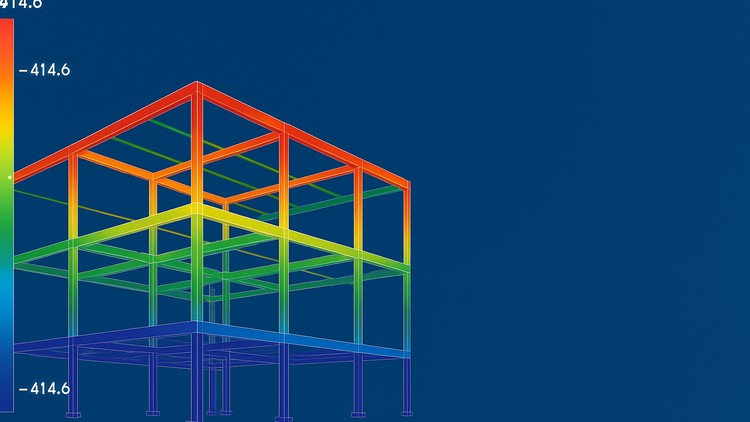
A Comprehensive Guide to Structural Analysis and Design
What you will learn
Note➛ Make sure your 𝐔𝐝𝐞𝐦𝐲 cart has only this course you're going to enroll it now, Remove all other courses from the 𝐔𝐝𝐞𝐦𝐲 cart before Enrolling!
Understand Interface of STAAD
Create and Analyze Structural Models
Assign Loads and Support Conditions
Interpret Analysis Results and Generate Reports
Add-On Information:
- Mastering Structural Design Workflows: Learn to seamlessly transition from conceptualization to final design, ensuring constructible and compliant structures.
- Adherence to Global Design Codes: Apply international and regional design codes (e.g., AISC, IS, Eurocodes) directly for steel and concrete elements.
- Advanced Material Behavior Modeling: Gain proficiency in defining and understanding the implications of various material properties, including anisotropy.
- Dynamic and Seismic Analysis Techniques: Explore advanced methods like modal, response spectrum, and time history analysis for structures under dynamic loads.
- Wind Load Generation and Application: Automatically generate and apply wind loads based on relevant building codes and geographical data.
- Optimized Section Design: Utilize STAAD.Pro’s capabilities to perform member optimization, leading to efficient material usage and cost savings.
- Foundation Design Integration: Learn to integrate structural models with foundation design modules for comprehensive substructure solutions.
- Reporting Customization and Automation: Develop skills in customizing comprehensive reports, including detailed calculations and material take-offs.
- Finite Element Method (FEM) Application: Grasp the underlying principles of FEM as applied for accurate analysis of complex geometries and plate/shell elements.
- P-Delta Analysis for Second-Order Effects: Implement P-Delta analysis to account for geometric non-linearity and its impact on structural stability.
- Reinforced Concrete Design: Delve into the specifics of RC beam, column, and slab design, including reinforcement detailing outputs.
- Interoperability with BIM Workflows: Discover how STAAD.Pro integrates with Bentley’s OpenBuildings Designer and other BIM software for collaborative delivery.
- Troubleshooting and Model Validation: Develop critical skills in identifying and resolving common modeling and analysis errors, ensuring solution robustness.
- Post-Processing for Design Visualization: Utilize advanced post-processing tools to visualize stresses, deflections, and forces, aiding in design validation.
- PROS:
- Industry-Recognized Proficiency: Gain sought-after skills, significantly enhancing career prospects in structural engineering.
- Efficient Problem Solving: Tackle complex structural challenges with advanced tools, improving design accuracy.
- Real-World Project Readiness: Prepare for immediate application of concepts in practical, real-world projects.
- Comprehensive Skill Set: Develop holistic understanding of engineering principles with powerful software capabilities.
- CONS:
- Steep Learning Curve for Beginners: Mastering advanced features requires dedicated practice and a solid foundation.
English
language