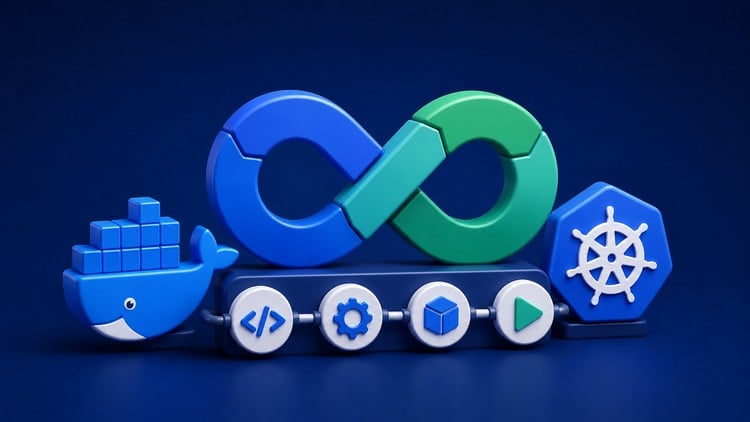
Ace your DevOps interviews with 200 realistic questions on Containerization, Pods, Terraform, and Blue-Green Deployments
What You Will Learn:
- Master containerization concepts by differentiating between Docker images and containers, and writing optimized Dockerfiles (CMD vs. ENTRYPOINT).
- Architect highly resilient microservices using Kubernetes, managing Pods, ReplicaSets, Deployments, and LoadBalancer Services.
- Automate the software delivery lifecycle by designing robust CI/CD pipelines and executing advanced zero-downtime deployment strategies (Blue-Green, Canary).
- Provision infrastructure safely using Infrastructure as Code (Terraform) and configure observability metrics using tools like Prometheus.
Overview: A High-Stakes Deep Dive into the DevOps Ecosystem
Let’s be real for a second: the term “DevOps” gets thrown around so much these days that it’s almost lost its meaning. But in the trenches of a production environment, it’s the difference between a seamless Friday afternoon release and a 2 AM emergency bridge call because a Kubernetes Pod entered a CrashLoopBackOff. I recently dug into the ‘DevOps Engineering: Docker, Kubernetes & CI/CD Exams’ course, and I wanted to share an honest take from someone who has spent a fair share of time wrestling with YAML files and failing pipelines.
This isn’t your typical “click-along” tutorial where everything works perfectly because the instructor pre-configured the environment. Instead, this course feels like a rigorous certification prep bootcamp disguised as a practice exam suite. It tackles the technical debt most beginners carry—like not knowing the actual difference between CMD and ENTRYPOINT in a Dockerfile—and forces you to think like an architect. The focus here is on job-ready skills, moving beyond “it works on my machine” to “it scales in the cloud.” If you’re tired of surface-level overviews and want a curriculum that actually simulates the pressure of a technical interview or a real-world project, this is where you land.
Prerequisites: What You Need Before You Dive In
You can’t build a skyscraper on a swamp. While the course covers beginner to advanced concepts, you’ll struggle if you don’t have a baseline. Before jumping into these exams, you should have a working knowledge of the Linux command line. If you don’t know how to `grep` a log file or `ssh` into a remote server, pause and go learn that first. A basic understanding of the Software Development Life Cycle (SDLC) is also a must. You don’t need to be a Senior Developer, but you should understand how code moves from a dev’s laptop to a server. Familiarity with YAML is non-negotiable, as it is the “language of the cloud” you’ll be using for Kubernetes manifests and Terraform configurations.
Skills & Tools: The Modern Engineer’s Swiss Army Knife
The course focuses heavily on industry-standard tools that are currently dominating the enterprise landscape. It’s a smart selection of technologies that actually talk to each other:
- Docker: It goes beyond basic `run` commands. You’ll learn image optimization, which is a massive career growth skill. Smaller images mean faster deployments and lower costs.
- Kubernetes: This is the heart of the course. You’ll deal with ReplicaSets, Deployments, and the trickier aspects of LoadBalancer Services. It forces you to understand the networking layer, not just the container layer.
- CI/CD Pipelines: You’ll explore the logic behind Blue-Green and Canary deployments. This is crucial because companies today are obsessed with zero-downtime strategies.
- Infrastructure as Code (IaC): Terraform is treated as a first-class citizen here. Learning to provision resources safely is what separates a script-kiddie from a DevOps Engineer.
- Observability: Using Prometheus to actually see what’s happening in your cluster. Because if you can’t measure it, you can’t manage it.
Career Benefits & Job Roles
Completing this level of training puts you in a different league. We are currently seeing a massive shift where “System Administrators” are being replaced by Site Reliability Engineers (SREs) and Cloud Architects. By mastering these 200 realistic questions, you’re essentially preparing for the “hot seat” in technical interviews. These skills are directly applicable to high-paying roles at tech giants and startups alike. Whether you’re aiming for a role as a Cloud Engineer, a Build/Release Manager, or a Platform Engineer, the ability to explain Infrastructure as Code and microservices orchestration is your ticket to a higher salary bracket. It’s about building a portfolio of job-ready skills that prove you can handle the complexity of modern distributed systems.
The Pros: Why This Course Stands Out
- Interview-Specific Focus: The 200 questions aren’t just trivia; they are scenarios. They mirror the “how would you handle X?” questions that I’ve both asked and answered in DevOps interviews.
- Granular Docker Insights: I loved the focus on optimized Dockerfiles. Most people write bloated images; this course teaches you to be surgical with your layers.
- Realistic Networking: The way it handles Kubernetes LoadBalancer Services and Pod-to-Pod communication is excellent. Networking is usually where DevOps learners get stuck, and this course hits it head-on.
- Deployment Strategies: The deep dive into Canary and Blue-Green deployments is rare. Most courses just mention them, but this one expects you to understand the underlying logic of traffic shifting.
The Cons: An Honest Critique
If I have one gripe, it’s the sheer density of the information. For a true “day one” beginner, the jump from Docker basics to Kubernetes orchestration can feel like a vertical climbing wall. There were moments where I felt like a few more hands-on labs specifically targeting Terraform state management would have helped bridge the gap between the theory of the exam questions and the actual execution in a terminal. It requires a lot of self-study outside of the questions to truly grasp the “why” behind some of the answers.
Final word? If you’re serious about career growth in the cloud space, this is a “must-take.” It’s tough, it’s opinionated, and it’s exactly what you need to stop being a “tutorial follower” and start being an engineer.