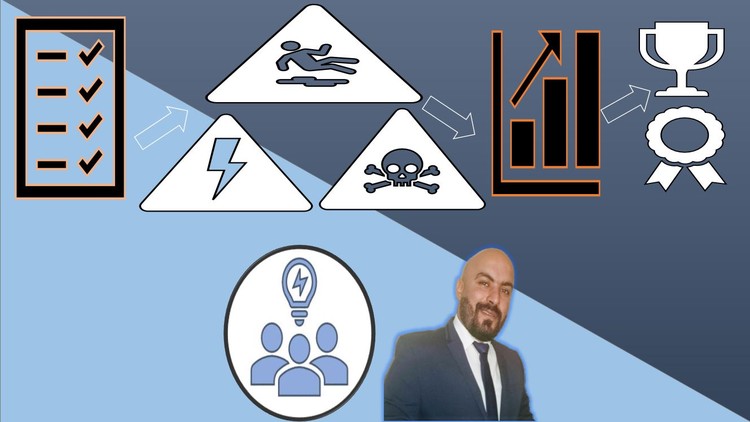
Your Real Comprehensive guide to ISO 31000 & COSO Framework. Finally, ERM Simplified & its Secrets revealed!
What you will learn
Enterprise Risk Management
Crisis Management
Business Strategies
Description
There was a wrong common thought that “Risk Management” is a secondary activity or function and not that important. Believers and followers of that school used to say that corporates should focus their time and efforts on revenue-generating activities only. In their views, those activities that need to be given too much importance are:
Sales, Logistics, Marketing and Finance not Risk Management. In the last two decades, we have seen many crisis and risks that made many big and famous companies go bankrupt and vanish from our business world due to lack of Enterprise risk management. Those cascading risks and crisis and their impacts on businesses turned the table on the followers of the old though.
Did you hear about a company called Kodak?
Kodak dominated the Photography business for so long and it was manufacturing the films for the old cameras. Its films were the most famous and trusted ones in all studios all over the world. New digital cameras were introduced in the market which was a great competition “RISK” to “KODAK”. Kodak neglected that risk as they weren’t competent with Risk Management.
Guess what was the result?????
Kodak is not existing any more after dominating the whole world!
I bet you are not one of those people who used to say that “Risk Management” is not important, that’s why you are reviewing my course right now!
Congrats, you are on the right path to safeguard and secure your company’s assets and operations!
That course will teach you the whole cycle of Enterprise Risk Management step by step!
Topics Covered are:
– Nature and Causes of Risk
– Risk types
– Risk appetite & attitudes
– Importance & Effectiveness of ERM
– ISO 31000
– COSO Framework
– Setting the context of ERM
– Risk identification / Event identification
– Risk assessment, Mapping, Analysis & Evaluation
– Risk Treatment, Actions & strategies
– Risk Communication and Reporting
– Monitoring, Reviewing & Documenting ERM
– Role of Insurance Companies in ERM
– ERM Information Systems & Software
– Credit Rating Agencies
-Real life ERM examples
I hope you will enjoy the course and can’t wait to start that journey with you!
Content
Introduction
Nature and Causes of risks
Risk Types
Quick Wins
Risk Appetites & Attitudes
Importance & Effectiveness of ERM
Setting the context of ERM
Risk Identification / Event Identification
Risk Assessment, Mapping, Analysis & Evaluation
Risk Treatment, Actions & Strategies
Risk Communication and Reporting
Monitoring, Reviewing & Documenting Risk Management Process
ERM & Corporate Social Responsibility CSR!
Role of Insurance Companies in ERM
ERM Information Systems & Softwares
Credit Rating Agencies
Real Past Bankruptcies Due to Lack of Risk Management
Investement Appraisal and ERM
Multiple Lectures
Wrapping Up and Conclusion
Formats & PDFs Bank
An Honest Look at the ERM Master Class: Beyond the Corporate Buzzwords
Let’s be real for a second: Enterprise Risk Management (ERM) usually sounds like the kind of topic that would put a caffeinated squirrel to sleep. Most courses on the subject feel like someone reading a dry ISO manual aloud while you contemplate your life choices. However, “The Complete Enterprise Risk Management ERM Master Class” actually surprised me. As someone who’s spent years in the tech and operations trenches, I’ve seen firsthand how “unforeseen risks” can blow up a multi-million dollar project overnight. This course isn’t just about theory; it’s about survival in a volatile corporate landscape.
What I appreciated most about this comprehensive guide is how it strips away the academic fluff. We’ve all heard of ISO 31000 and the COSO Framework, but how many of us actually know how to deploy them without causing a mutiny in the boardroom? This course acts as a translator, turning high-level “corporate-speak” into job-ready skills that you can actually use. It moves fluidly from beginner to advanced concepts, ensuring you don’t just memorize definitions but actually understand the “why” behind risk appetite and tolerance. It’s less about checking boxes and more about strategic decision-making, which is where the real career growth happens.
Prerequisites: Who Should Actually Sign Up?
You don’t need to be a Chief Risk Officer to get value here, but you shouldn’t come in totally green either. While the course is marketed as beginner to advanced, having a basic grasp of how a business functions—specifically how departments interact—will help the concepts stick. If you’ve ever managed a budget or led a small team, you have enough context. From a technical standpoint, a decent handle on Excel is a must, as you’ll be thinking through real-world projects that involve data-driven risk assessment. If you’re looking for a certification prep foundation, this is a solid starting point, but bring your analytical hat; you’ll need it.
Skills & Tools: Building Your Risk Toolkit
This isn’t just a series of lectures; it’s a toolkit assembly line. You get deep exposure to industry-standard tools and methodologies that are currently being used by Fortune 500 companies. We’re talking about more than just “identifying risks.” You’ll dive into:
- Risk Assessment Methodologies: Learning the nuance between qualitative gut-checks and quantitative data modeling.
- The COSO Matrix: Understanding how to align risk management with internal controls and organizational strategy.
- Heat Maps & Risk Registers: These aren’t just pretty charts; they are the hands-on labs of the ERM world, and the course teaches you how to build them from scratch.
- ISO 31000 Standards: Getting a grip on the international benchmark for risk management so you can speak the global language of compliance.
Career Benefits & Job Roles
In today’s economy, being the person who can “predict the rain and build the ark” is a massive competitive advantage. Completing this course positions you for high-impact roles such as Risk Manager, Compliance Officer, Internal Auditor, or Operations Manager. I’ve noticed that “Risk Management” is no longer tucked away in a dark corner of the Finance department; it’s now a core requirement for Project Managers and Tech Leads. By mastering these job-ready skills, you’re effectively future-proofing your career. Companies are desperate for people who can bridge the gap between technical risk and business objectives, and this course provides the blueprint for that career growth.
Pros: Why This Course Stands Out
- Demystifies the Giants: It takes the ISO 31000 and COSO frameworks—which are notoriously dense—and breaks them down into actionable steps. No more scratching your head over abstract guidelines.
- Practical Application: I loved the focus on real-world projects. It’s one thing to know what a “risk response” is; it’s another to know when to mitigate versus when to just accept the risk and move on.
- Scalable Logic: The logic taught here works whether you’re at a 10-person startup or a massive multinational. It’s about the mindset of risk, not just the scale of the company.
Cons: The Honest Truth
If I have one gripe, it’s the density. This is a “Master Class” in the truest sense, meaning some sections are incredibly heavy on documentation and methodology. If you’re looking for a “quick win” or a 2-hour crash course, this isn’t it. You have to be willing to sit through some of the more “regulatory” aspects of the industry-standard tools, which can feel a bit sluggish if you’re more of a “move fast and break things” type of professional. It requires patience to see the full picture.