From Zero To Hero | Thinking Out Of Box
What you will learn
Program in Arduino
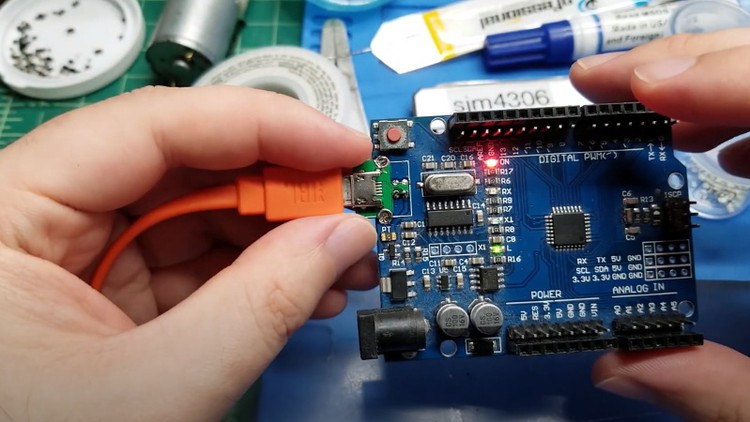
Use Arduino board and sensors
Solid background about electronics, arduino and programming
Well-equipped with the skills in to how to search and take the idea to real-life
Description
Updated: July 26th, 2021| Monday
_______________________________________
About this course: The Arduino is an open-source computer hardware/software platform for building digital devices and interactive objects that can sense and control the physical world around them. In this class, you will learn how the Arduino platform works in terms of the physical board and libraries and the IDE (integrated development environment). You will also learn about shields, which are smaller boards that plug into the main Arduino board to perform other functions such as sensing light, heat, GPS tracking, or providing a user interface display. The course will also cover programming the Arduino using C code and accessing the pins on the board via the software to control external devices.
Upon completing this course, you will be able to:
1. Outline the composition of the Arduino development board
2. Describe what it means to program the board
3. All of the Arduino Uno components
4. Install Arduino IDE
5. Describe what “shields” are and how they are used
6. Specify the role of libraries in the use of shields
7. Compile and run a program
8. Name C Variables and Types
9. Name common C operators
10. Use conditionals and loops
11. Explain functions, their definition, and invocation
12. Explain the implications of global variables
13. Undertake the Arduino build process
14. Describe the role of the tools behind the IDE
15. Describe how to invoke functions in classes
16. Explain the structure of an Arduino sketch
17. Access the pins of the Arduino
18. Differentiate between digital and analog pin
19. Hands-on experience and create innovative projects.
and all of it through a very creative learning way, I am sure that it is going to be a short and sweet learning process for you.
If you would love to start making what you have in your mind of creative ideas, enroll, and best of luck.
Best Wishes to all of you ; ).
– Instructor
Content
- Course Overview
- This program introduces a revolutionary Super Way to master the world of microcontrollers by prioritizing creative exploration over rote memorization.
- The curriculum is meticulously designed to take learners From Zero To Hero, transforming absolute beginners into competent inventors through immersive, hands-on projects.
- We emphasize Thinking Out Of Box, encouraging students to view electronic components not just as tools, but as building blocks for digital art and innovation.
- Participants will explore the synergy between hardware and software, learning how to breathe life into inanimate objects using simple yet powerful logic.
- The course moves beyond standard tutorials by teaching the underlying philosophy of interaction design, ensuring you understand the relationship between user input and machine response.
- Requirements / Prerequisites
- A burning curiosity and a willingness to experiment, fail, and iterate on designs until they function perfectly.
- Access to a personal computer (Windows, macOS, or Linux) with administrative rights to install necessary drivers and software.
- A standard Arduino Uno starter kit or equivalent components, including a breadboard, jumper wires, and various basic sensors.
- No prior experience in computer science or electrical engineering is required; the course is structured to be accessible to everyone.
- Basic mathematical literacy is helpful but not mandatory, as we focus on the logic of the code rather than complex formulas.
- Skills Covered / Tools Used
- Fluency in the Arduino Programming Language (C/C++), specifically tailored for hardware control and optimization.
- Proficiency in using the Arduino Integrated Development Environment (IDE) for writing, debugging, and uploading code.
- Mastery of Circuit Prototyping on breadboards, allowing for rapid testing of ideas without the need for permanent soldering.
- In-depth knowledge of Digital and Analog Input/Output systems to read data from the physical world and control external devices.
- Utilization of Pulse Width Modulation (PWM) to achieve precise control over motor speeds and light intensity.
- Application of Serial Monitoring techniques to troubleshoot logic errors and visualize data flow in real-time.
- Benefits / Outcomes
- The ability to conceptualize and build fully functional prototypes for home automation, robotics, or interactive art.
- A profound improvement in computational thinking and logical problem-solving skills that are transferable to any tech field.
- The confidence to reverse-engineer existing electronic gadgets and modify them for your own creative purposes.
- Development of a professional portfolio of projects that demonstrate your technical proficiency and creative ingenuity.
- Acquisition of a maker’s mindset, empowering you to solve everyday problems with custom-built electronic solutions.
- PROS
- Focuses on creative application, making the learning process far more engaging than traditional technical courses.
- Bridges the gap between theory and practice by providing immediate physical feedback for every line of code written.
- Promotes originality, ensuring that your projects stand out in the global maker community.
- CONS
- The unconventional learning path may feel less structured for students who prefer a strictly academic, textbook-heavy environment.
Introduction
Introduction to programming and Arduino
Start Building | Inspiring journey
Creative Ideas – Competitions
THE Last Section :