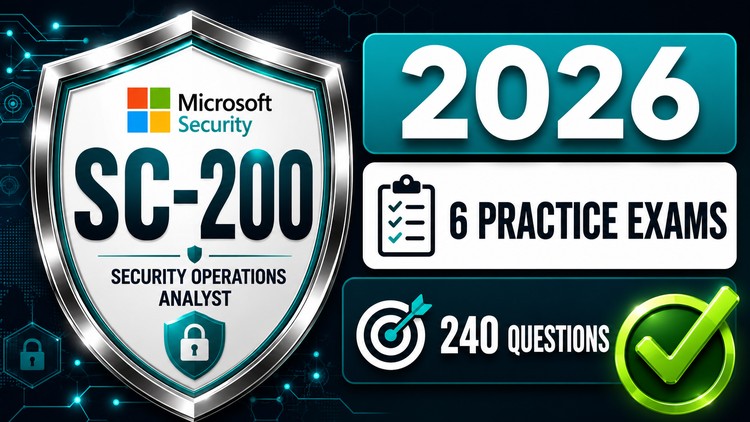
240 exam-style questions with explanations on Microsoft Sentinel, Defender XDR, incident response, threat hunting and KQ
What You Will Learn:
- Pass the SC-200 exam on your first attempt by working through 240 questions built to match the real exam in wording, length and difficulty.
- Answer scenario-based and multiple-response questions on Microsoft Sentinel, Defender XDR and Defender for Cloud under real exam time pressure.
- Explain why each option is right or wrong, using per-option explanations that point back to the official Microsoft Learn documentation.
- Configure automation, data connectors, analytics rules and custom detections the way the current SC-200 objectives expect you to.
- Investigate and remediate incidents across email, identity, endpoint and cloud, from the first alert through to containment and recovery.
- Read and write KQL for advanced hunting, covering table selection, joins, aggregations, JSON handling and time-series analysis.
- Show more
Overview
Alright, so you’re eyeing the SC-200 Security Operations Analyst certification, a crucial credential for anyone serious about a career in a modern Security Operations Center (SOC). This set of ‘SC-200 Security Operations Analyst: 6 Practice Exams 2026’ isn’t just another dump of questions; it’s designed to be your final, critical step in `certification prep`. What immediately stands out is the commitment to mirroring the real exam experience – 240 questions crafted to match the wording, length, and difficulty you’ll encounter on test day. This isn’t just about memorizing answers; it’s about internalizing the material, understanding the nuances of Microsoft’s security ecosystem, and truly assessing if you’ve developed the `job-ready skills` necessary for a SOC role. The inclusion of scenario-based and multiple-response questions under timed conditions is invaluable, helping you manage pressure and think critically, just as you would in an actual security incident. This isn’t a replacement for foundational learning, but rather an advanced validation tool, perfect for solidifying your understanding across `industry-standard tools` like Microsoft Sentinel and Defender XDR before you face the real deal.
Prerequisites
To get the most out of these practice exams, you shouldn’t be starting from zero. While the explanations are thorough, a baseline understanding of security concepts is essential. Think network fundamentals, common attack vectors (phishing, malware), and an awareness of identity management. You’ll also need some familiarity with Microsoft 365 and Azure environments – knowing your way around Azure Active Directory, the Microsoft 365 Defender portal, and basic Azure services will be a huge advantage. If you’ve already completed some foundational Microsoft security courses (like SC-900) or have a few months of IT/security experience, you’re likely in a good spot. This material moves beyond basic theory quickly, expecting you to apply knowledge to solve complex problems, so it’s aimed at someone progressing from `beginner to advanced` in their Microsoft security journey.
Skills & Tools
These practice exams are a robust test of your proficiency across the core tools and skills expected of a modern Security Operations Analyst. You’ll be challenged on:
- Microsoft Sentinel: Mastering SIEM configuration, data connectors, analytics rules, workbooks, and automation playbooks.
- Microsoft Defender XDR: Covering threat detection, investigation, and response across Defender for Endpoint, Identity, Office 365, and Cloud Apps.
- Incident Response: Simulating the entire incident lifecycle, from initial alert through investigation, containment, remediation, and recovery.
- Threat Hunting: Developing proactive hunting skills, including the crucial ability to read and write advanced Kusto Query Language (KQL) queries for data analysis and discovery.
- Cloud Security: Understanding how to leverage Defender for Cloud (formerly Azure Security Center) for posture management and threat protection in cloud environments.
Effectively, these exams are designed to ensure you’re competent with the `industry-standard tools` that form the backbone of a Microsoft-centric SOC.
Career Benefits & Job Roles
Passing the SC-200 certification significantly enhances your `career growth` prospects in the cybersecurity domain. This particular set of practice exams doesn’t just help you pass; it reinforces practical, `job-ready skills` that are highly sought after. Achieving this certification validates your expertise in operating Microsoft security solutions, making you a more attractive candidate for roles such as:
- Security Operations Analyst: The most direct fit, focused on monitoring, detecting, and responding to threats.
- SOC Engineer: Someone involved in configuring and optimizing the security tools and infrastructure.
- Threat Hunter: Utilizing tools like KQL for proactive threat discovery.
- Incident Responder: Specializing in the end-to-end management of security incidents.
- Cloud Security Engineer: Leveraging Defender for Cloud and Sentinel to secure cloud environments.
Demonstrating proficiency through this `certification prep` directly translates into tangible skills needed for `real-world projects` and operational tasks, opening doors to more specialized and higher-paying positions.
Pros
- Exceptional Question Quality & Relevance: The questions genuinely reflect the SC-200 exam’s format, difficulty, and focus areas. This isn’t just about testing knowledge; it’s about building exam-taking stamina and familiarity with the expected question types.
- In-Depth Explanations with Official Links: This is a huge differentiator. For every option, you get a clear explanation of why it’s right or wrong, often pointing directly to specific Microsoft Learn documentation. This fosters true understanding rather than mere memorization, which is critical for retaining `job-ready skills`.
- Up-to-Date Content (2026): The “2026” in the title is reassuring, indicating the content is current and aligns with the latest iterations of Microsoft’s rapidly evolving security services. This is paramount when dealing with `industry-standard tools`.
- Comprehensive Topic Coverage: From KQL to incident response, and across Sentinel and Defender XDR, these exams cover all major domains of the SC-200 objectives, ensuring a well-rounded `certification prep`.
Cons
- No Hands-on Lab Simulation: While the scenarios are well-crafted, these are practice exams, not `hands-on labs`. They test your theoretical and practical *knowledge* of how to configure and operate the tools, but they don’t provide a sandbox environment for you to actually *perform* the configurations or run KQL queries. You’ll need to supplement these exams with real-world practice or dedicated lab environments to fully solidify the muscle memory required for some tasks.