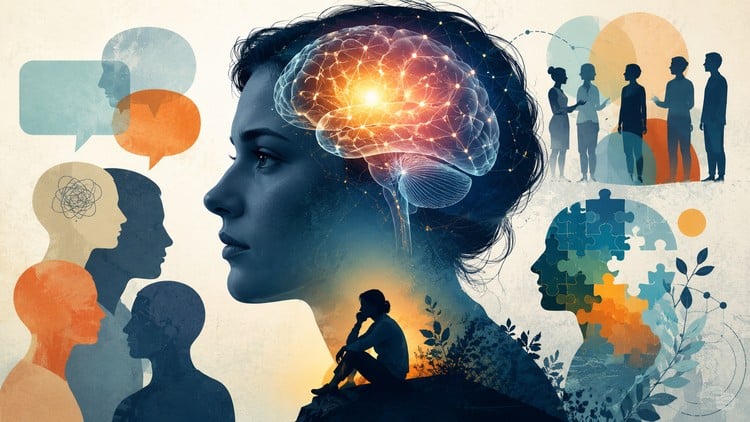
Learn psychology, human behavior, emotions, personality, and communication.
What You Will Learn:
- Understand the foundations of psychology and human behavior.
- Explore emotions, motivation, personality, and communication.
- Learn how people think, feel, react, and make decisions.
- Recognize psychological factors behind social and interpersonal behavior.
- Apply basic psychology concepts to daily and professional life.
- Improve self-awareness, empathy, and understanding of others.
- Understand how personality differences affect relationships and communication.
- Develop a practical foundation for future psychology learning.
As an experienced tech professional, I’ve seen firsthand how crucial understanding the human element is, whether you’re building software, leading teams, or navigating complex client relationships. The ‘Psychology and Human Behavior Certificate Course’ isn’t just another bullet point for your resume; it’s a surprisingly potent toolkit for anyone looking to decrypt the often-mystifying world of human interaction. This course goes beyond rote memorization, providing a foundational framework for understanding motivations, biases, and communication patterns that drive everything from user engagement to team dynamics. It’s about gaining a practical operating manual for people, translating complex theories into actionable insights you can apply immediately. For those of us used to optimizing algorithms and streamlining processes, learning to optimize our human interactions can be a genuine accelerator for both personal growth and professional effectiveness.
Prerequisites
Let’s be clear: you don’t need a psychology degree or even a basic grasp of cognitive science to dive into this. The beauty of this course is its genuine accessibility; it caters from `beginner to advanced` learners without overwhelming you with academic jargon. If you possess an open mind, a natural curiosity about *why* people (including yourself) behave the way they do, and perhaps a knack for analytical thinking (which most tech folks inherently have), you’re more than adequately prepared. No prior experience in psychology is required, making it an excellent entry point for anyone curious about this fascinating field.
Skills & Tools
While you won’t be spinning up virtual machines or coding in new languages, the “tools” you gain from this course are arguably more impactful for your day-to-day interactions. You’ll develop acute observation skills, learning to decode non-verbal cues and underlying motivations. Key skills acquired include:
- Enhanced Communication & Active Listening: Crucial for stakeholder management, user interviews, and effective team collaboration.
- Emotional Intelligence & Self-Awareness: Understanding your own biases and emotional triggers, leading to better self-regulation.
- Behavioral Analysis: Applying psychological frameworks to understand why users interact with products in certain ways or why team members react to feedback differently.
- Conflict Resolution Techniques: Leveraging insights into personality types and motivations to navigate disagreements more effectively.
- Empathy & Perspective-Taking: A cornerstone for effective leadership and building stronger, more productive relationships.
The “tools” are essentially the mental models and theoretical frameworks for understanding personality types, cognitive biases, motivational theories, and communication strategies. These provide a robust lens through which to analyze and improve virtually any human interaction.
Career Benefits & Job Roles
For a tech professional, the `career growth` potential here might not immediately jump out compared to a new programming language, but its impact is profound and far-reaching. This certificate equips you with critical `job-ready skills` that are increasingly vital as roles become more interdisciplinary and collaborative. Think about how understanding human behavior directly impacts:
- Leadership & Management: Essential for engineering managers, product leads, and team managers looking to motivate, resolve conflicts, and build high-performing teams.
- Product Management & UX/UI Design: Deep insights into user psychology, decision-making processes, and emotional responses to digital products.
- Sales & Marketing: Tailoring communication, understanding customer needs, and addressing objections effectively.
- HR & Talent Acquisition: Improved interviewing skills, better understanding of team dynamics, and strategies for employee retention.
- Consulting & Client Relations: Analyzing organizational behavior and facilitating successful change management.
It’s about becoming a more influential communicator, an empathetic leader, and a more insightful problem-solver – qualities that are universally valued and directly contribute to advancing into senior and strategic roles, regardless of your core technical stack.
Pros
- Actionable & Practical Insights: This course excels at translating complex psychological theories into immediately `job-ready skills`. It’s not just academic fluff; you learn concepts one day and find yourself applying them in meetings, client calls, or even personal conversations the next. It’s truly an accelerator for developing crucial ‘people skills’.
- Significant Boost to Self-Awareness & Empathy: The focus on understanding emotions, personality differences, and communication styles is a game-changer. I saw a tangible improvement in my ability to articulate complex technical ideas to non-technical stakeholders and to navigate difficult conversations with greater clarity. It significantly boosts your `self-awareness` and `empathy`, which are foundational for effective leadership and collaboration.
- Robust Foundation for `Career Growth`: While it’s a certificate, it provides a remarkably solid and digestible `foundation for future psychology learning`. For those considering deeper dives into UX psychology, organizational behavior, or even personal coaching, it sets a strong stage. More importantly, these refined soft skills are direct pathways to `career growth`, especially into leadership and strategic roles where understanding people is paramount.
Cons
If I had one minor critique, it would be the relative lack of traditional `hands-on labs` or structured `real-world projects` in the tech sense. While the course encourages self-reflection and application in daily life (which *is* a form of practical exercise), a few more dedicated, simulated case studies for conflict resolution, user persona development, or communication strategy could further solidify the practical application for learners who thrive on direct experiential practice. It’s a certificate, so expectations should be managed, but a slightly more interactive approach would be a welcome enhancement.