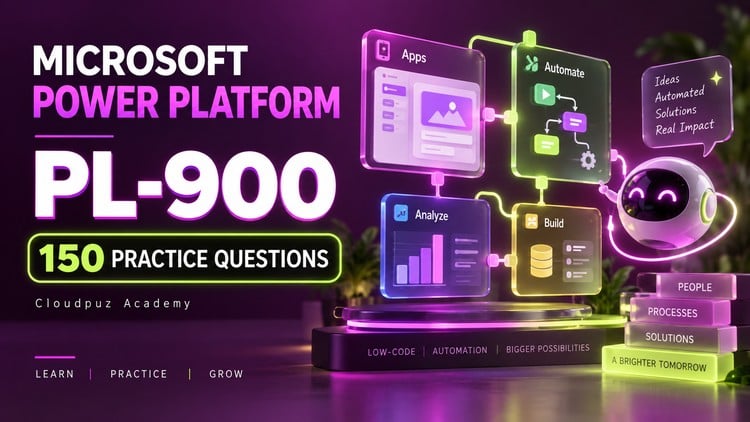
Two 75-question sets with explanations on Dataverse, Power Apps, Power Automate, and Copilot Studio agents
What You Will Learn:
- Compare Power Platform services and identify suitable business uses for apps, automation, data, websites, and agents.
- Review Dataverse, environments, security, governance, monitoring, and application lifecycle management concepts.
- Distinguish canvas, model-driven, and code apps and evaluate cloud and desktop flow scenarios.
- Identify Copilot Studio knowledge, topics, tools, channels, evaluations, and agent governance capabilities.
Alright folks, let’s talk about the Power Platform PL-900: 150 Practice Questions course. As someone who’s been navigating the tech landscape for a good while, and has seen a fair share of certification prep materials, I was keen to see how this one stacked up, especially with the PL-900 being a foundational cert in the Microsoft ecosystem. This isn’t your typical “read this and you’ll pass” kind of deal; it’s more of a targeted drill. They’ve packaged it as two 75-question sets, aiming to cover the breadth of Dataverse, Power Apps, Power Automate, and Copilot Studio agents, all wrapped up with explanations. Let’s dive in.
Overview
The core proposition here is clear: supplement your learning with a significant chunk of practice questions. What sets this apart from just grabbing random questions online is the structured approach. It’s not just about rote memorization; the explanations are meant to solidify your understanding of how these Power Platform services interoperate and where they fit into business scenarios. This is crucial for the PL-900, which, while beginner-focused, still requires you to grasp the ‘why’ behind using specific tools, not just the ‘how’. They’ve woven in concepts like comparing services, identifying suitable business uses for everything from apps and automation to websites and agents, and even touching upon the less glamorous but vital aspects of Dataverse, environments, security, governance, monitoring, and application lifecycle management. This holistic view is what separates good certification prep from great. It’s about building a mental model of the Power Platform, not just ticking boxes.
Prerequisites
Honestly, for the PL-900 itself, and by extension this practice question set, the bar is set pretty low, which is a good thing. If you’ve got a basic understanding of business processes and a general familiarity with cloud-based applications, you’re probably in a good spot. You don’t need to be a seasoned developer or have deep IT infrastructure knowledge. However, a genuine interest in understanding how technology can solve business problems is a must. If you’re coming in completely cold, I’d recommend a quick overview of what Power Platform is before diving headfirst into 150 questions. Think of it like learning your ABCs before attempting to write an essay.
Skills & Tools
This course is designed to hone your understanding of core Microsoft Power Platform services. You’ll get a solid grip on:
- Dataverse: Its role as a data backbone, fundamental for most Power Platform solutions.
- Power Apps: Distinguishing between canvas apps, model-driven apps, and understanding their use cases.
- Power Automate: Evaluating cloud and desktop flow scenarios for automation.
- Copilot Studio Agents: Grasping their knowledge, topics, tools, channels, and governance.
- Environments, Security, and Governance: Essential concepts for real-world deployments.
- Application Lifecycle Management (ALM): A peek into managing solutions effectively.
The primary ‘tool’ you’re using here is your brain, paired with the structured questions and explanations provided. While it doesn’t offer hands-on labs, it serves as an excellent primer and reinforcement for what you’d be doing in actual hands-on labs or on real-world projects.
Career Benefits & Job Roles
Let’s be real, the primary driver for many is career growth. The PL-900 certification, supported by practice like this, opens doors. It’s a signal to employers that you understand the foundational concepts of a rapidly growing low-code/no-code platform. This can lead to roles like:
- Power Platform Functional Consultant
- Business Process Analyst
- Junior Power App Developer
- Automation Specialist
- Citizen Developer
It’s about acquiring job-ready skills that are in high demand. Even if your current role isn’t directly in Power Platform, understanding it can make you a more valuable asset, helping to identify opportunities for improvement and automation within your existing teams.
Pros
- Targeted Practice: 150 questions is a substantial amount, providing ample opportunity to test your knowledge across all key PL-900 domains. The explanations are the real MVP here, turning mistakes into learning opportunities.
- Comprehensive Coverage: The questions and their explanations effectively touch upon a wide array of topics, from the core services like Power Apps and Automate to the often-overlooked but critical areas of security, governance, and ALM.
- Scenario-Based Learning: The emphasis on identifying suitable business uses and distinguishing between app types pushes you towards understanding the ‘why’ and ‘when,’ which is far more valuable than memorizing definitions for real-world projects.
- Builds Confidence: Successfully working through these questions and understanding the rationale behind the answers significantly boosts confidence for the actual exam.
Cons
My main gripe, and it’s a significant one for me, is the lack of hands-on component. While practice questions are invaluable for theory and testing recall, the Power Platform is inherently a hands-on platform. To truly master it and be job-ready, you need to build. Ideally, this practice question set would be integrated with or at least point towards practical exercises or simulations that allow you to apply the concepts you’re learning. Without that practical application, it remains primarily a theoretical exercise, albeit a very well-structured one.