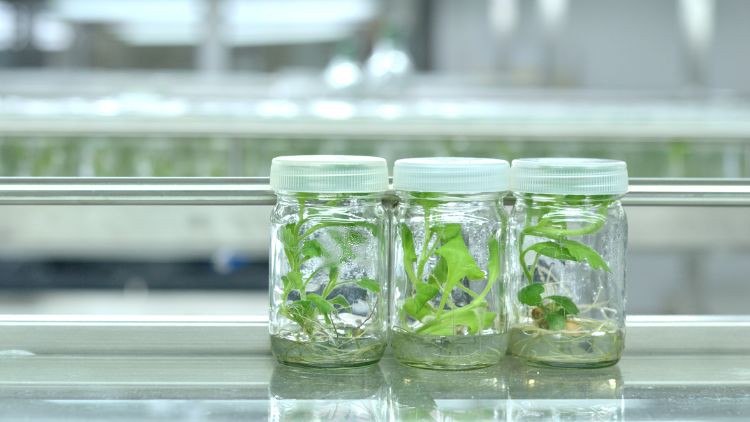
Cultivating Botanical Advancements
What you will learn
Note➛ Make sure your 𝐔𝐝𝐞𝐦𝐲 cart has only this course you're going to enroll it now, Remove all other courses from the 𝐔𝐝𝐞𝐦𝐲 cart before Enrolling!
Stay ahead in the field of botanical research with insights into the latest advancements in plant cell and tissue culture.
Understand how plant cell and tissue culture techniques applied in agriculture, pharmaceuticals, biotechnology, and conservation efforts.
Understand how plant cell and tissue culture techniques are applied in agriculture, pharmaceuticals, biotechnology, and conservation efforts.
Access course materials anytime, anywhere, and at your own pace, fitting seamlessly into your busy schedule.
Add-On Information:
- Master the foundational principles of sterile technique and aseptic manipulation, crucial for successful plant propagation and genetic manipulation.
- Explore the intricate relationship between plant hormones (auxins, cytokinins, gibberellins) and their specific roles in inducing cell division, differentiation, and organogenesis.
- Develop practical skills in preparing and sterilizing culture media, tailoring nutrient compositions for diverse plant species and objectives.
- Learn to establish and maintain various explant types (meristems, leaves, seeds, roots) for in vitro propagation and regeneration.
- Gain expertise in micropropagation techniques to rapidly multiply elite plant genotypes, ensuring clonal fidelity and uniformity.
- Understand the science behind callus induction and its subsequent manipulation for somatic embryogenesis and regeneration pathways.
- Investigate advanced techniques such as anther/microspore culture for haploid production and hybrid development, streamlining breeding programs.
- Delve into cryopreservation methods for long-term germplasm storage, safeguarding biodiversity and valuable plant genetic resources.
- Discover the applications of genetic transformation in plant biotechnology, enabling the development of disease-resistant, herbicide-tolerant, and enhanced nutritional value crops.
- Analyze the process of secondary metabolite extraction and production from plant cell cultures for pharmaceutical and industrial applications.
- Learn to diagnose and troubleshoot common issues encountered in plant tissue culture, such as contamination, browning, and poor growth.
- Understand the principles of ex vitro acclimatization and hardening of plantlets, ensuring their successful transition to autotrophic life.
- Explore the economic viability and scalability of tissue culture protocols for commercial horticultural and agricultural ventures.
- Gain insights into the ethical considerations and regulatory frameworks surrounding genetically modified organisms (GMOs) developed through plant biotechnology.
- Acquire the ability to design and conduct independent research projects utilizing plant cell and tissue culture methodologies.
- PROS:
- Develop highly sought-after practical skills applicable across a broad spectrum of botanical disciplines.
- Enhance critical thinking and problem-solving abilities essential for research and development in plant science.
- CONS:
- Requires meticulous attention to detail and adherence to strict aseptic protocols, which can be challenging for beginners.
English
language