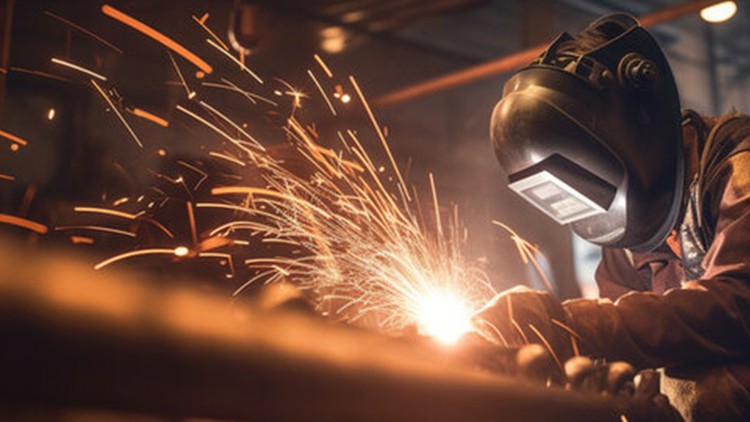
9+ Hours Course that Covers all the Eelding Types, Defects of Welding and their Solution with Animated Explanations.
What you will learn
Gain a comprehensive overview of welding as a joining process, its historical significance, and its importance in various industries.
Understand methods of joining materials and how welding fits into the broader classification, including mechanical joining, adhesive bonding, and soldering.
Learn the fundamentals of fusion welding, including the use of heat to melt and join metal parts, and explore its applications in gas welding.
Discover the principles and equipment involved in gas welding, such as oxy-fuel gases, and understand the basic setup for performing gas welding operations.
Dive into the details of shield metal arc welding (SMAW), including the electrode selection, arc initiation, and control of welding parameters.
Explore the benefits of SMAW, such as its versatility and suitability for outdoor applications, as well as its limitations.
Familiarize yourself with GTAW and understand its characteristics, such as the use of a non-consumable tungsten electrode and inert shielding gas.
Learn the step-by-step procedure for performing GTAW, including electrode preparation, arc initiation, and the control of welding variables.
Explore the principles and applications of GMAW, which utilizes a consumable electrode and shielding gas to create a metal arc.
Understand the different metal transfer modes in GMAW, and their effects on the welding process.
Immerse yourself in the world of submerged arc welding, understanding its principles, equipment, and applications for superior welding outcomes.
Explore the role of fluxes in submerged arc welding, including their types, composition, and importance in ensuring weld integrity.
Delve into the principles and applications of resistance welding, gaining insights into its advantages and suitability for specific projects.
Explore different types of resistance welding and their specific applications in joining metal components.
Familiarize yourself with common welding defects and develop the skills to identify, analyze, and rectify issues like porosity, undercutting&incomplete fusion
Learn effective methods of inspecting welding defects to ensure the integrity and reliability of welded structures.
xplore the concept of the heat-affected zone (HAZ) and its significance in welding, understanding its formation and potential effects on material properties.
Discover strategies to reduce the size and impact of the heat-affected zone through proper heat control, material selection, and welding techniques.
Gain insights into the art of brazing, understanding its advantages, applications, and the intricacies of creating strong and precise joints.
Compare and contrast soldering, brazing, and welding techniques, examining their strengths, limitations, and optimal use cases.
Description
In a world where metal plays a vital role in construction, manufacturing, and innovation, the art of welding and joining stands as a cornerstone of modern engineering. If you’ve ever marveled at the precision and strength of metal structures or dreamt of crafting your own creations, our comprehensive welding course is your gateway to unlocking a world of endless possibilities.
Join us on an immersive journey that transcends mere technical training and transforms you into a master of the craft. From seasoned professionals seeking to refine their skills to passionate enthusiasts looking to dive into a new realm of creativity, this course is designed to cater to all levels of experience and ignite a lifelong passion for welding.
Through a meticulously curated curriculum, you will delve into the essence of welding, discovering its indispensable role in shaping our world. Gain a profound understanding of the profound importance of welding as the foundation of numerous industries, from towering skyscrapers and sturdy bridges to the intricacies of aerospace engineering and the precision of automotive manufacturing.
Our course takes you on a captivating exploration of the diverse welding processes, equipping you with the knowledge and expertise to wield various techniques with confidence. From shielded metal arc welding to gas tungsten arc welding, from gas metal arc welding to submerged arc welding, you will unravel the intricacies of each method, its applications, and its inherent advantages and limitations.
Safety is our paramount concern, and our expert instructors will guide you through the essential safety protocols and precautions necessary for a secure welding environment. Learn how to protect yourself and others from potential hazards, understand the importance of proper ventilation and fire prevention, and master the correct usage of personal protective equipment.
But our course doesn’t stop at the technicalities – we delve deeper, empowering you to inspect and assess weld quality with an expert eye. Discover the art of detecting and addressing welding defects, ensuring the structural integrity and longevity of your creations. Furthermore, unravel the enigma of heat-affected zones and learn techniques to minimize their impact, ensuring exceptional weld performance.
Beyond traditional welding, our course embraces the versatility of brazing and soldering, enabling you to broaden your skill set and take on a wider range of projects. Explore the intricate nuances of these joining techniques, understand their unique advantages, and learn how they differ from welding. With this comprehensive skill repertoire, you will possess the ability to tackle diverse fabrication challenges with finesse.
Embark on a transformative journey, where the molten metal becomes your canvas and the welding torch becomes your brush. Unleash your inner artisan and embrace the art of welding and joining. Enroll today and embark on a path of limitless creativity, where your dreams of metal fabrication come to life.
Content
Introduction
Gas Welding:
Shielded Metal Arc Welding (SMAW):
Gas Tungsten Arc Welding (GTAW):
Gas Metal Arc Welding (GMAW):
Submerged Arc Welding (SAW):
Resistance Welding:
Welding Defects:
Heat Affected Zone due to Welding:
Brazing and Soldering:
Alright, let’s talk about the ‘Metallurgy of Welding for Engineers’ course. As someone who’s spent a fair bit of time in the trenches dealing with material failures and manufacturing challenges, I’m always on the lookout for resources that genuinely bridge the gap between theory and practical application. This course, clocking in at 9+ hours, aims to do just that, and for the most part, it hits the mark.
Overview
Forget just learning which button to push on a welding machine; this course digs deep into the why. It’s not just a primer on different welding processes; it’s a vital exploration of what happens at a microstructural level when you fuse metals. For engineers, understanding the science behind the weld – the phase transformations, the grain growth, the heat-affected zone (HAZ) behavior, and solidification kinetics – is paramount. This insight is what empowers you to prevent defects, select the right materials, and design robust joints. The animated explanations mentioned in the caption aren’t just a gimmick; they are absolutely crucial for visualizing complex metallurgical phenomena that are otherwise incredibly difficult to grasp from static diagrams or text alone. It’s a solid foundational piece for anyone looking to move beyond superficial welding knowledge and truly master the material science that dictates weld quality and performance, ultimately leading to better problem-solving capabilities when things go wrong.
Prerequisites
While the course description suggests it covers concepts from beginner to advanced, I’d recommend having a foundational understanding of engineering principles. Specifically, a basic grasp of materials science, thermodynamics, and perhaps a touch of heat transfer will make this course far more digestible. You don’t need to be a welding guru coming in, but if terms like “austenite,” “martensite,” or “eutectic” are entirely foreign to you, you might find some initial sections challenging. It’s definitely geared towards engineers, so a college-level science/engineering background will serve you well.
Skills & Tools
Upon completing this course, you’re not just gaining theoretical knowledge; you’re developing critical job-ready skills. You’ll be equipped to analyze and understand various welding processes (with detailed dives into gas welding and SMAW, among others), identify common weld defects by their metallurgical origins, and propose effective solutions. This translates into being able to select appropriate filler metals, understand pre and post-weld heat treatments, and interpret welding procedure specifications (WPS) with a much deeper appreciation for the underlying science. While you won’t be using specific software tools, the course instills an understanding of how industry-standard tools like spectrometers, hardness testers, and microscopes are used in weld inspection and quality control, and how their results tie back to metallurgical principles. You’ll be better prepared to contribute to quality assurance, manufacturing process development, and failure analysis teams.
Career Benefits & Job Roles
For engineers, this course is a serious accelerator for career growth. The insights you gain into welding metallurgy are invaluable across a spectrum of roles. Think about positions like Welding Engineer, Materials Engineer, Quality Control Engineer, Manufacturing Engineer, or even Design Engineer where understanding weld limitations and capabilities is crucial. This knowledge provides a significant edge in industries such as aerospace, automotive, shipbuilding, oil & gas, and heavy manufacturing. Being able to speak intelligently about HAZ properties, solidification cracking, or hydrogen embrittlement goes a long way in distinguishing you. While not direct certification prep, the strong theoretical foundation it provides will undoubtedly make studying for recognized welding certifications (like AWS CWI or CSWIP) far more effective and meaningful, as you’ll understand the ‘why’ behind the ‘what’ in exam questions.
Pros
- Animated Explanations are a Game Changer: Seriously, for complex metallurgical concepts like phase diagrams, solidification fronts, and defect formation, these animations are gold. They break down intricate processes into easily digestible visual sequences that significantly enhance understanding.
- Focus on Defects and Solutions: The course doesn’t just list defects; it delves into their metallurgical root causes and, critically, offers practical solutions. This problem-solving approach is exactly what engineers need in the real world.
- Comprehensive Metallurgical Approach: Unlike many process-focused welding courses, this one truly emphasizes the ‘Metallurgy for Engineers’ aspect, providing a deeper, more scientific understanding of material behavior during welding. This foundation is transferable across various welding technologies.
- Broad Welding Type Coverage: While detailing SMAW and Gas Welding, the course effectively frames these within a broader discussion of “all welding types,” equipping you with a framework to understand even those not explicitly detailed.
Cons
- Limited Interactive Application: While the animated explanations are stellar for visualization, I do wish there were more interactive metallurgical simulations or detailed, in-depth real-world projects or case studies showing specific failure analyses tied directly to the metallurgical principles discussed. It’s a bit heavy on theory without much opportunity to virtually apply that theory in a problem-solving scenario *within the course structure itself*, which could bridge the gap to actual hands-on labs even more effectively.