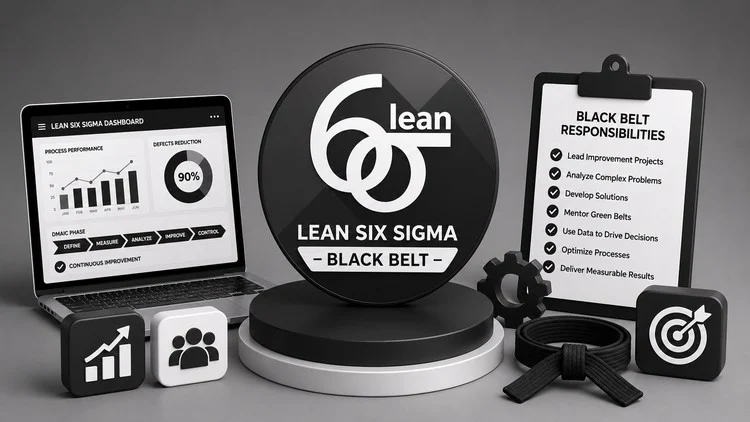
300+ exam-style questions with full rationales. Pass your LSSBB certification on the first attempt — ASQ, IASSC & CSSC
👥 60 students
Alright, let’s talk about the ‘Lean Six Sigma Black Belt Practice Test 2026’. As someone who’s been through the trenches of process improvement and wrangled data for years, I know the value of solid certification prep. This isn’t a full-blown LSSBB course, so let’s get that straight upfront. It’s explicitly a practice test designed to hone your knowledge and test your mettle before you sit for one of the toughest certifications out there.
Overview
First off, calling this a “course review” is a bit of a misnomer, because it’s precisely what it says on the tin: a practice test. And honestly, it’s a damn good one if you approach it with the right mindset. Instead of teaching from scratch, this resource assumes you’ve already invested time in a proper Lean Six Sigma Black Belt program and are now looking to solidify your understanding and identify your weak spots. The 300+ exam-style questions aren’t just fluff; they dive deep into the kind of scenarios and statistical nuances you’ll encounter on the actual ASQ, IASSC, or CSSC exams. The full rationales for each answer are a lifesaver, turning every incorrect answer into a genuine learning opportunity rather than just a missed point. It’s about bridging that gap from “I think I know this” to “I definitely know this and why.” This is where you truly start to translate theoretical knowledge into practical, job-ready skills for tackling complex business challenges.
Prerequisites
Let’s be blunt: this isn’t for the faint of heart or the uninitiated. If you’re a beginner just dipping your toes into Lean or Six Sigma, turn back now. This practice test is firmly in the intermediate to advanced category. You absolutely need a strong foundation, ideally with a Lean Six Sigma Green Belt certification under your belt, or at least equivalent experience in process improvement methodologies. Expect to understand statistical concepts like hypothesis testing, regression analysis, ANOVA, and various control charts. A working knowledge of the DMAIC (Define, Measure, Analyze, Improve, Control) framework at an operational level is also non-negotiable. You should be comfortable with basic project management principles and have some exposure to data analysis, even if you haven’t mastered every industry-standard tool yet. Essentially, you’re expected to arrive with a comprehensive conceptual understanding, and this test will push you to apply it under pressure.
Skills & Tools
While this practice test doesn’t offer hands-on labs to teach you how to operate Minitab or JMP, it implicitly requires and tests your understanding of the results and interpretations derived from such tools. You’ll be strengthening your grasp of advanced statistical analysis, including topics like non-parametric tests, design of experiments (DOE), and advanced capability analysis. The questions will challenge your ability to identify appropriate Lean tools (Value Stream Mapping, Kaizen, 5S) and Six Sigma techniques (Gage R&R, FMEA, Hypothesis Testing selection) for various scenarios. You’ll refine your critical thinking around root cause analysis, risk management, and process optimization strategies. Furthermore, the Black Belt role often involves leadership and change management, so questions often touch upon decision-making, stakeholder management, and project leadership principles relevant to complex real-world projects.
Career Benefits & Job Roles
Passing a Lean Six Sigma Black Belt certification isn’t just a feather in your cap; it’s a significant accelerator for career growth. This practice test, by preparing you thoroughly, acts as a direct pathway to that advancement. Certified Black Belts are highly sought after in numerous industries because they possess the analytical acumen and leadership skills to drive substantial operational excellence and business transformation initiatives. You’ll be primed for roles such as: Process Improvement Manager, Quality Engineer/Manager, Operations Manager, Continuous Improvement Lead, Senior Business Analyst (with a process focus), or even a Consultant specializing in operational strategy. These roles often come with higher compensation and greater strategic influence within an organization, leading large-scale projects aimed at improving efficiency, reducing costs, and enhancing customer satisfaction.
Pros
- Realistic Exam Simulation: With 300+ questions covering all the major certification bodies (ASQ, IASSC, CSSC), this practice test offers an incredibly authentic experience. The question styles and difficulty levels accurately mimic what you’ll face on exam day, which is crucial for building confidence.
- Comprehensive Rationale Explanations: This is arguably its strongest feature. Every question, right or wrong, comes with a detailed explanation. This isn’t just about knowing the answer; it’s about understanding the underlying concepts, the “why” behind it, and connecting it back to the core methodologies. This turns errors into invaluable learning moments.
- Deep Dive into Advanced Concepts: Unlike some superficial prep materials, this test genuinely digs into advanced DMAIC methodology, complex statistical analysis, and nuanced process optimization strategies. It ensures you’re not just memorizing, but truly understanding and applying sophisticated Black Belt concepts.
- Excellent for Gap Analysis and Confidence Building: By repeatedly taking these practice tests, you can pinpoint your knowledge gaps, reinforce weaker areas, and track your progress. This systematic approach is fantastic for building the necessary confidence to pass your Lean Six Sigma Black Belt certification on the first attempt.
Cons
- Not a Standalone Learning Resource: This is critical to understand. While it excels as a practice test, it offers no instructional material. If you haven’t already taken a comprehensive LSSBB course or gained significant practical experience, this test won’t teach you the material. It’s purely for assessment and reinforcement, so don’t expect it to provide the foundational knowledge for beginner to advanced learning; it’s strictly for testing advanced knowledge.