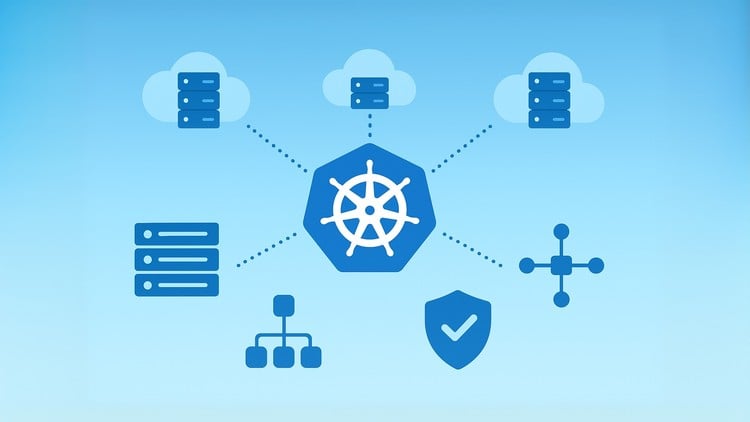
Manage federation, Karmada, Rancher, cross-cluster networking, failover strategies & workload distribution
👥 516 students
🔄 October 2025 update
Add-On Information:
Note➛ Make sure your 𝐔𝐝𝐞𝐦𝐲 cart has only this course you're going to enroll it now, Remove all other courses from the 𝐔𝐝𝐞𝐦𝐲 cart before Enrolling!
-
Course Overview
- Welcome to Kubernetes Multi-Cluster (K8S-MC-203): 1500 Questions, an intensive and uniquely structured program designed for seasoned Kubernetes professionals aiming to conquer the complexities of distributed cloud-native environments. This course transcends foundational single-cluster management, diving deep into the architectural, operational, and strategic nuances of orchestrating applications across multiple Kubernetes clusters. With a remarkable focus on practical application, the curriculum is reinforced by an extensive bank of 1500 challenging questions, ensuring a robust, scenario-driven learning experience that hones your problem-solving capabilities. You will explore critical aspects such as centralized control plane management, secure cross-cluster communication, robust failover mechanisms, and intelligent workload distribution. Updated for October 2025, the course incorporates the latest advancements and best practices in the multi-cluster ecosystem, making it highly relevant for current and future enterprise demands. This is not merely a theoretical exposition but a hands-on journey towards becoming a true multi-cluster Kubernetes architect, ready to design and implement resilient, highly available, and globally distributed applications at scale. Join a community of over 516 dedicated students in mastering the intricate world of multi-cluster Kubernetes.
-
Requirements / Prerequisites
- Proficiency in Core Kubernetes Concepts: A strong, working understanding of single-cluster Kubernetes operations, including deploying applications, managing resources (Deployments, Services, Pods, PVs/PVCs), networking (Services, Ingress), and access control (RBAC). This course assumes you are comfortable administrating a single Kubernetes cluster daily.
- Intermediate Linux Command Line Skills: Competence in navigating Linux environments, shell scripting basics, and utilizing common command-line tools for system and network diagnostics.
- Networking Fundamentals: A solid grasp of TCP/IP, DNS, VPNs, and basic network architecture. Understanding of CIDR blocks, routing, and firewall concepts is crucial for comprehending cross-cluster connectivity.
- Experience with YAML and JSON: Ability to read, write, and troubleshoot Kubernetes manifest files, Helm charts, and Kustomize overlays.
- Familiarity with Cloud Providers (Beneficial but not mandatory): While the principles are universal, practical examples may touch upon specific cloud provider offerings (e.g., AWS EKS, GKE, Azure AKS). General understanding of cloud infrastructure concepts is advantageous.
- Git Version Control: Basic familiarity with Git for managing configurations and codebases.
- Problem-Solving Mindset: An eagerness to tackle complex technical challenges and a commitment to deep, investigative learning are essential, given the course’s question-driven approach.
-
Skills Covered / Tools Used
- Multi-Cluster Management Platforms:
- Deep-dive into Kubernetes Federation (v2): Deploying federated control planes, managing federated resources, and understanding its reconciliation loops and limitations.
- Hands-on with Karmada: Implementing this CNCF project for multi-cloud, multi-cluster Kubernetes orchestration, including policy propagation, override policies, and multi-cluster scheduling.
- Leveraging Rancher: Utilizing Rancher’s robust capabilities for centralized multi-cluster lifecycle management, cluster provisioning across diverse infrastructures, and comprehensive observability.
- Cross-Cluster Networking & Connectivity:
- Designing and implementing secure inter-cluster communication strategies using various approaches like VPNs, direct connect solutions, and advanced network overlay technologies.
- Strategies for global service discovery and load balancing across geographically dispersed clusters.
- Applying consistent network policies and security controls across federated environments.
- Failover Strategies & Disaster Recovery:
- Architecting highly available applications with active-active and active-passive failover mechanisms across multiple Kubernetes clusters.
- Implementing robust disaster recovery plans, including data replication, backup strategies, and rapid cluster restoration.
- Managing stateful applications in multi-cluster setups, addressing data consistency and replication challenges.
- Workload Distribution & Optimization:
- Advanced workload scheduling and placement strategies based on cluster health, resource availability, cost, and geographical proximity.
- Implementing traffic management and ingress solutions for intelligent workload routing across distributed services.
- Techniques for cost optimization and resource utilization efficiency in a multi-cluster landscape.
- Observability in Distributed Systems:
- Setting up unified monitoring (e.g., Prometheus, Grafana) and logging (e.g., Loki, Elasticsearch) solutions for insights across all managed clusters.
- Implementing distributed tracing (e.g., Jaeger) to diagnose performance issues in complex, cross-cluster microservice architectures.
- Key Tools Utilized: kubectl, Helm, Karmadactl, Rancher UI/CLI, cloud provider CLIs (e.g., `aws cli`, `gcloud`), Git, various networking tools, and specialized Kubernetes multi-cluster components.
- Multi-Cluster Management Platforms:
-
Benefits / Outcomes
- Master Multi-Cluster Architectures: Gain the expertise to design, implement, and manage complex, highly available Kubernetes deployments spanning multiple clusters, clouds, and hybrid environments.
- Expertise in Leading Multi-Cluster Tools: Develop hands-on proficiency with industry-standard and emerging technologies like Kubernetes Federation, Karmada, and Rancher, becoming adept at their deployment and advanced configuration.
- Robust Problem-Solving Skills: Sharpen your analytical and troubleshooting abilities through 1500 intensive, real-world scenario-based questions, preparing you for any multi-cluster challenge.
- Design Resilient Systems: Learn to architect solutions with sophisticated failover, disaster recovery, and intelligent workload distribution strategies, ensuring business continuity and optimal performance.
- Optimize Operations: Acquire skills in cross-cluster networking, global load balancing, and centralized observability to streamline operations and enhance the efficiency of your distributed applications.
- Career Advancement: Elevate your profile as a highly specialized Kubernetes professional, opening doors to advanced roles in DevOps, SRE, Cloud Architecture, and Platform Engineering within enterprises adopting multi-cluster strategies.
- Confidence in Complex Environments: Graduate with the confidence and practical experience to lead and implement multi-cluster Kubernetes initiatives, tackling challenges from security and networking to scalability and management.
-
PROS
- Unparalleled Depth: The 1500-question format offers an exceptionally thorough and practical examination of multi-cluster Kubernetes, moving beyond theoretical knowledge to genuine problem-solving mastery.
- Cutting-Edge Content: Focuses on highly relevant and current technologies like Karmada and the latest Rancher features, ensuring the skills acquired are directly applicable to modern enterprise needs.
- Real-World Scenarios: Directly addresses critical challenges faced by organizations, such as failover, disaster recovery, workload distribution, and secure cross-cluster networking, preparing students for practical implementation.
- Holistic Skill Development: Covers not just tools but also architectural considerations, strategic planning, and operational best practices for managing complex distributed systems.
- High Value for Specialization: Ideal for professionals seeking to specialize in advanced Kubernetes administration, significantly boosting career prospects in an in-demand niche.
- Continuously Updated: The October 2025 update ensures the content remains fresh, reflecting the rapid evolution of the Kubernetes ecosystem and its multi-cluster capabilities.
-
CONS
- Steep Learning Curve: Requires a significant foundation in single-cluster Kubernetes and a strong commitment to rigorous study, potentially overwhelming for those without adequate prior experience.
Learning Tracks: English,IT & Software,IT Certifications