Master electronics assembly standards with targeted MCQ practice for exam readiness and skill confidence
👥 14 students
🔄 December 2025 update
Overview: Cutting Through the Noise of Standards
If you have spent more than five minutes on a modern SMT production floor, you know that the IPC-A-610 isn’t just a document—it is the literal law of the land. However, reading the manual and actually passing the certification prep exam are two entirely different beasts. I’ve seen seasoned technicians with a decade of experience get tripped up by the nuances between a Class 2 and Class 3 solder fillet. This “IPCA610 MCQ Exam Preparation Course” is designed to bridge that gap. It doesn’t just parrot the text; it forces you to think like an inspector.
What I appreciated most about this prep course was the lack of fluff. It’s built for the experienced tech professional who needs to validate their knowledge quickly. Instead of long-winded lectures on the history of electronics, the course dives straight into the visual paradoxes of PCBA inspection. It tackles the ambiguity of “Acceptable” versus “Defect” conditions with a level of granularity that standard training often skips. By the time you finish the final module, you aren’t just memorizing answers; you’re developing a “calibrated eye” that is essential for career growth in high-reliability sectors like aerospace or medical electronics.
Prerequisites: What You Need Before You Start
While this course scales from beginner to advanced, you shouldn’t walk in completely blind. To get the most out of these MCQ sets, you should have:
- A basic understanding of electronic components (resistors, capacitors, IC packages).
- Access to (or a general familiarity with) the IPC-A-610 standard manual, as this course acts as a companion to the text.
- A fundamental grasp of the soldering process, though you don’t need to be a master solderer to understand the inspection criteria.
- A mindset geared toward real-world projects where precision is non-negotiable.
Skills & Tools: Mastering the Inspection Bench
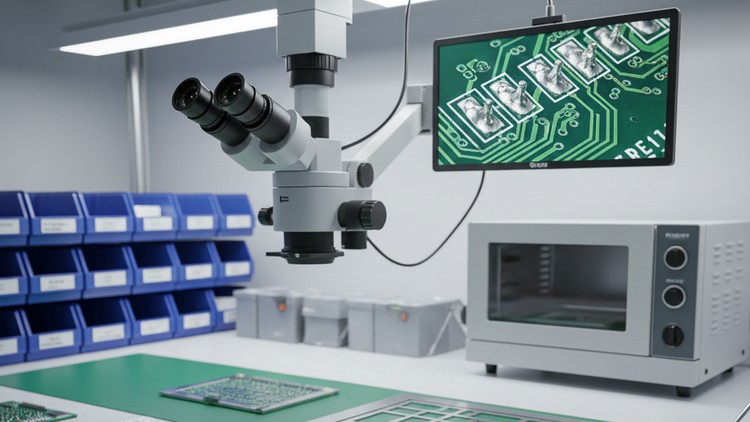
This course focuses heavily on industry-standard tools and methodologies. While it is an MCQ-based prep, it simulates the decision-making process you’d face at a high-magnification inspection station. You’ll learn to navigate the industry-standard tools of documentation and quality control. The primary “tool” here is the IPC manual itself, and the course teaches you how to weaponize it—finding the exact criteria for 1-1-1 through 1-1-12 in seconds.
The curriculum emphasizes job-ready skills such as identifying wetting angles, recognizing cold solder joints, and evaluating component alignment on land patterns. You’ll also get a deep dive into the criteria for PTH (Plating Through-Hole) and SMT (Surface Mount Technology), ensuring you can pivot between different real-world projects without missing a beat. It turns the theoretical “what” of the standards into the practical “how” of the inspection bench.
Career Benefits & Job Roles
Let’s talk money and career growth. In the current manufacturing climate, being a “good solderer” isn’t enough. Companies are looking for Certified IPC Specialists (CIS) who can guarantee quality and reduce rework costs. Completing this course puts you on the fast track for several high-demand roles:
- Quality Assurance (QA) Inspector: The primary gatekeeper for PCBA manufacturing.
- Manufacturing Engineer: Using these standards to optimize production lines and reduce defects.
- Production Supervisor: Leading teams with a definitive understanding of what constitutes a “shippable” product.
- SMT Process Technician: Fine-tuning industry-standard tools like pick-and-place machines based on inspection feedback.
This isn’t just about a certificate; it’s about acquiring job-ready skills that make you indispensable in a high-tech assembly environment.
Pros
- Highly Targeted Content: The MCQs are specifically designed to mimic the trickery of the actual IPC exam, focusing on the subtle differences between “Target” and “Acceptable” across different classes.
- Efficiency: It respects your time. If you already know your way around a board, you can breeze through the basics and spend more time on the complex hands-on labs-style logic puzzles.
- Confidence Building: The repetitive nature of the practice sets builds the “muscle memory” needed to handle the pressure of a timed certification exam.
- Focus on Logic: It teaches you the *why* behind the standards, which is much more valuable than simple rote memorization.
Cons
- Visual Fatigue: Because the course relies heavily on high-resolution images for inspection criteria, the sheer volume of “is this a defect?” questions can be mentally draining. I’d love to see more interactive 3D component models to break up the static 2D image sets.
Final take? If you’re serious about your career growth in electronics, don’t leave your certification to chance. This course is the grindstone you need to sharpen your skills and walk into that exam room with total confidence.