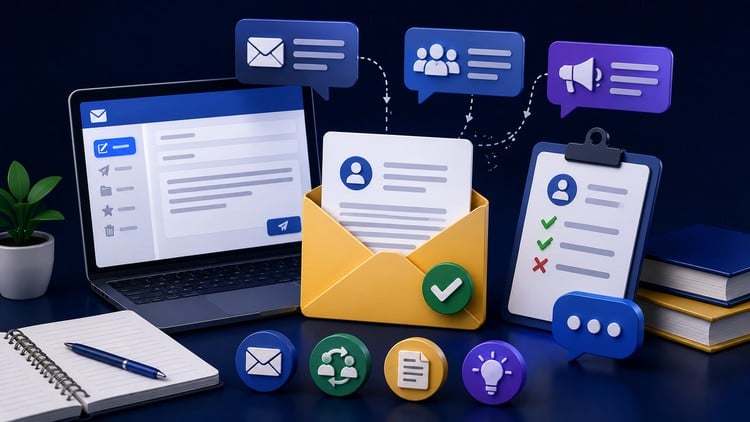
Master professional email writing, workplace communication, business etiquette, and practical communication tests
What You Will Learn:
- Understand professional email writing formats and workplace communication standards used in corporate environments
- Improve business communication skills for meetings, reporting, escalations, and professional conversations
- Identify common email writing mistakes and learn effective workplace communication practices
- Prepare for corporate interviews and workplace assessments related to communication and professional etiquette
My Raw Take on Professional Polish: Why Most Techies Fail the Inbox Test
Let’s be honest: most of us in the tech world would rather debug a legacy codebase for twelve hours than spend twenty minutes drafting a high-stakes email to a C-suite executive. I’ve seen brilliant developers and systems architects stall their career growth simply because their “soft skills” were anything but soft—they were non-existent. The ‘Corporate Email Writing & Business Communication Tests’ course isn’t your typical, dry English 101. It’s a tactical deep dive into the industry-standard tools and protocols that actually run the business side of technology.
What I appreciated most was the lack of fluff. This course focuses on job-ready skills that you can implement the second you log off. We’re talking about the nuances of professional email writing that separate the juniors from the seniors. In an era where “per my last email” is a passive-aggressive battle cry, learning how to handle escalations and reporting without burning bridges is a superpower. This course treats communication like a real-world project, providing a framework for business etiquette that feels more like an algorithm for success than a lecture on manners.
Prerequisites for Success
One of the best things about this curriculum is that it scales from beginner to advanced levels seamlessly. You don’t need a background in corporate communications to get started. All you really need is:
- A baseline proficiency in English (you don’t need to be a poet, just coherent).
- A willingness to unlearn those “text-speak” habits that creep into professional threads.
- Access to standard workplace tools like Outlook, Gmail, or Slack to practice your hands-on labs.
- An open mind toward certification prep and the rigor of professional communication tests.
The Toolkit: Skills & Tools You’ll Actually Use
This isn’t just about where to put a comma. The course dives into the industry-standard tools of the trade and the psychological mechanics of workplace interaction. By the time you finish the hands-on labs, you’ll have a grasp on:
- Mastering Email Formats: Learning the structural anatomy of an email that actually gets read by busy stakeholders.
- Meeting Etiquette: How to facilitate and contribute to meetings without wasting everyone’s time—a rare skill in today’s corporate climate.
- Escalation Management: The specific logic and templates needed to move a project forward when things go sideways.
- Interview Readiness: Using these job-ready skills to crush the behavioral and communication portions of corporate interviews.
- Conflict Resolution: Navigating professional conversations that could otherwise turn into HR nightmares.
Career Benefits & Job Roles: Moving Beyond the Keyboard
If you’re looking for a promotion, you need to realize that your technical output is only half the battle. Your visibility depends on your communication. This course is a massive catalyst for career growth across a variety of job roles, including:
- Project Managers: Who need to translate technical jargon into business value for clients.
- Software Engineers & Tech Leads: Who must communicate complex updates and escalations to non-technical departments.
- Business Analysts: For whom professional etiquette and clear reporting are daily requirements.
- HR and Operations: To set the standard for workplace communication within an organization.
The certification prep elements of the course ensure that you aren’t just “good at talking,” but that you meet the industry-standard benchmarks required by top-tier firms.
The Pros: Why This Course Hits the Mark
- Realistic Test Scenarios: The practical communication tests are the highlight. They don’t just ask you “what is a subject line?” They put you in the hot seat with real-world projects and scenarios that mimic a high-pressure office environment.
- Actionable Templates: You walk away with a library of professional email writing templates for everything from “I’m sick” to “This project is six months behind and it’s not my fault.”
- Holistic Approach: It covers the entire spectrum of business etiquette, including those awkward professional conversations that happen in the breakroom or on a Zoom call when the camera is off.
The Cons: An Honest Critique
If I have to be the “bad guy” here, the one drawback is the pacing for seasoned veterans. If you’ve been in a management role for ten years, some of the beginner to advanced transition might feel a bit slow during the introductory modules. The course spends a significant amount of time on basic workplace communication standards that some might find “obvious,” though, to be fair, seeing the state of my current inbox, clearly those “obvious” lessons haven’t been learned by everyone yet. Overlooking the basics is how most people fail, so while it can feel tedious, it’s probably a necessary evil for a comprehensive certification prep experience.