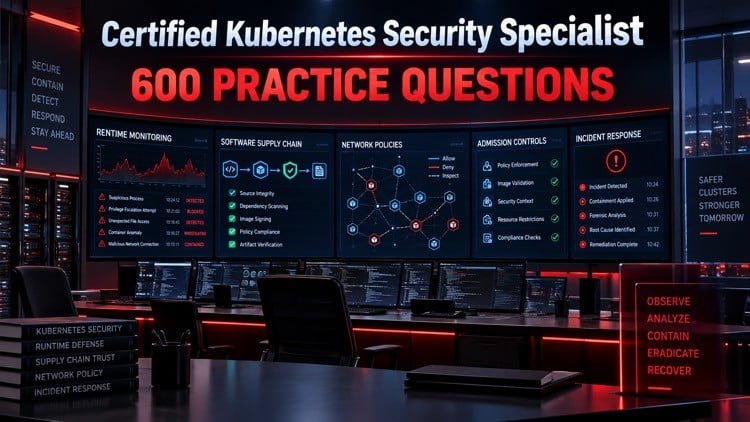
600 original CKS questions with detailed explanations for every answer option
What You Will Learn:
- Assess readiness across the current CKS exam objectives.
- Apply core CKS concepts to realistic exam-style scenarios.
- Explain why the correct answer fits and why each distractor does not.
- Use test results to build a focused revision plan before exam day.
The Realities of Taming the CKS Beast
Anyone who has spent time in the trenches of cloud-native orchestration knows that the Certified Kubernetes Security Specialist (CKS) is widely considered the “final boss” of the CNCF certifications. Unlike the CKA, which focuses on keeping the lights on, the CKS is about keeping the intruders out. I’ve seen plenty of seasoned engineers crumble under the time pressure of the exam, not because they didn’t know the commands, but because they didn’t understand the nuances of the security stack. That’s where the CKS Practice Exams: 600 Kubernetes Security Questions course enters the picture.
In my experience, most practice tests are either too shallow or lazily recycled from documentation. This course feels different. It doesn’t just ask you to identify a NetworkPolicy; it forces you to think like a security auditor. The sheer volume of 600 questions is, frankly, overkill—but in a good way. It creates a level of muscle memory for certification prep that moves you beyond rote memorization into actual conceptual mastery. You aren’t just looking for the right answer; you’re learning to spot the subtle misconfigurations that lead to cluster-wide compromises in real-world projects.
Prerequisites for Success
Before you even think about clicking “buy” on this course, let’s be clear: this isn’t a beginner to advanced bootcamp. You need to have your Certified Kubernetes Administrator (CKA) certification active and tucked under your belt. Without a fundamental understanding of how K8s handles scheduling, services, and storage, these security questions will feel like reading ancient Greek. You should also be comfortable with the Linux command line and basic YAML syntax. This course is designed for those ready to transition from general administration to a specialized security mindset.
Mastering the Modern Security Stack
The course goes deep into industry-standard tools that are currently dominating the DevSecOps landscape. You aren’t just learning Kubernetes native features; you’re diving into the ecosystem that supports it. Through these 600 questions, you’ll sharpen your skills in:
- Falco: Learning how to write and interpret runtime security rules to catch malicious behavior in real-time.
- Trivy: Mastering vulnerability scanning for container images before they ever reach your registry.
- Open Policy Agent (OPA) / Gatekeeper: Implementing fine-grained admission control to enforce organizational compliance.
- AppArmor & Seccomp: Hardening the underlying host and restricting what system calls your containers can make.
- Kube-bench: Auditing your cluster against CIS benchmarks to ensure your hands-on labs translate to hardened production environments.
Career Growth and Job Roles
Let’s talk money and career growth. Security is the highest-paying niche within the cloud-native ecosystem right now. Completing these practice exams prepares you for roles like Security Architect, DevSecOps Engineer, or Cloud Security Consultant. Companies aren’t just looking for people who can run a cluster; they are desperate for professionals with job-ready skills who can prevent data breaches that cost millions. By mastering these industry-standard tools, you position yourself as a high-value asset in a market that is increasingly focused on zero-trust architecture and supply chain security.
What This Course Gets Right
- The Power of the Distractor: My favorite part of this course is the explanation of the “wrong” answers. In the CKS, two options often look correct. This course explains the technical “why” behind every distractor, which is vital for building deep certification prep intuition.
- Scenario-Based Learning: These aren’t just “what is this flag?” questions. They are “here is a compromised pod, what is the first step?” scenarios. This mirrors the high-pressure environment of the actual exam and real-life incident response.
- Detailed Revision Logic: The results dashboard allows you to categorize your failures. If you are consistently failing Microservice Isolation questions, you know exactly where to focus your hands-on labs for the next week.
- Massive Question Bank: With 600 questions, you can take multiple practice runs without seeing the same content twice for a long time. It effectively prevents “memorizing the test” and forces actual learning.
The Honest Downside
If I have one gripe, it’s that the CKS exam itself is 100% performance-based (you’re in a terminal, not answering multiple-choice questions). While this course is incredible for certification prep and theoretical grounding, it cannot replace time spent in a real shell. Some students might get a false sense of security by acing these questions while still lacking the speed required to fix a broken Admission Controller in a live terminal under a 120-minute clock. Use this to build your knowledge, but don’t forget to keep your terminal open.