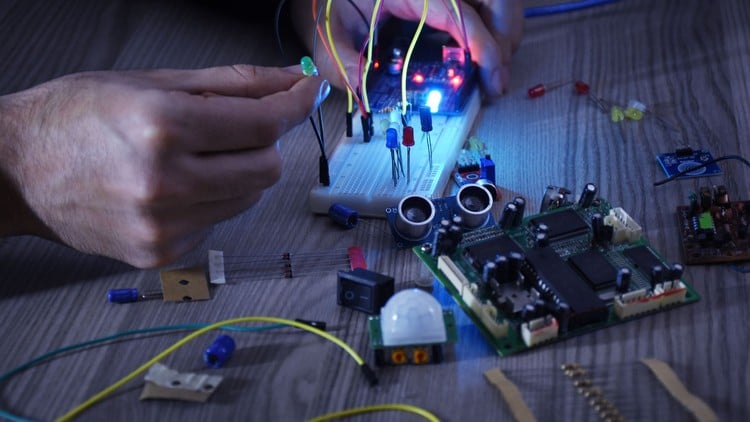
Master Arduino UNO Starting From Zero – Learn with Hands-on Activities and Many Arduino Projects.
⏱️ Length: 4.5 total hours
⭐ 4.33/5 rating
👥 45,472 students
🔄 June 2024 update
Add-On Information:
Note➛ Make sure your 𝐔𝐝𝐞𝐦𝐲 cart has only this course you're going to enroll it now, Remove all other courses from the 𝐔𝐝𝐞𝐦𝐲 cart before Enrolling!
- Course Overview
- Initiate your captivating journey into embedded systems and physical computing with the versatile Arduino UNO platform.
- Specifically designed for absolute beginners, this bootcamp transforms abstract electronic concepts into tangible, working projects.
- Embrace an intensive, hands-on learning approach, guiding you from zero prior knowledge to confident project creation.
- Discover the fundamental principles behind seamlessly integrating software code with electronic hardware.
- Cultivate invaluable problem-solving and critical thinking skills essential for innovative electronic development.
- Navigate a clear, step-by-step curriculum, ensuring even the most complex topics become easily approachable.
- Unleash your inherent creativity by empowering you to build practical, functional electronic prototypes.
- Gain a solid foundation that unlocks endless possibilities for personal projects and future technological exploration.
- Requirements / Prerequisites
- Zero Prior Experience: Absolutely no background in programming, electronics, or microcontrollers is needed to start this course.
- Basic Computer Literacy: Comfort with fundamental personal computer operations, including software installation and web browsing.
- Reliable Computer: Access to a desktop or laptop running Windows, macOS, or Linux, capable of running the Arduino IDE.
- Stable Internet Connection: Essential for downloading course materials, software, libraries, and accessing online support resources.
- Arduino UNO Kit: Requires an Arduino UNO development board, a breadboard, jumper wires, and basic components (e.g., LEDs, resistors, buttons).
- Enthusiastic Learner: The most crucial requirement is a genuine willingness to explore, experiment, and systematically troubleshoot your projects.
- Skills Covered / Tools Used
- Microcontroller C/C++: Master fundamental programming constructs like variables, loops, conditionals, and functions for Arduino sketches.
- Digital & Analog I/O: Learn to effectively control and read signals from various electronic components.
- Basic Circuit Design: Acquire the principles of building simple electronic circuits safely on a breadboard.
- Component Identification: Gain practical recognition and application skills for common components such as LEDs, resistors, buttons, buzzers, and potentiometers.
- Sensor Integration: Develop techniques for interfacing with diverse sensors to collect real-world data (e.g., light, temperature, distance).
- Actuator Control: Learn to program motors (servo/DC), relays, and other output devices to enable physical actions and responses.
- Pulse Width Modulation (PWM): Understand and generate analog-like effects digitally, such as dimming lights or controlling motor speed.
- Serial Communication: Effectively utilize the Arduino Serial Monitor for critical code debugging and seamless data exchange.
- Arduino IDE Mastery: Become proficient in efficiently using the development environment for writing, compiling, and uploading code.
- Prototyping Techniques: Acquire hands-on skills for rapid assembly and testing of electronic hardware designs.
- Debugging & Troubleshooting: Develop systematic methods to identify and resolve both hardware and software issues within your projects.
- Embedded Systems Logic: Gain a foundational understanding of the core operational principles of microcontrollers executing tasks.
- Power Management: Learn basic concepts for safely supplying power to your Arduino board and connected components.
- Libraries Management: Discover, install, and integrate external libraries to significantly enhance Arduino project functionality.
- Benefits / Outcomes
- Independent Project Development: By course completion, gain the confidence to conceptualize, design, and build your own electronic projects from scratch.
- Foundational Programming Skills: Acquire a strong base in C/C++ programming, a valuable skillset transferable to various embedded platforms.
- Practical Electronics Acumen: Develop a robust working understanding of how electronic components function and interact within circuits.
- Enhanced Problem-Solving: Sharpen your analytical and logical thinking abilities through hands-on project building and troubleshooting.
- Tangible Project Portfolio: Accumulate a collection of functional Arduino projects to proudly showcase your practical abilities.
- Gateway to Advanced Tech: Establish a solid springboard for exploring advanced fields like robotics, IoT, or professional embedded systems development.
- Hardware-Software Synergy: Deeply grasp the critical interaction and relationship between programmed code and physical hardware responses.
- Maker Community Ready: Equip yourself to actively participate and innovate within the vibrant global DIY electronics movement.
- Creative Empowerment: Transform imaginative ideas into functional, real-world devices and practical solutions.
- Technical Communication: Learn to effectively articulate project goals, component choices, and system functionalities.
- PROS
- Absolute Beginner Focus: Meticulously structured for individuals with no prior programming or electronics knowledge, ensuring a gentle and supportive learning start.
- High Student Satisfaction: A 4.33/5 rating from over 45,472 students undeniably confirms the course’s proven learning efficacy and positive user experience.
- Current & Relevant: Updated in June 2024, ensuring the curriculum utilizes the latest best practices, libraries, and tools available in Arduino development.
- Efficient Learning: At just 4.5 total hours, the course efficiently delivers substantial, actionable skills without unnecessary time commitment.
- Hands-on Immersion: A strong emphasis on practical activities and project building facilitates deep, experiential understanding and superior skill retention.
- Massive Community Endorsement: The sheer volume of enrolled students and positive experiences validates the course’s quality and teaching effectiveness.
- Solid Career Launchpad: Provides a robust foundational skillset for pursuing further technological education or entry-level embedded systems roles.
- Engaging Content: The course is specifically designed to keep learners motivated through practical, real-world applications and project-based learning.
- CONS
- Introductory Depth: While exceptionally thorough for beginners, this course primarily focuses on foundational concepts and practical application, and does not delve into highly advanced topics like real-time operating systems, complex data structures, or specialized microcontroller architectures often found in professional embedded systems development.
Learning Tracks: English,IT & Software,Hardware