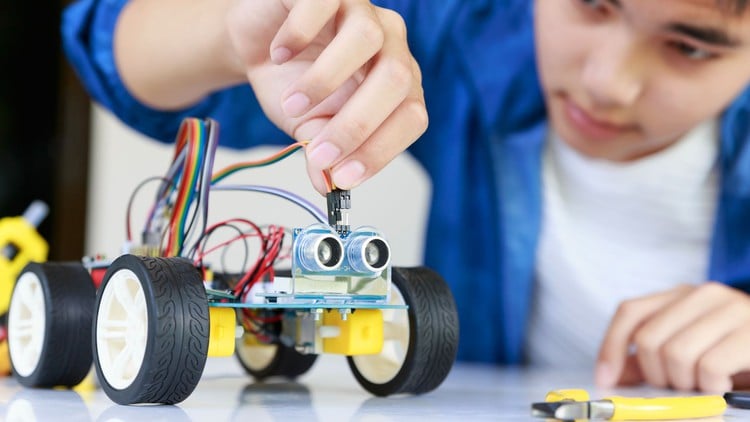
Learn To Create Arduino UNO Based Obstacle Avoiding Robot Car & RC-Control
⏱️ Length: 1.9 total hours
⭐ 4.24/5 rating
👥 38,555 students
🔄 May 2022 update
Add-On Information:
Note➛ Make sure your 𝐔𝐝𝐞𝐦𝐲 cart has only this course you're going to enroll it now, Remove all other courses from the 𝐔𝐝𝐞𝐦𝐲 cart before Enrolling!
-
Course Overview
- This concise course offers an exhilarating dive into practical robotics, focusing on building and programming intelligent robotic vehicles. You will engineer an Arduino UNO-powered robot car capable of autonomously avoiding obstacles and mastering remote-controlled operation. The curriculum demystifies embedded systems, integrating hardware assembly and software development into a seamless learning experience.
- Beyond component assembly, gain insights into how electronic modules communicate, transforming parts into a cohesive, functional machine. This project-centric approach empowers you to bring a robotic concept from idea to tangible reality. It’s an ideal launchpad for aspiring engineers, hobbyists, and anyone curious about electronics, programming, and automation, culminating in building your own intelligent robot car.
- Despite its compact 1.9-hour duration, the course is packed with essential information, guiding learners through a complete build process to a fully operational obstacle-avoiding and RC-controlled robot. High student ratings and impressive enrollment underscore its effectiveness and popularity as an accessible entry point into robotics.
-
Requirements / Prerequisites
- No Prior Experience Necessary: Designed for absolute beginners in programming and electronics. Basic computer operation is beneficial, but no prior coding or circuit design knowledge is required.
- Basic Computer Skills: Familiarity with navigating an operating system, downloading files, installing software, and using a text editor is essential for setting up Arduino IDE and coding.
- Required Hardware Components: Acquire readily available, affordable components: Arduino UNO board, chassis kit (wheels, DC motors), L298N motor driver, HC-SR04 ultrasonic sensor, breadboard, jumper wires, battery pack, and an RC transmitter/receiver module.
- Required Software: Install the free, open-source Arduino Integrated Development Environment (IDE) on your computer.
- Enthusiasm for Learning and Experimentation: A curious mind and willingness to troubleshoot, experiment, and learn through hands-on practice are invaluable for success.
-
Skills Covered / Tools Used
- Microcontroller Programming Logic: Develop fundamental C++ programming for Arduino IDE, including conditionals (
if/else), loops (for/while), and custom functions. - Digital and Analog I/O Control: Manage Arduino UNO’s digital/analog pins to interact with components, understanding signal differences for effective sensor reading and actuator control.
- Sensor Integration: Gain practical experience interfacing with an ultrasonic distance sensor (e.g., HC-SR04), interpreting raw data into meaningful distance measurements.
- Motor Control: Master driving DC motors using an H-bridge motor driver (L298N), controlling direction and implementing Pulse Width Modulation (PWM) for precise speed.
- Basic Robotics Fundamentals: Acquire foundational knowledge in mobile robotics: kinematics, autonomous obstacle avoidance strategies, and remote control principles.
- Circuit Prototyping: Develop proficiency in breadboard circuit building, component connections, wiring diagrams, and safe robot car assembly.
- Troubleshooting and Debugging: Cultivate problem-solving skills to diagnose and resolve hardware and software issues through systematic debugging.
- Tools Utilized: Primary software: Arduino IDE. Hardware: Arduino UNO, breadboard, jumper wires, multimeter (recommended), basic assembly tools.
- Microcontroller Programming Logic: Develop fundamental C++ programming for Arduino IDE, including conditionals (
-
Benefits / Outcomes
- Hands-On Robotics Engineering Experience: Construct a fully functional robot car (obstacle-avoiding and RC-controlled), providing a tangible project to showcase new skills.
- Enhanced Problem-Solving and Critical Thinking: Develop analytical skills by troubleshooting wiring, debugging code, and optimizing robot behavior.
- Solid Foundation in Embedded Systems: Understand microcontroller-component interfacing, serving as a springboard for IoT, home automation, and advanced robotics.
- Confidence in Hardware-Software Integration: Gain confidence in bridging physical electronics and digital programming, bringing digital instructions to physical life.
- Pathway to Advanced Learning: Acts as a gateway to explore complex topics in robotics, AI, mechatronics, and autonomous systems with fundamental knowledge.
- Practical Application of Concepts: Witness immediate, real-world application of sensor data processing, motor control, and programming logic, making learning engaging and relevant.
- Creative and Innovative Mindset: Empower creativity by designing and implementing functionalities, encouraging innovation in robotic solutions.
- Showcasing a Portfolio Project: Conclude with a demonstrable project for your portfolio, validating practical skills in robotics and embedded programming.
-
PROS
- Highly Practical, Project-Based: Build a tangible, working robot from day one, fostering engagement and concrete understanding.
- Excellent for Beginners: Systematically introduces concepts, making them digestible without prior electronics or coding experience.
- Dual Functionality: Covers both autonomous obstacle avoidance and remote control within one comprehensive project.
- Affordable Component Cost: Uses widely available, inexpensive Arduino components, accessible to a broad audience.
- Strong Community Support: Benefits from the extensive Arduino ecosystem with online resources and a global community.
- High Student Satisfaction: A 4.24/5 rating from over 38,000 students attests to its quality and effectiveness.
- Quick and Engaging: Delivers a complete project efficiently (1.9 hours), providing rewarding accomplishment.
-
CONS
- Limited Depth for Advanced Topics: Due to its introductory nature and condensed duration, the course may not delve deeply into the theoretical underpinnings or advanced optimization techniques for robotics or microcontroller programming.
Learning Tracks: English,IT & Software,Hardware