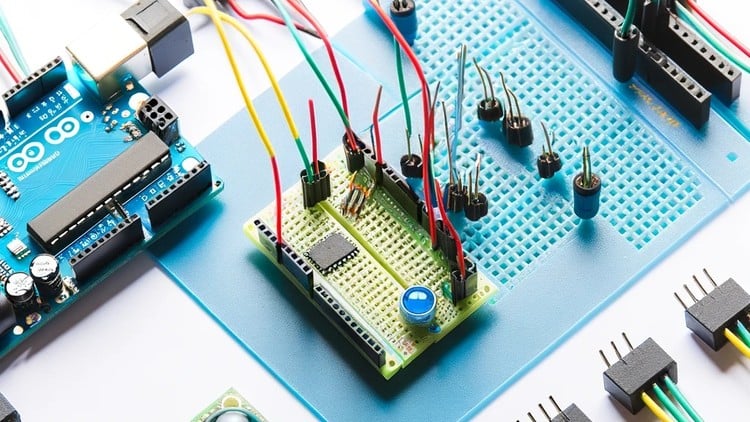
A Guide to start Your Own Arduino adventure in no Time, step by step practical exercises that will help you become Pro
⏱️ Length: 1.9 total hours
⭐ 4.17/5 rating
👥 15,962 students
🔄 June 2025 update
Add-On Information:
Note➛ Make sure your 𝐔𝐝𝐞𝐦𝐲 cart has only this course you're going to enroll it now, Remove all other courses from the 𝐔𝐝𝐞𝐦𝐲 cart before Enrolling!
-
Course Overview
- Kickstart Your Arduino Journey: A rapid, hands-on introduction to the world of Arduino, designed for complete beginners eager to build electronic projects.
- Practical, Step-by-Step Learning: Focuses on immediate application through practical exercises, transforming abstract concepts into functional prototypes.
- Demystifying Embedded Systems: Understand the fundamentals of how microcontrollers work and how Arduino simplifies complex hardware interactions.
- Efficient Skill Acquisition: Structured to deliver essential Arduino programming and hardware interfacing knowledge in a concise, impactful timeframe.
- Foundation for Innovation: Equips learners with the core skills to independently conceptualize, design, and implement their own creative electronic solutions.
-
Requirements / Prerequisites
- No Prior Experience Needed: This course is specifically designed for absolute beginners in both programming and electronics, assuming zero previous knowledge.
- Basic Computer Literacy: Familiarity with operating a personal computer (Windows, macOS, or Linux) for software installation and managing files is essential.
- Internet Connection: Required for downloading the Arduino IDE, any necessary libraries, and accessing all course materials, including updated content.
- Arduino Board (Highly Recommended): A physical Arduino board (e.g., Uno, Nano) and basic components (e.g., LEDs, resistors) are strongly encouraged for hands-on practice, though theoretical understanding can be gained without them.
-
Skills Covered / Tools Used
- Arduino IDE Mastery: Navigate and effectively utilize the Arduino Integrated Development Environment for writing, compiling, and uploading your code.
- Core Embedded C/C++ Programming: Grasp fundamental syntax including variables, data types, control flow structures (if/else, loops), and functions tailored for microcontrollers.
- Digital I/O Control: Learn to manipulate digital pins for controlling output devices like LEDs and accurately reading inputs from physical buttons and switches.
- Analog Sensor Interfacing: Understand how to work with analog signals to read continuous inputs from various sensors, such as potentiometers and light-dependent resistors.
- Pulse Width Modulation (PWM) Implementation: Discover and apply PWM techniques for generating analog-like outputs, enabling control over brightness (LEDs) or motor speeds.
- Serial Communication for Debugging: Effectively utilize the Serial Monitor for sending data, receiving real-time feedback, and systematically troubleshooting your Arduino programs.
- Basic Circuit Prototyping on Breadboards: Develop essential skills in safely assembling and testing temporary electronic circuits using breadboards.
- Introduction to Component Selection: Gain familiarity with common electronic components, their basic functions, and how to appropriately integrate them into Arduino projects.
- Understanding Arduino Libraries: Learn the concept and practical application of external libraries to extend Arduino’s functionality and simplify complex tasks.
-
Benefits / Outcomes
- Independent Project Development: Gain the confidence and technical ability to design and build your own custom Arduino-based electronic devices from scratch.
- Rapid Prototyping Expertise: Acquire the skill to quickly translate abstract ideas into working prototypes, making you proficient in the iterative design process with Arduino.
- Gateway to Advanced Platforms: Establish a robust foundational understanding for exploring more complex microcontrollers, Internet of Things (IoT) devices, and advanced embedded systems development.
- Enhanced Problem-Solving Skills: Develop a systematic and logical approach to diagnosing and resolving both hardware and software issues commonly encountered in embedded projects.
- Practical Electronics Fundamentals: Beyond just coding, acquire tangible knowledge of how various electronic components interact and contribute to functional circuits.
- Portfolio-Ready Basic Skills: Accumulate a set of tangible, demonstrable skills that can be showcased for educational pursuits, hobby groups, or entry-level tech discussions.
- Community Engagement Readiness: Be well-prepared to understand discussions and actively participate in the vast open-source Arduino community and online technical resources.
- Ignite Creativity and Innovation: Unlock your potential to invent, experiment, and bring imaginative electronic concepts and solutions to life with practical applications.
-
PROS
- Highly Practical Approach: The course emphasizes hands-on exercises and real-world applications, ensuring concepts are directly translated into tangible skills.
- Excellent for Beginners: Specifically designed for individuals with zero prior programming or electronics experience, offering a smooth and accessible entry point into Arduino.
- Time-Efficient Learning: Delivers core, essential Arduino knowledge and practical skills in a remarkably concise 1.9-hour format, perfect for quick learners seeking immediate application.
- Recently Updated Content: Benefits from a June 2025 update, guaranteeing relevant and up-to-date information, tools, and best practices in Arduino development.
- Strong Student Satisfaction: A high rating of 4.17/5 from nearly 16,000 students indicates effective teaching, quality content, and positive learning outcomes.
- Step-by-Step Guidance: The structured, methodical approach ensures learners can easily follow along and progressively build confidence and competence.
-
CONS
- Introductory Depth for “Everything”: While providing a solid foundational kickstart, the course’s brief 1.9-hour duration inherently means it offers an overview rather than deep, exhaustive mastery of every advanced facet of Arduino programming and embedded electronics.
Learning Tracks: English,IT & Software,Hardware