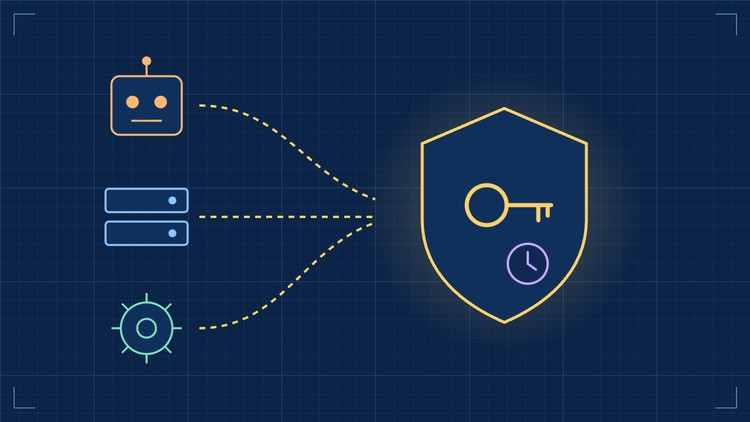
Find, scope, rotate and revoke the keys, tokens and service accounts behind AI agents, with free labs on your laptop
What You Will Learn:
- Classify non-human identities and explain how AI agents differ from classic service accounts
- Build an NHI inventory with an owner, purpose and expiry for every key, token and account
- Find leaked secrets in git history with gitleaks and TruffleHog, and revoke instead of delete
- Replace static keys with short-lived OpenBao tokens and workload identity federation
- Delegate to agents safely with OAuth token exchange, the act claim and key-bound tokens
- Apply the MCP authorization rules: audience checks, no token passthrough, per-client consent
- Rotate, revoke and offboard credentials, then detect misuse with JSON logs, jq and Python
- Run a credential incident playbook end to end in a local capstone drill
The Unfiltered Reality of NHI Security
Let’s be honest: most of us have spent years obsessing over human access—MFA, phishing training, and password policies—while the “back door” has been left wide open. In my experience across various dev teams, the number of service accounts and API tokens usually outnumbers human users by five to one. With the sudden explosion of AI agents, that ratio is going nuclear. This course, “Non-Human Identity Security: Secrets, Tokens and AI Agents,” is a refreshing, no-nonsense deep dive into what I consider the most neglected frontier in modern cybersecurity.
The core insight here isn’t just “don’t hardcode keys.” We’ve known that for a decade. The real value is in the shift toward machine identity management as a distinct discipline. The course treats AI agents not just as another script, but as dynamic entities that need a sophisticated level of governance. It moves beyond the beginner to advanced spectrum by focusing on the messy, “real-world” lifecycle of a secret—from the moment it’s generated to the inevitable day it leaks and needs to be rotated without breaking production. This isn’t just theory; it’s about surviving an audit and preventing a massive breach.
What You Actually Need to Know First
This isn’t a “coding for absolute beginners” class. To get the most out of these hands-on labs, you should be comfortable in a terminal and have a basic understanding of how APIs talk to each other. If you’ve ever dealt with a 401 Unauthorized error or struggled with a `.env` file, you’re ready. Familiarity with basic Git workflows and a little bit of Python will help you breeze through the automation sections. However, the course does a great job of explaining the underlying logic of industry-standard tools, so even if you aren’t a senior dev, you won’t feel left behind.
The Toolkit and Hard Skills You’ll Build
The curriculum is packed with job-ready skills that directly translate to high-level security engineering roles. You aren’t just reading slides; you’re performing real-world projects on your own machine.
- Secret Discovery & Remediation: Using gitleaks and TruffleHog to scan histories and understanding why “delete” is a dangerous myth compared to “revoke.”
- Workload Identity: Moving away from long-lived static keys and implementing OpenBao (the community-driven fork of Vault) and OIDC-based Workload Identity Federation.
- AI Agent Governance: Mastering the Model Context Protocol (MCP) to ensure AI agents aren’t just passing high-privilege tokens around like candy.
- Automation & Monitoring: Using jq and Python to parse JSON logs, which is vital for detecting credential misuse before it hits the news.
- Incident Response: The capstone drill is essentially a certification prep for real-life emergencies, teaching you how to run a credential incident playbook under pressure.
Career Growth and Market Demand
If you look at recent high-profile breaches, the culprit is almost always a leaked service account or an over-privileged token. Mastering NHI security is a massive boost for career growth. We are seeing a new wave of job roles like Identity Architect, Cloud Security Engineer, and DevSecOps Lead where these skills are non-negotiable. Being the person who knows how to properly scope an OAuth token exchange or implement the act claim for agent delegation makes you incredibly valuable in a market that is currently terrified of AI-driven data leaks.
What I Loved (The Pros)
- Practical Local Labs: I’m a huge fan of the “lab on your laptop” approach. You don’t need a complex AWS environment that costs you $50 in accidental egress fees to learn these concepts.
- Modern Tooling: The focus on OpenBao and MCP shows the creators are paying attention to the current landscape. This isn’t recycled 2018 content.
- Focus on Logic over Syntax: The course teaches you why you should use short-lived tokens, which is more important than just memorizing a CLI command.
- The Capstone Drill: Most courses end with a quiz. This ends with a simulated fire. It’s the best way to ensure the skills actually stick.
The Honest Downside (The Con)
The only real gripe I have is the pace of the AI agent section. Because the Model Context Protocol (MCP) and AI agent frameworks are evolving almost weekly, some of the specific library versions in the labs can feel a bit “bleeding edge.” You might find yourself doing a bit of extra troubleshooting if a new version of a tool drops mid-course. It’s a small price to pay for being at the forefront of the field, but it can be frustrating if you expect a perfectly curated, static environment.
In summary, if you want to move beyond basic user management and tackle the actual “engine room” of modern infrastructure, this course is an essential investment in your career growth.