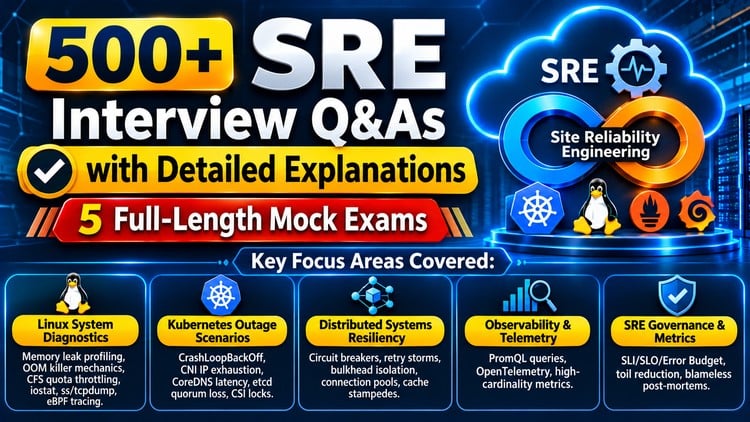
500+ SRE interview Q&As with detailed explanations covering Linux kernel, K8s outages, SLOs, and incident response.
What You Will Learn:
- Master 500+ scenario-based SRE interview questions covering Linux diagnostics, Kubernetes outages, distributed systems, and incident response
- Diagnose live production incidents, kernel resource starvation, network drops, storage deadlocks, and cascading microservices failures.
- Formulate SRE operational metrics including SLIs, SLOs, Error Budgets, toil reduction strategies, and blameless post-mortem frameworks.
- Pass technical screens, live CLI debugging rounds, and SRE system design interviews for senior SRE and Platform Engineering roles.
The SRE Reality Check: More Than Just a Question Bank
Let’s be honest: the Site Reliability Engineering (SRE) interview landscape has changed. Gone are the days when knowing the difference between a Process and a Thread would land you a six-figure offer. Today, if you’re gunning for a Senior SRE or Platform Engineering role at a Tier-1 tech firm, you’re expected to debug a kernel panic or a distributed system deadlock in real-time while a hiring manager breathes down your neck. I recently dove into the ‘500+ SRE Interview Q&As with Detailed Explanations’, and I wanted to share my take on whether it actually prepares you for the “trial by fire” that is the modern technical screen.
What struck me immediately is that this isn’t just a list of definitions. It’s more of a real-world project simulation in text form. The industry is currently obsessed with “scenario-based” interviewing. They don’t want to hear that you know what an SLO is; they want to know how you’d handle an Error Budget depletion when the product manager is screaming for a new feature release. This course acts as a bridge between theoretical knowledge and job-ready skills by forcing you to think like an operator under pressure. It’s opinionated, occasionally grueling, and exactly what the market looks like right now.
Prerequisites: Who Should Actually Buy This?
While the course claims to cover beginner to advanced levels, I’d argue you need a solid baseline to get the most out of it. If you don’t know your way around a Linux terminal or haven’t ever touched a YAML file, the sections on Kubernetes outages will feel like reading Greek.
Ideally, you should have a fundamental grasp of TCP/IP networking, basic Python or Go for automation, and at least some exposure to container orchestration. This isn’t a “How to Code” course; it’s a career growth tool for those who already have the foundations but lack the high-level diagnostic intuition required for senior-level roles. If you’re transitioning from traditional SysAdmin work into SRE, this will be your roadmap, but expect to do some heavy googling on the side.
Mastering the Tools of the Trade
The curriculum is heavy on industry-standard tools and the underlying mechanics that make them break. You won’t just learn about Kubernetes (K8s); you’ll learn why a Persistent Volume Claim (PVC) might get stuck in a pending state or how a sidecar injection failure can take down an entire namespace.
- Linux Kernel & Systems Programming: Deep dives into eBPF, cgroups, and resource starvation (CPU/RAM).
- Observability Stack: Using Prometheus and Grafana to identify cascading failures before they turn into outages.
- Infrastructure as Code (IaC): Troubleshooting state locks in Terraform and configuration drift.
- Incident Response: Practical application of blameless post-mortems and the psychological side of on-call rotations.
Career Benefits & Job Roles
If you’re looking for certification prep, this is a solid supplement for the CKA (Certified Kubernetes Administrator) or even Google Professional Cloud DevOps Engineer exams. However, its real value lies in the “Live CLI” rounds. Many companies now use “Bring Your Own Debugger” style interviews where you’re dropped into a broken environment.
By internalizing these 500+ scenarios, you develop a mental library of failure patterns. This is what separates a $120k engineer from a $250k engineer. You start seeing distributed systems as a collection of interconnected failure points rather than a black box. Potential job roles after mastering this material include Infrastructure Engineer, Cloud Architect, Reliability Lead, and of course, DevOps Specialist.
The Pros: Why It Stands Out
- Depth of Scenarios: It covers the “weird” stuff—storage deadlocks and network drops that only happen at scale. It prepares you for the questions that aren’t on the first page of Google.
- Operational Logic: It teaches you how to think about SLIs and SLOs from a business perspective, making you a more valuable asset to the non-technical stakeholders.
- Hands-on Labs Mentality: Even though it’s a Q&A format, the explanations are so detailed that they feel like hands-on labs. You can practically see the terminal output in your head.
- No Fluff: It skips the generic HR talk and gets straight into the technical meat, which is a breath of fresh air in an era of bloated certification prep courses.
The Cons: The Honest Truth
The biggest drawback is the sheer volume of information. Without a structured study plan, 500+ questions can feel overwhelming. It lacks a built-in interactive sandbox or real-world projects environment where you can physically break things while you learn. You’ll have to be disciplined enough to spin up your own Minikube or AWS instance to test these scenarios yourself if you want the knowledge to truly stick.
In short: it’s an incredible repository of wisdom, but it requires a high degree of self-motivation to get through it without burning out. Regardless, for anyone serious about SRE career growth, this is one of the most comprehensive “cheat codes” available today.