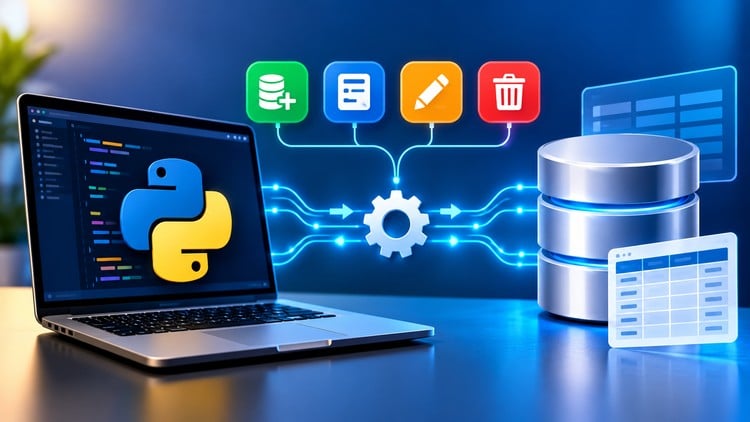
Learn Python Database Connectivity with SQLite, SQL, CRUD Operations, Transactions, Exception & Real-World Projects
What You Will Learn:
- • Understand the fundamentals of Python Database Connectivity
- • Connect Python applications with SQLite databases
- • Use Python’s built-in sqlite3 module
- • Create databases and tables using Python
- • Insert records into database tables
- • Retrieve data using SQL SELECT queries
- • Use fetchone(), fetchmany(), and fetchall()
- • Update existing database records using Python
- Show more
Moving Beyond Volatile Data: Why This Course Matters
Let’s be honest: you can write the most elegant Python scripts in the world, but if your data disappears the moment you close your terminal, you’re not building a product—you’re just playing with a calculator. In my years working across the stack, I’ve seen countless developers hit a wall when they try to move from beginner to advanced levels because they treat data persistence as an afterthought. This course on Python Database Connectivity is, in my opinion, the bridge between being a “scripter” and becoming a legitimate software engineer.
What I appreciate about this specific curriculum is that it doesn’t just throw syntax at you. It tackles the industry-standard tools like the sqlite3 module in a way that feels organic. SQLite is often unfairly dismissed as a “lite” tool, but for local development, mobile apps, and rapid prototyping, it’s the gold standard. The course does a great job of explaining the plumbing—how Python actually talks to a database file—without making your head spin with unnecessary DBA jargon. It focuses on job-ready skills by emphasizing the lifecycle of a connection, which is where most juniors mess up by leaving connections open or mishandling cursors.
The transition from manual data entry to real-world projects that automate CRUD operations (Create, Read, Update, Delete) is where the “lightbulb moment” usually happens. By the time you get to the transactions and exception handling sections, you’re no longer just writing code; you’re building resilient systems. If you’re looking for a no-nonsense path to understanding how data lives and breathes within a Python environment, this is a solid investment in your career growth.
What You Need Before Diving In
You don’t need a PhD in computer science to get started, but you shouldn’t go in blind. To get the most out of the hands-on labs, I recommend having the following under your belt:
- Core Python Logic: You should be comfortable with variables, lists, dictionaries, and especially loops. If you don’t know how to iterate through a list, handling fetchall() results will be confusing.
- Basic File Handling: Understanding how Python interacts with the local file system helps, as SQLite databases are essentially specialized files.
- A Logical Mindset: Database work is 10% coding and 90% logic. If you can visualize how tables relate to one another, you’re already halfway there.
The Toolkit: Skills & Industry Tools
This isn’t just a “watch and repeat” type of course. You’ll be working with a suite of tools that are used in certification prep and actual production environments:
- The sqlite3 Module: Python’s built-in powerhouse for database interaction. No external installations required, which is a huge plus for beginners.
- SQL (Structured Query Language): You’ll learn the bread and butter of data—SELECT, INSERT, UPDATE, and DELETE. These skills are 100% transferable to PostgreSQL, MySQL, and SQL Server.
- Database Cursors: Learning how to use cursors to navigate through result sets using fetchone() and fetchmany().
- Transaction Management: Understanding commit() and rollback()—crucial for maintaining data integrity and preventing “zombie” data entries.
- Exception Handling: Using try-except blocks specifically for database errors, which is a vital job-ready skill for any backend developer.
Career Benefits & Job Roles
Mastering Python database connectivity is a massive catalyst for career growth. Data is the new oil, and people who know how to pump it are in high demand. Completing this course and building the real-world projects included will prepare you for roles such as:
- Backend Developer: Every modern web app needs a database. Period.
- Data Engineer: You’ll have the foundation to build ETL (Extract, Transform, Load) pipelines.
- Automation Specialist: Move beyond CSV files and start storing your automation logs and results in structured databases.
- Junior Full-Stack Developer: Being able to handle the “back of the house” makes you a much more versatile hire.
The Pros: Why This Course Stands Out
- Zero-Config Setup: Using SQLite means you don’t have to spend three hours configuring a server before you write your first line of code. It’s the ultimate beginner to advanced gateway.
- Focus on Security: The course touches on parameterized queries, which is the only way to prevent SQL injection—a must-know for anyone serious about industry-standard tools.
- Practicality Over Theory: The hands-on labs ensure you aren’t just watching videos. You are actually building the tables and querying them yourself.
- Transferable Knowledge: The logic you learn here applies to almost every other Relational Database Management System (RDBMS) you’ll encounter in your career.
The Reality Check: One Honest Con
If I’m being completely transparent, the course leans heavily on SQLite. While SQLite is fantastic for learning and small-scale real-world projects, it doesn’t cover the complexities of user permissions or concurrent “heavy-lifting” that you’d find in a multi-user environment like PostgreSQL or Oracle. If your goal is to manage massive, enterprise-scale server clusters immediately, you’ll eventually need to take a follow-up course specifically on client-server database architectures. However, for 90% of developers starting out, what’s taught here is exactly what you need to get your foot in the door.