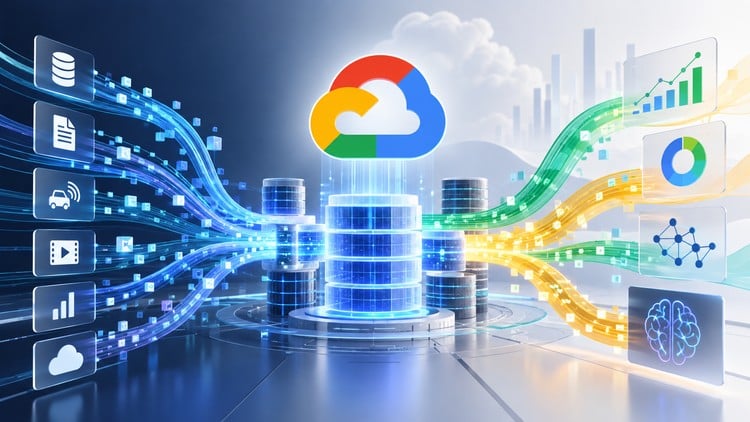
Prepare with confidence and pass your GCP Professional Data Engineer with scenario-based & realistic questions & explain
What You Will Learn:
- Data Processing Systems: Designing streaming and batch pipelines using Cloud Dataflow (Apache Beam), Cloud Dataproc (Spark/Hadoop), Cloud Data Fusion
- Storage and Warehousing: Choosing and optimizing storage solutions including BigQuery, Bigtable, Cloud Spanner, Cloud SQL, and Cloud Storage.
- Data Pipelines & Orchestration: Automating and managing robust workflows with Cloud Composer (Apache Airflow) and Workflows.
- Machine Learning & AI Integration: Understanding the data requirements for Vertex AI, BigQuery ML, and feature store pipelines.
- Security, Compliance & Governance: Implementing IAM, data masking, encryption (CMEK/CSEK), Cloud DLP, and Dataplex/Data Catalog governance.
- Performance Tuning & Cost Optimization: Partitioning, clustering, BigQuery slot management, and high-throughput ingestion strategies.
- Show more
The Real Deal on Prepping for the GCP Professional Data Engineer Exam
Look, I’ve been in the data trenches for over a decade, and if there is one thing I’ve learned, it’s that a GCP Professional Data Engineer certification isn’t just another digital badge to collect for your LinkedIn profile. It is arguably one of the most grueling exams in the cloud ecosystem. Why? Because Google doesn’t care if you know what a button does; they want to know if you can architect a resilient, cost-effective system when a streaming pipeline is failing at 3:00 AM. That’s where the GCP Professional Data Engineer Practice Exams | SEP 2026 package comes into play.
What sets these practice exams apart from the generic brain dumps you find in the darker corners of the internet is the “why” behind the “what.” This isn’t just about rote memorization. These exams are designed to break your brain in the same way the actual certification prep process should—by forcing you to choose between two “correct” answers where one is slightly more cost-optimized or performant. In the current market, job-ready skills are defined by your ability to navigate these nuances, not just your ability to follow a tutorial. This course acts as a simulation of the high-pressure environment you’ll face during the actual test, making it an essential final mile in your career growth journey.
What You Need Before Hitting ‘Start’
Don’t jump into these practice tests if you’ve never touched the Google Cloud Console. You’ll just end up frustrated. To get the most out of this, you should have a solid foundation in data engineering principles. Ideally, you’ve spent a few months playing around with hands-on labs or, better yet, working on real-world projects involving large-scale data migration or ETL/ELT processing. You need a baseline understanding of SQL (obviously) and a passing familiarity with Python or Java, as Apache Beam code snippets often make a guest appearance. This is a beginner to advanced bridge course; it assumes you know what a database is but helps you master when to use Bigtable versus Cloud Spanner.
Mastering Industry-Standard Tools
The curriculum covered in these exams hits every pillar of the modern data stack. You aren’t just learning tools; you’re learning the industry-standard tools that top-tier tech companies actually use. We’re talking about:
- BigQuery: Beyond simple queries, you’ll dive into partitioning, clustering, and managing slots for enterprise-level performance.
- Cloud Dataflow: Mastering the unified model for batch and streaming data processing.
- Vertex AI: Understanding how to bridge the gap between data engineering and Machine Learning operations (MLOps).
- Cloud Composer: Getting comfortable with Apache Airflow for complex workflow orchestration.
- Dataplex: Mastering data governance and centralized management across a distributed data lake.
Career Benefits and Job Roles
Let’s talk money and career trajectory. Passing the GCP Professional Data Engineer exam is a massive signal to recruiters that you understand the Cloud Data Lifecycle. This certification is a frequent requirement for high-paying job roles such as Senior Data Engineer, Cloud Architect, and Machine Learning Engineer. As companies migrate away from legacy on-prem systems to the cloud, the demand for professionals who can implement security and compliance (think Cloud DLP and CMEK) is skyrocketing. Investing in this course is essentially investing in your own marketability in a competitive tech landscape.
What I Liked (The Pros)
- Scenario-Based Complexity: The questions aren’t one-liners. They are mini-case studies that mirror the actual exam’s scenario-based format, testing your ability to solve architectural puzzles.
- Deep-Dive Explanations: Every answer comes with a comprehensive breakdown. Even if you get a question right, reading the explanation often reveals a performance tuning tip or a cost optimization strategy you hadn’t considered.
- Up-to-Date Content: With a “SEP 2026” target, the material includes the latest GCP updates, ensuring you aren’t studying deprecated features like the old AI Platform—you’re focused on Vertex AI and modern GenAI data requirements.
- Focus on Security: I appreciated the heavy emphasis on IAM roles and data masking, which are often the areas where most candidates trip up during the real exam.
The Reality Check (The Cons)
- The “Wall of Text” Fatigue: Because the questions are so realistic and detailed, taking a full-length practice exam can be mentally draining. It’s not a “fun” way to spend two hours, but then again, neither is the actual exam. It would be nice to have a “light mode” for quicker review sessions when you don’t have a full block of time.