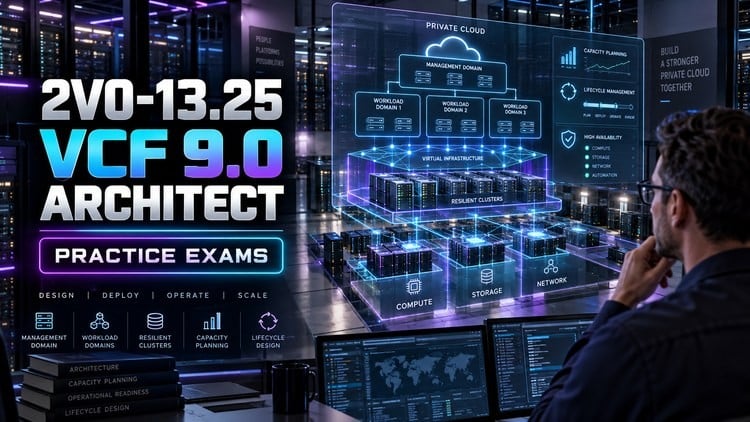
75 original scenario-based questions with detailed explanations for every answer option
What You Will Learn:
- Assess VMware Cloud Foundation architecture choices across management, workload, networking, storage, and lifecycle domains.
- Apply availability, scalability, security, and governance requirements to realistic VCF architecture scenarios.
- Identify supported design patterns and trade-offs for private cloud platform services and operations.
- Use detailed answer explanations to close knowledge gaps before the 2V0-13.25 exam.
Overview
Alright, let’s talk about the ‘2V0-13.25 VMware Cloud Foundation Architect Practice Exams’. If you’re eyeing that VCAP-CMA Design or the newer VCDX-CMA certification track, you know the 2V0-13.25 exam isn’t your average multiple-choice stroll in the park. This isn’t about memorizing definitions; it’s about architecting solutions under pressure. That’s precisely where these practice exams shine. Forget generic brain dumps. What we’ve got here are 75 meticulously crafted, scenario-based questions designed to push your understanding beyond theoretical concepts into practical application. The real gem? The deep-dive explanations for *every* answer option – not just the correct one. This isn’t just about getting the right answer; it’s about understanding *why* the other options are wrong, which is crucial for truly grasping complex VCF architectural decisions. It’s less a test and more a guided learning experience, pinpointing your exact knowledge gaps before you walk into the actual exam. Think of it as your personal architectural sparring partner, preparing you for the curveballs the real 2V0-13.25 will throw your way, solidifying your certification prep.
Prerequisites
Let’s be real, this isn’t for the faint of heart or the complete VCF novice. Before diving into these practice questions, you absolutely need a solid foundation. I’d strongly recommend having at least a couple of years of hands-on experience deploying and managing VMware Cloud Foundation environments. Ideally, you should hold a VCP-DCV or VCP-CMA certification, as that foundational knowledge is implicitly assumed. You’ll need to be comfortable with core components like vSphere, vSAN, NSX-T Data Center, and SDDC Manager. A good grasp of general networking principles (VLANs, routing, firewalls), storage concepts (shared storage, HCI), and security best practices within a virtualized environment is also non-negotiable. If you’re still figuring out what an SDDC is, or struggling with basic NSX concepts, hit the books and some hands-on labs first. This material is designed for someone who’s ready to think like an architect at an advanced level, not someone still learning the basics of how to rack a server. It’s a leap from beginner to advanced concepts, so come prepared.
Skills & Tools
Working through these practice exams isn’t just about passing the 2V0-13.25. It’s about sharpening a very specific set of job-ready skills critical for any cloud architect role. You’ll be honing your ability to dissect complex requirements – availability, scalability, security, governance – and map them directly to VCF’s capabilities. This means understanding the intricate dependencies between VCF’s management domain, workload domains, and underlying infrastructure components. You’ll become adept at identifying supported design patterns, recognizing anti-patterns, and most importantly, evaluating the inevitable trade-offs involved in real-world projects. The ‘tools’ here aren’t just software; they’re intellectual frameworks: critical thinking, problem decomposition, and systematic solution design using industry-standard tools like VMware Cloud Foundation itself. You’ll learn to speak the language of VCF architecture, from initial assessment to ongoing lifecycle management. It’s truly a leap from an operational mindset to a strategic, architectural one, emphasizing the practical application of theory.
Career Benefits & Job Roles
Earning the 2V0-13.25 certification, supported by the rigor of these practice exams, is a significant accelerator for your career growth. This isn’t just another badge; it validates your expertise in designing sophisticated private cloud platforms using VMware’s flagship HCI solution. This credential positions you perfectly for senior roles such as a VMware Cloud Foundation Architect, Cloud Solutions Architect, Principal Cloud Engineer, or a high-level Platform Engineer focusing on hyperconverged infrastructure. Companies are desperately seeking individuals who can architect, not just implement, robust, scalable, and secure cloud environments. This certification signals to employers that you can take complex business requirements and translate them into a coherent VCF design, ensuring optimal performance, cost-efficiency, and operational readiness. It’s a clear differentiator in a competitive market, demonstrating your mastery of one of the most critical enterprise cloud platforms today and enhancing your market value with validated job-ready skills.
Pros
- Authentic Scenario-Based Questions: These aren’t simplistic knowledge checks. The questions mirror the complexity and structure of the actual 2V0-13.25 exam, forcing you to apply architectural principles to realistic design challenges. This focus on “assess VMware Cloud Foundation architecture choices” is precisely what makes the real exam so challenging, and these practice questions prepare you for it exceptionally well.
- Comprehensive and Detailed Explanations: This is arguably the biggest selling point. Each answer option comes with a thorough explanation of why it’s correct or incorrect. This mechanism is invaluable for closing specific knowledge gaps and understanding the nuances of VCF design, ensuring you grasp the underlying principles rather than just memorizing answers.
- Wide-Ranging Topic Coverage: The practice exams meticulously cover all domains outlined for the 2V0-13.25 exam, including management, workload, networking, storage, and lifecycle domains. This ensures you’re prepared across the board for requirements like “availability, scalability, security, and governance” and helps identify areas where further study is needed, transforming potential weaknesses into strengths.
- Builds Confidence and Exam Strategy: By simulating the exam environment, these questions help you manage time effectively, reduce exam anxiety, and develop a strategic approach to tackling complex multi-choice questions. It’s like a dress rehearsal, ensuring you’re not caught off guard on exam day and that your certification prep is complete.
Cons
- No Direct Hands-On Component: While excellent for theoretical and design knowledge, these practice exams inherently lack a direct hands-on labs component. True mastery of VCF architecture often benefits immensely from deploying and troubleshooting solutions in a lab environment or through real-world projects. These practice questions are outstanding for intellectual preparation, but they can’t fully substitute for the muscle memory gained from direct interaction with the VCF stack, which some individuals might prefer as part of their learning process.