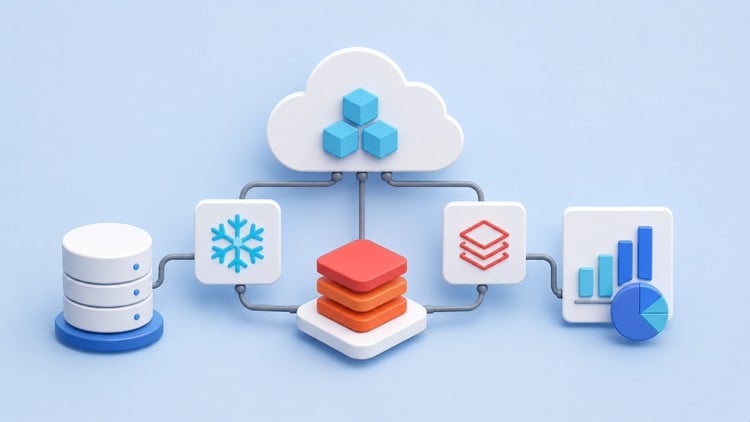
Ace your data engineering interviews with 200 realistic questions on Delta Lake, Snowpipe, and Spark Architecture.
What You Will Learn:
- Differentiate between traditional Data Lakes and modern Data Lakehouse architectures utilizing Databricks Delta Lake.
- Master Snowflake’s unique multi-cluster shared data architecture, understanding the separation of storage and compute.
- Architect continuous data ingestion pipelines using Snowflake Snowpipe and Databricks Structured Streaming mechanisms.
- Optimize massive datasets for querying performance by applying Delta Lake OPTIMIZE commands and Snowflake Micro-partitions.
Cutting Through the Hype: Why This Course Actually Matters
Listen, if you’ve spent any time on LinkedIn lately, you know the data world is currently obsessed with the “Snowflake vs. Databricks” rivalry. Most tutorials force you to pick a side, but in the actual trenches of Cloud Data Engineering, you rarely have that luxury. I’ve worked on projects where we used Databricks for the heavy-duty Spark Architecture processing and Snowflake as the gold-standard serving layer. This course, ‘Cloud Data Engineering: Snowflake & Databricks Exams,’ is one of the few resources I’ve found that actually treats these tools as a complementary ecosystem rather than enemies.
What caught my eye wasn’t just the promise of certification prep, but the focus on the “why” behind the “how.” It’s easy to click buttons in a UI; it’s much harder to explain to a hiring manager why you’d choose a Data Lakehouse architecture over a traditional warehouse during a high-pressure interview. This course focuses heavily on those architectural trade-offs. It bridges the gap between being a “tool operator” and becoming a true Cloud Architect. By focusing on 200 realistic questions, it forces you to think about edge cases—the kind that usually crash your ETL pipelines at 3:00 AM on a Sunday.
What You Need Before Diving In
I’ll be blunt: this isn’t a “learn to code from scratch” experience. If you don’t know your way around a basic SQL query or understand the difference between a Join and a Union, you’re going to feel underwater pretty quickly. To get the most out of these hands-on labs, you should have a solid grasp of:
- Foundational SQL: You need to be comfortable with complex queries and data manipulation.
- Basic Cloud Concepts: A general understanding of AWS, Azure, or GCP storage (like S3 or ADLS Gen2) is essential.
- Data Logic: You should understand the basic lifecycle of data—from raw ingestion to cleaned, curated tables.
- Python Basics: While not strictly mandatory for every section, having a bit of Python knowledge helps when navigating the PySpark components of Databricks.
The Modern Data Stack: Skills & Tools
The curriculum is a “greatest hits” of industry-standard tools. You aren’t just learning buzzwords; you’re getting into the guts of how big data actually moves across the wire. Throughout the modules, you’ll be working with:
- Databricks & Apache Spark: Mastering the Spark Architecture to handle distributed computing without losing your mind.
- Snowflake: Deep-diving into Micro-partitions and Zero-copy Cloning—features that make Snowflake a beast for concurrency.
- Delta Lake: Understanding the “Lakehouse” paradigm and how to bring ACID transactions to messy data lakes.
- Automation Tools: Using Snowpipe for automated ingestion and Structured Streaming for real-time data flow.
- Optimization Techniques: Learning when to use Z-Order indexing or Data Clustering to save your company thousands in compute costs.
Career Benefits & Job Roles
We’re currently in a market where “knowing a little bit of everything” doesn’t pay the bills. Specialization does. Completing this course puts you on a direct path toward career growth in high-paying niches. If you’re looking for job-ready skills, this is the blueprint. After finishing the material and the real-world projects, you’ll be qualified for roles such as:
- Data Engineer: Designing and maintaining the pipelines that power Business Intelligence.
- Analytics Engineer: Bridging the gap between raw data engineering and data science.
- Cloud Architect: Deciding which platforms an enterprise should invest in for their Data Infrastructure.
- Data Platform Engineer: Focusing on the DevOps side of data, ensuring scalability and security.
The Pros: Why It’s Worth Your Time
- Interview-Centric Design: The 200-question bank is a lifesaver. It doesn’t just ask “What is a Virtual Warehouse?”—it asks how you’d resize one to handle a specific workload spikes, which is exactly what technical recruiters want to hear.
- Dual-Platform Mastery: Most courses are siloed. Learning Snowflake and Databricks side-by-side allows you to see the strengths and weaknesses of each, making you a much more valuable consultant or employee.
- Focus on Optimization: I love that it emphasizes query performance. Anyone can write a query that works; writing one that doesn’t blow the budget is what gets you promoted.
- Practical Scenario-Based Learning: The labs feel like real-world projects. You aren’t just following a script; you’re solving problems that mimic actual Data Engineering bottlenecks.
The Cons: An Honest Critique
If I have one gripe, it’s that the pace from beginner to advanced is extremely fast. For a true novice, the transition from “What is a Data Lake?” to “Implementing Delta Lake OPTIMIZE commands” can feel like a vertical climbing wall. If you aren’t disciplined about doing the outside reading, you might find yourself memorizing the certification prep answers rather than truly absorbing the underlying architecture. I’d recommend slowing down in the Spark sections—distributed computing has a steep learning curve that no 700-word review can fully prepare you for.