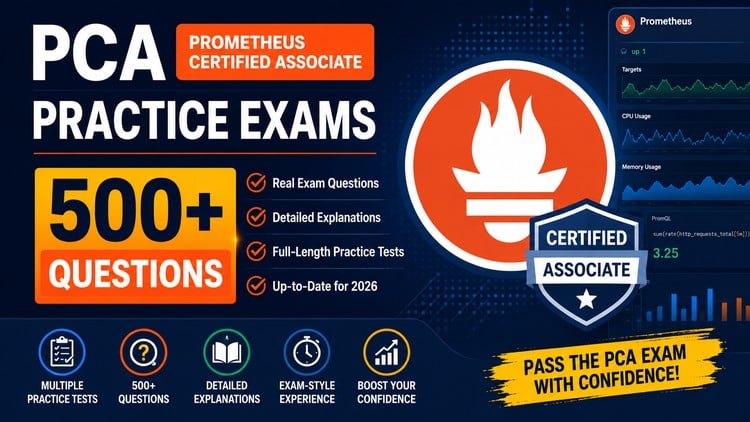
Prepare for the PCA exam with realistic practice tests, 500+ questions, and detailed explanations | Golden Kubestronaut
What You Will Learn:
- Assess your readiness for the Prometheus Certified Associate (PCA) certification exam.
- Practice with realistic, exam-style questions covering all PCA exam domains.
- Strengthen your understanding of Prometheus, PromQL, alerting, exporters, and monitoring concepts.
- Identify knowledge gaps through detailed explanations for every question.
- Build confidence and improve your chances of passing the PCA certification exam on your first attempt.
The Real Deal on the PCA Prometheus Practice Exams
Let’s be honest for a second: the Prometheus Certified Associate (PCA) isn’t just another checkbox on your LinkedIn profile. If you’ve spent any time in the DevOps trenches, you know that observability is the heartbeat of modern infrastructure. But studying for the exam? That’s a different beast entirely. I recently dove into the PCA Prometheus Practice Exam | 500+ Questions by Golden Kubestronaut, and I’ve got some thoughts. If you’re looking for a silver bullet, this is about as close as it gets, but you have to be willing to put in the work. This isn’t just about memorizing definitions; it’s about surviving the logic traps that the CNCF loves to set.
What struck me immediately is the sheer volume. We’re talking about 500+ questions spread across six full-length exams. In the world of certification prep, quantity usually sacrifices quality, but that’s not the case here. The questions feel like they were written by someone who has actually failed and then passed the exam—they hit those “gotcha” moments where you know the concept but get tripped up by the syntax. Whether you’re a seasoned SRE or a developer looking to round out your job-ready skills, these tests force you to think like a Prometheus engine.
Prerequisites for Success
Don’t just jump into these practice tests if you’ve never touched a YAML file. To get the most out of this resource, you should have a baseline understanding of industry-standard tools like Docker and Kubernetes. While the course covers the beginner to advanced spectrum, it assumes you aren’t allergic to a command line. You should ideally have spent some time with:
- A basic grasp of microservices architecture and why we monitor them.
- Familiarity with the Linux terminal (standard stuff for any cloud professional).
- Previous exposure to hands-on labs or a sandbox environment where you’ve at least installed Prometheus once.
- A healthy curiosity about how metrics differ from logs and traces.
If you’re coming in cold, use these exams as a diagnostic tool, but pair them with the official documentation so you don’t get overwhelmed by the PromQL logic early on.
Mastering the Tools and Skills
The core of this practice set revolves around mastering the “Prometheus way” of doing things. It’s not just about knowing what a Counter is; it’s about knowing when to use rate() vs. irate() and why that matters for your dashboarding accuracy. Through these 500+ questions, you’ll sharpen your skills in:
- PromQL: Building complex queries that actually make sense for real-world projects.
- Alertmanager: Understanding grouping, inhibition, and silencing—essentially, how to stop your phone from blowing up at 3 AM.
- Exporters and Service Discovery: How Prometheus finds targets in a dynamic environment like K8s.
- Architecture: The internal mechanics of the TSDB (Time Series Database) and how the scrapers function.
By the time you finish the sixth exam, these concepts stop being abstract theories and start becoming job-ready skills you can actually apply in a production environment.
Career Benefits and Job Roles
Let’s talk money and career growth. Every major enterprise is migrating to cloud-native stacks, and they are desperate for engineers who can do more than just “restart the pod.” Achieving the PCA certification signals to recruiters that you understand the telemetry of a system. This course prepares you for high-impact roles such as:
- Site Reliability Engineer (SRE): Where monitoring is literally half the job.
- DevOps Engineer: Integrating observability into the CI/CD pipeline.
- Cloud Architect: Designing resilient systems that are observable by default.
- Platform Engineer: Building the internal tooling that other developers use to monitor their apps.
Having “PCA Certified” on your resume, backed by the knowledge gained from these tests, significantly increases your leverage during salary negotiations.
What I Liked (The Pros)
- The Explanation Depth: This is the biggest win. Every question comes with a detailed breakdown of why the right answer is right and—more importantly—why the distractors are wrong. This is where the real learning happens.
- Exam Mimicry: The wording and the pressure of these tests closely mirror the actual CNCF environment. It builds the mental stamina you need for the real 90-minute gauntlet.
- Comprehensive Coverage: It doesn’t just stick to the easy stuff. It dives deep into Pushgateway, Node Exporter, and security configurations, ensuring no domain is left untouched.
The One Drawback (The Con)
If I have one gripe, it’s that this is strictly a practice exam suite. There are no video lectures or hands-on labs included in this specific package. If you’re the type of learner who needs a visual walkthrough before testing yourself, you’ll need to supplement this with a primary study guide or a video course. It’s a specialized tool for certification prep, not a one-stop-shop for someone who has never seen a metric before.