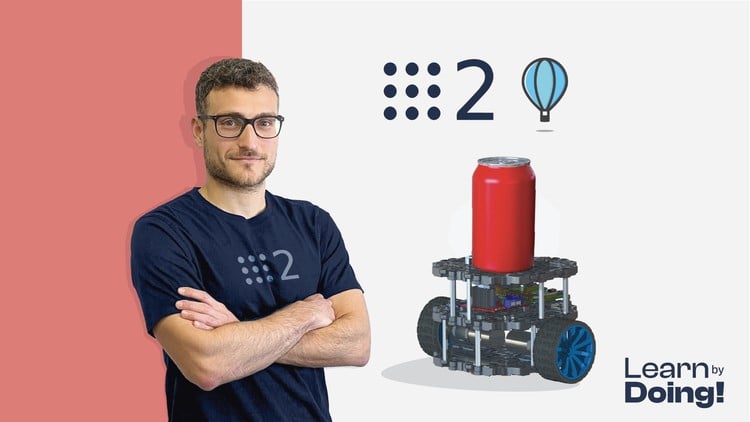
Create a ROS2 Self-Driving robot with Python and C++. Master Odometry, Control and Sensor Fusion using Kalman Filters
What You Will Learn:
- Create a Real Self-Driving Robot
- Mastering ROS2, the latest version of the Robot Operating System
- Implement Sensor Fusion algorithms
- Simulate a Self-Driving robot in Gazebo
- Programming Arduino for Robotics Applications
- Use the ros2_control library
- Develop a Controller
- Odometry and Localization
- Show more
Beyond the Simulation: A Deep Dive into ROS 2 Robotics
If you have spent any time in the robotics industry lately, you know that ROS 2 is no longer “the future”—it is the present. For those of us who cut our teeth on the original Robot Operating System, the transition to ROS 2 felt like moving from a sandbox to a high-performance engine. That is exactly where this course, “Self Driving and ROS 2 – Learn by Doing! Odometry & Control,” finds its sweet spot. It doesn’t just teach you how to write code; it teaches you how to think like a Robotics Engineer who has to deal with the messy, noisy reality of physical hardware.
What I found most refreshing about this curriculum is that it moves past the “hello world” scripts very quickly. We aren’t just moving a turtle on a screen. The course forces you to grapple with the industry-standard tools used in high-stakes real-world projects. From the jump, you are looking at the bridge between high-level software (Python/C++) and low-level hardware (Arduino). This “full-stack” approach to robotics is exactly what is missing from many academic-style programs. It’s an honest take on what it takes to build a robot that doesn’t just work in a vacuum, but functions reliably in an environment full of sensor noise and mechanical limitations.
Prerequisites for the Aspiring Engineer
This is a beginner to advanced journey, but don’t let the “beginner” tag fool you—you need to come prepared. If you want to get the most out of these hands-on labs, you should have a solid foundation in the following:
- Linux Fundamentals: You should be comfortable navigating the terminal and managing packages in Ubuntu.
- Programming Proficiency: A working knowledge of Python is essential, and a basic understanding of C++ will help you navigate the ros2_control components more effectively.
- Mathematical Intuition: You don’t need a PhD, but you shouldn’t be afraid of matrices or basic trigonometry. When you start implementing Kalman Filters, the math gets real.
- Basic Electronics: Knowing your way around a breadboard and an Arduino will make the hardware section much smoother.
Mastering Industry-Standard Skills & Tools
The course is packed with job-ready skills that align with what recruiters are looking for in the autonomous vehicle and warehouse automation sectors. You aren’t just “playing” with robots; you are mastering a professional tech stack:
- The ROS 2 Ecosystem: Extensive use of Gazebo for high-fidelity simulation and Rviz for data visualization.
- Control Theory: Implementing PID Controllers that actually manage the velocity and steering of a physical unit.
- State Estimation: Using Sensor Fusion (merging IMU data with encoder data) to solve the drift problem in Odometry and Localization.
- Modern ROS Frameworks: Deep dives into the ros2_control library, which is the gold standard for managing hardware interfaces in professional robotics.
- Embedded Integration: Bridging the gap between a micro-controller and a high-level OS using micro-ROS or custom serial bridges.
Career Benefits & Job Roles
In terms of career growth, this course acts as a massive portfolio builder. In an interview, being able to explain how you tuned a Kalman Filter to handle wheel slippage is worth more than a dozen theoretical certificates. It serves as excellent certification prep for those looking to validate their skills in the autonomous systems space. Completion of this course prepares you for roles such as:
- Robotics Software Engineer: Designing the middleware and node logic for autonomous platforms.
- Control Systems Engineer: Focusing on the Odometry and Control loops that keep the robot on its path.
- Perception and Localization Specialist: Working specifically on Sensor Fusion and EKF implementations.
- Autonomous Vehicle Operator/Tuner: Ensuring that the bridge between simulation and reality is seamless.
Why This Course Hits the Mark (The Pros)
- Bridge to Reality: Most courses stay in Gazebo. This course takes the leap into Arduino and real hardware, which is where the real learning happens.
- Modern Frameworks: The focus on ros2_control is a huge plus. Many older courses still use outdated methods; this keeps you at the cutting edge of industry-standard tools.
- Deep Dive into Noise: The sections on Sensor Fusion and Kalman Filters are explained with a practical intuition that makes complex math feel accessible and applicable to real-world projects.
- Portfolio-Ready Output: By the end, you have a functional, self-driving robot architecture that looks incredible on a GitHub profile.
The Honest Reality Check (The Cons)
- Hardware Dependency: To get the full 100% value out of this, you really need to buy the hardware. If you are on a tight budget and stay strictly in simulation, you’ll miss out on the “pain” of real-world physics (like friction and sensor jitter) that makes the hands-on labs so valuable. It can be a bit of an investment up front.