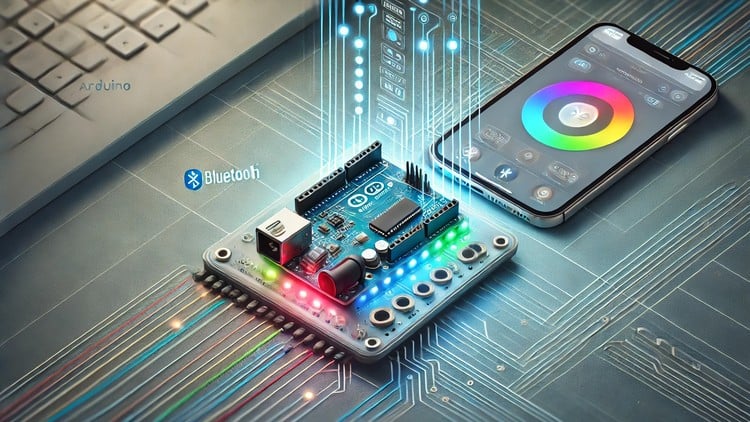
Learn to Interface Arduino with a Mobile App via Bluetooth and Master RGB Multicolor LED Control
⏱️ Length: 1.8 total hours
⭐ 3.37/5 rating
👥 7,636 students
🔄 June 2025 update
Add-On Information:
Note➛ Make sure your 𝐔𝐝𝐞𝐦𝐲 cart has only this course you're going to enroll it now, Remove all other courses from the 𝐔𝐝𝐞𝐦𝐲 cart before Enrolling!
- Course Overview
- This course offers an engaging, hands-on introduction to interactive electronics, culminating in a personalized Arduino Multicolor RGB LED Lamp controlled via Bluetooth. You’ll explore the synergy between hardware and digital control, orchestrating vibrant light patterns and custom color schemes. It’s a foundational project introducing core concepts of embedding intelligence into everyday objects, transforming a basic LED into a smartphone-controlled lighting fixture. The curriculum guides you through building a tangible product, demystifying microcontrollers and wireless communication, with immediate gratification as code translates into physical action.
- Embark on a creative exploration of light and color, understanding how digital signals generate visual outputs. This project serves as an excellent gateway into home automation, IoT, and interactive art, demonstrating how simple components create sophisticated user experiences. Emphasis is on practical skills, enabling you to construct, program, and interact with your own smart device. Gain insight into modern gadget communication, empowering you to move from technology consumer to creator. It’s an ideal starting point for anyone interested in making, electronics, or programming.
- Requirements / Prerequisites
- Basic computer literacy is beneficial; no prior experience in programming, electronics, or Arduino is required. The course starts with fundamental concepts, supporting beginners. An open mind and willingness to experiment are crucial, as hands-on projects involve iterative learning, fostering a solid understanding of hardware and software integration.
- Essential hardware includes an Arduino board (e.g., Uno R3), an RGB LED, a Bluetooth module (e.g., HC-05/06), a breadboard, various resistors, jumper wires, and a power supply. Software-wise, you’ll need a computer with the free Arduino IDE installed, and a smartphone (Android or iOS) for the Bluetooth control application. These readily available tools facilitate practical application.
- Skills Covered / Tools Used
- Master Hardware Prototyping Techniques: reading circuit diagrams, safe component connection, and efficient breadboard layout. Understand practical voltage, current, and resistance. Gain proficiency in Embedded C++ Programming for Arduino: developing structured code, utilizing libraries, and implementing logic for digital/analog outputs, building a strong embedded software foundation.
- Learn Pulse Width Modulation (PWM) for smooth color transitions and intensity control, enabling millions of colors and dynamic lighting effects. Delve into Serial Communication Protocols: understanding data exchange between Bluetooth and Arduino, vital for wireless control and IoT. Effectively use the Arduino IDE for writing, compiling, uploading code, and debugging.
- Explore Mobile Application Interaction: how smartphone apps send commands (e.g., color, brightness) and how Arduino interprets them. Develop strong Troubleshooting and Debugging Skills for hardware and software issues. Acquire fundamental Project Management Skills: breaking down complex projects from design to deployment, fostering a systematic technical approach.
- Benefits / Outcomes
- You will build a fully functional, smartphone-controlled RGB LED lamp, an impressive tangible project showcasing new skills. This prototype serves as a foundational piece for future smart home or interactive art projects, providing practical experience in full-stack interactive device development from circuit design to wireless communication, invaluable for aspiring electronics/IoT professionals.
- Gain a solid foundation in Arduino programming and electronics, building confidence to tackle diverse projects. Develop intuitive grasp of component interaction and efficient microcontroller coding. Enhance Problem-Solving and Critical Thinking Skills, engaging with wiring, code logic, and communication challenges. This iterative process fosters a resilient, analytical mindset applicable across many domains.
- This course acts as a springboard into advanced topics like IoT, custom PCB design, or mobile app development for hardware. You’ll grasp core smart device principles. Ultimately, foster Creative Expression through Technology, personalizing your lamp’s behavior and aesthetics, translating abstract ideas into physical realities through a rewarding blend of technical proficiency and creative freedom.
- PROS
- Highly Practical and Hands-On Learning: Builds a real-world, functional device, ensuring deep understanding through direct application.
- Excellent Introduction to IoT and Smart Devices: Provides an accessible entry point into controlling physical objects with digital interfaces.
- Visually Rewarding Project: Immediate and colorful feedback from the RGB LED lamp makes the learning process engaging and motivating.
- Develops Core Troubleshooting Skills: Learn essential debugging techniques for both hardware and software.
- Foundation for Future Projects: Concepts and techniques are highly transferable, equipping you for a wide range of more complex Arduino and electronics projects.
- CONS
- Limited Depth Due to Short Duration: The 1.8-hour total length, while efficient for a specific project, means advanced topics or extensive customization options might not be covered in significant detail.
Learning Tracks: English,IT & Software,Hardware