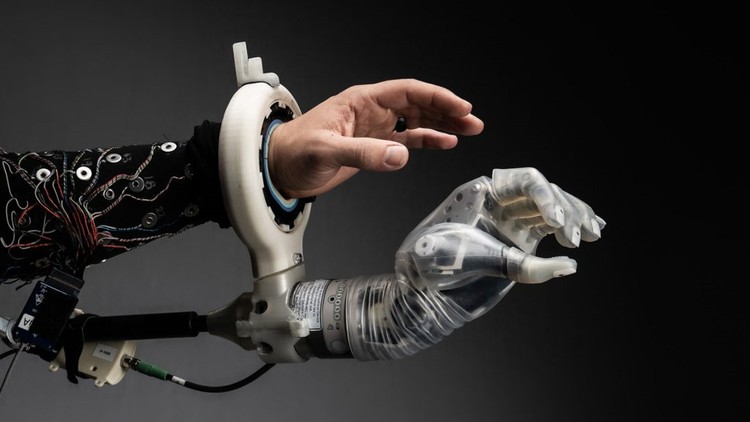
Fundamentals of Neural Recording, Neural Stimulation, & Brain-Computer Interfaces for Medical & Robotic Applications
What you will learn
Note➛ Make sure your 𝐔𝐝𝐞𝐦𝐲 cart has only this course you're going to enroll it now, Remove all other courses from the 𝐔𝐝𝐞𝐦𝐲 cart before Enrolling!
Learning objectives are listed categorically as software/hardware expertise, quantitative skills, critical thinking, biology knowledge, and scientific literacy
Software: filter noisy biological signals
Software: extract features from neuromuscular waveforms
Software: decode information from neural and electromyographic recordings
Software: implement an artificial neural network in MATLAB for real-time control
Software: control a robotic hand in real-time using biological recordings
Software: implement real-time bioinspired haptic feedback
Software: develop real-time functional electrical stimulation for assistive and rehabilitative tech
Hardware: describe how to implement various electrophysiology techniques (e.g., space clamp, voltage clamp) and what they are used for
Hardware: describe the principles of safe and effective neurostimulation
Hardware: sketch various stimulation waveforms
Hardware: describe chemical reactions for electrically exciting neurons
Hardware: explain the pros and cons of various materials as neurostimulation electrodes
Hardware: record electromyographic signals from the surface of the body
Quantitative: model neurons as electrical circuits
Quantitative: quantify ion and voltage changes during action potentials
Quantitative: quantify spatiotemporal changes in electrical activity throughout neurons
Quantitative: perform a safety analysis of neurostimulation
Quantitative: measure how changes in neuron morphology (e.g., length, diameter) impact spatiotemporal changes in electrical activity
Quantitative: measure how changes in neuron electrical properties (e.g., capacitance, resistance) impact spatiotemporal changes in electrical activity
Critical Thinking: explain the characteristics of good training data for neural engineering applications
Critical Thinking: describe how artificial neural networks relate to biological neural networks
Critical Thinking: explain how artificial neural networks work in the context of neural engineering
Critical Thinking: evaluate the performance of a motor-decode algorithm
Critical Thinking: interpret physiological responses to neurostimulation
Critical Thinking: debug common neurostimulation errors
Critical Thinking: debug common electrophysiology errors
Critical Thinking: develop novel neuromodulation applications
Critical Thinking: critically evaluate brain-computer interface technology
Biology: list several applications of neural engineering
Biology: identify potential diseases suitable for next-generation neuromodulation applications
Biology: draw and explain how biological neural networks transmit information and perform complex tasks
Biology: describe the molecular basis of action potentials
Biology: summarize the pathway from motor intent to physical movement
Biology: explain the neural code for motor actions
Biology: sketch various neuromuscular waveforms
Biology: describe how biological neural networks encode sensory information
Biology: use basic biological principles to guide the development of artificial intelligence
Scientific Literacy: summarize the state of the neural engineering field
Scientific Literacy: identify future research challenges in the field of neural engineering
Scientific Literacy: cite relevant neural engineering manuscripts
Scientific Literacy: write 4-page conference proceedings in IEEE format
Scientific Literacy: use a reference manager
Scientific Literacy: performance basic statistical analyses
English
language