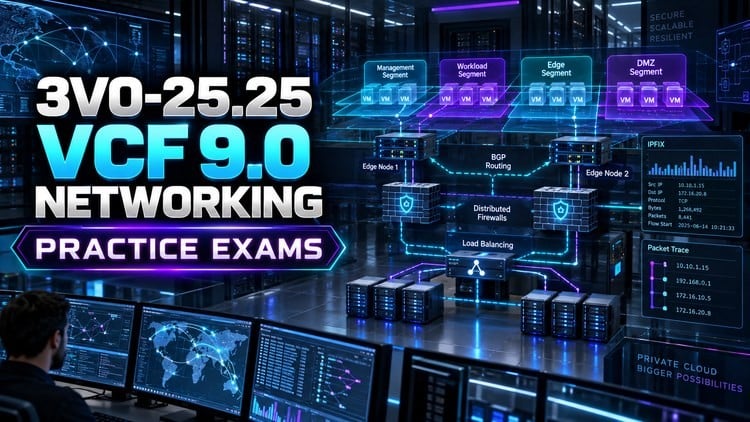
75 original scenario-based questions with detailed explanations for every answer option
What You Will Learn:
- Assess advanced VMware Cloud Foundation networking concepts across the current 3V0-25.25 exam objectives.
- Apply NSX architecture, connectivity, security, resilience, and troubleshooting knowledge to realistic scenarios.
- Identify supported network designs and trade-offs while avoiding common distractors and unsupported shortcuts.
- Use detailed explanations to close knowledge gaps before the 3V0-25.25 exam.
Overview
Alright folks, let’s talk about a crucial component for anyone seriously eyeing the advanced echelons of VMware Cloud Foundation networking: the ‘3V0-25.25 VCF Advanced Networking Practice Exams’. This isn’t your average quiz bank; it’s a meticulously crafted set of 75 scenario-based questions designed to really put your VCF and NSX-T knowledge through the wringer. If you’re preparing for the 3V0-25.25 certification, you know it’s not a paper-pushing exercise. VMware’s advanced certifications demand a deep, practical understanding, and this practice exam package aims squarely at testing that depth.
Overview
Forget passive learning; these practice exams are about active assessment and surgical identification of your knowledge gaps. What struck me immediately wasn’t just the quantity of questions, but the quality and thought put into making them genuinely scenario-based. They’re not just asking for definitions; they’re presenting you with situations you’d genuinely encounter in a production VCF environment, forcing you to apply your NSX architecture, connectivity, security, resilience, and troubleshooting expertise. The detailed explanations for *every* answer option are a game-changer. This isn’t just about getting the right answer; it’s about understanding *why* it’s right, and equally important, *why* the other options are wrong – a critical aspect of effective certification prep.
Prerequisites
Let’s be blunt: this isn’t for the faint of heart or the greenhorn. The “Advanced” in the title isn’t decorative. You absolutely need a solid foundation in VMware vSphere, vSAN, and, critically, a working knowledge of NSX-T Data Center. Think VCP-NV (or equivalent practical experience) as a bare minimum. If you haven’t deployed, configured, or troubleshoot NSX-T in a meaningful way, you’re going to struggle. This practice exam assumes you’ve already spent significant time with the industry-standard tools – NSX-T Manager, vCenter, various CLI commands – and understand the fundamental networking concepts intrinsic to a software-defined data center. It’s designed to take you from ‘proficient’ to ‘expert’, not from ‘beginner’ to ‘intermediate’. You really need prior exposure to real-world projects involving VCF and NSX to get the most out of these questions.
Skills & Tools
Successfully navigating these practice exams will hone several high-value skills. You’ll solidify your ability to analyze complex network requirements within VCF, design robust NSX-T topologies, implement advanced security policies (like distributed firewall rules and micro-segmentation), and critically, develop systematic troubleshooting methodologies for NSX-T components. While the practice exams themselves don’t provide a direct environment, they mentally prepare you to work with industry-standard tools such as NSX-T Manager UI/API, vCenter Server, and various command-line interfaces for deep dives. It refines your decision-making under pressure and your ability to spot subtle but significant details, all of which are essential job-ready skills for high-stakes environments.
Career Benefits & Job Roles
Passing the 3V0-25.25 exam, backed by the rigorous preparation these practice questions offer, significantly boosts your career growth trajectory. It validates that you possess expert-level knowledge in a highly specialized and in-demand area of cloud infrastructure. This opens doors to roles such as Senior Network Engineer, Cloud Architect, VMware Cloud Foundation Specialist, or a Professional Services Consultant focusing on VCF deployments. Your ability to demonstrate advanced proficiency with NSX-T within a VCF context makes you an invaluable asset for organizations adopting or optimizing their private cloud strategies. These are the kinds of skills that directly translate into leading real-world projects and architecting resilient, secure, and scalable cloud networks.
Pros
- Authentic Scenario-Based Questions: The questions are not simplistic. They reflect the complexity and nuances of real-world VCF deployments, which is crucial for advanced certification prep. This approach helps build genuine job-ready skills, moving beyond rote memorization.
- Comprehensive and Detailed Explanations: This is arguably the strongest feature. Knowing the right answer is one thing; understanding the underlying logic and why other seemingly plausible options are incorrect is where true learning happens. It’s excellent for closing knowledge gaps.
- Directly Aligned with Exam Objectives: The practice exams precisely target the 3V0-25.25 blueprint, ensuring your study time is efficient and focused on what truly matters for the exam. This precision avoids wasting time on irrelevant topics.
- Identifies Common Distractors and Unsupported Shortcuts: As explicitly stated in the caption, the design helps candidates identify and avoid typical traps and non-standard configurations that often trip up even experienced professionals.
Cons
- Assumes Significant Hands-On Experience: This isn’t a learning course; it’s a diagnostic tool. While the explanations are superb for reinforcing concepts, if you lack fundamental hands-on labs experience with NSX-T and VCF, these questions will expose your weaknesses but won’t provide the practical environment to build that experience from scratch. It’s an assessment and refinement tool for those already advanced, not a replacement for foundational practical work.