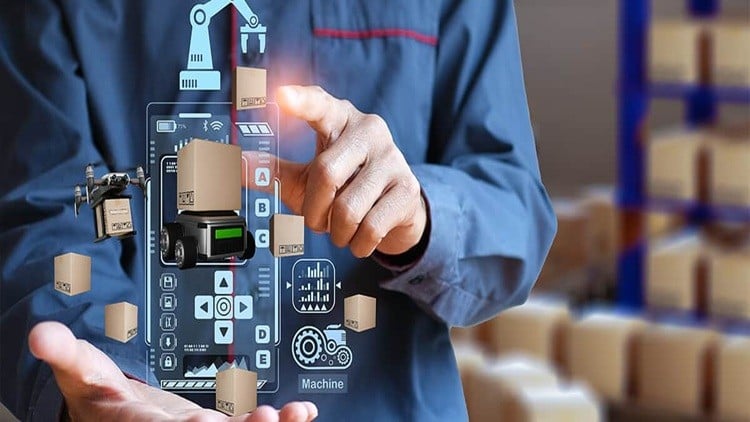
Voice Picking, AMRs, AutoStore, Goods-to-Person Systems, Cobots & Robotic Arms — From Manual to Fully Automated, by a 20
What You Will Learn:
- Why order picking costs 35% of all warehouse operating costs — and how automation eliminates this
- Voice picking, barcode scanning, pick-to-light and vision picking — how each works and when to use them
- Goods-to-person systems: carousels, Vertical Lift Modules, A-frames and mini-load AS/RS
- Autonomous Mobile Robots (AMRs) — how they navigate, pick and scale your operation
- AutoStore grid systems — the highest density storage and picking technology available
- Collaborative robots (cobots) and AI-driven robotic piece picking
- Robotic depalletising — the fastest ROI in warehouse automation
- How to choose the RIGHT automation system for YOUR specific operation
- The future of picking: AI orchestration, humanoid robots, Robotics-as-a-Service
The Real Deal on Cracking the Picking Code
Let’s be honest: if you’ve spent five minutes in a fulfillment center during peak season, you know that the “walking” part of the job is an absolute productivity killer. We’ve all seen the stats—picking can easily eat up over a third of your entire operating budget. This course, Warehouse Automation: Picking Automation & Strategies, doesn’t just repeat those scary numbers; it actually gives you the blueprint to fix them. As someone who has watched the industry shift from clipboards to AI-driven orchestration, I found this curriculum to be a breath of fresh air. It’s not just a sales pitch for expensive hardware; it’s a masterclass in logic, throughput, and scalability.
What I appreciated most was the focus on the transition. Most courses jump straight into the “shiny toys” like humanoid robots, but this one starts with the reality of manual operations and builds a bridge to fully automated environments. It tackles the messy middle—the collaborative robots (cobots) and voice picking systems that bridge the gap for companies that aren’t ready to drop $10 million on a grid system overnight. It’s a strategic deep-dive that feels like sitting down with a veteran consultant rather than a dry academic lecture.
Prerequisites
You don’t need a PhD in robotics to get value here, but you should have a foundational understanding of how a warehouse breathes. If you know the difference between an SKU and a pallet, you’re ready. The course is designed for career growth, so whether you are a floor supervisor looking to move into operations management or a tech enthusiast wanting to enter the logistics space, the barrier to entry is low. A basic grasp of KPIs (Key Performance Indicators) like pick-to-clean and order cycle time will help you appreciate the ROI calculations discussed throughout the modules.
Skills & Tools
This isn’t just theory; it’s about building job-ready skills that you can take to an interview tomorrow. You’ll walk away with a comprehensive toolkit that includes:
- System Selection Logic: Learning how to match specific SKU profiles to the right tech, from Vertical Lift Modules (VLMs) to A-frames.
- AMR Fleet Management: Understanding the navigation and logic behind Autonomous Mobile Robots and how they interact with human workers.
- AutoStore Optimization: A deep dive into high-density storage and how to manage the “grid” for maximum efficiency.
- ROI Modeling: Mastering the math behind robotic depalletising and why it’s often the fastest way to see a return on investment.
- Integration Literacy: Understanding how these tools talk to your Warehouse Management System (WMS) and Warehouse Control System (WCS).
Career Benefits & Job Roles
The logistics world is currently desperate for people who actually understand automation beyond the buzzwords. Completing this course acts as a solid certification prep for anyone looking to become a Certified Logistics Professional or a Solutions Architect. We are seeing a massive surge in roles like Automation Project Manager, Continuous Improvement Lead, and Robotics Implementation Specialist. By mastering these industry-standard tools, you’re positioning yourself at the top of the resume pile. Companies like Amazon, DHL, and Maersk aren’t looking for people to move boxes; they’re looking for people who can manage the robots that move the boxes. This is hands-on labs style thinking that translates directly to real-world projects.
Pros
- Strategic Depth: It doesn’t just show you what an AutoStore is; it explains *why* you would choose it over a mini-load AS/RS system based on your specific order volume and product dimensions.
- Future-Proofing: The sections on Robotics-as-a-Service (RaaS) and AI orchestration are gold. They prepare you for where the industry is heading in the next 5-10 years, not just where it is today.
- ROI-Focused: I love that the course emphasizes the “fastest ROI” (like robotic depalletising). It teaches you how to talk to the C-suite in the language they care about: money saved.
Cons
If I have one gripe, it’s that the course is so comprehensive it can feel like a firehose of information. While it covers beginner to advanced topics, a newcomer might feel a bit overwhelmed by the technical specifications of vision picking sensors or the nuances of AMR SLAM navigation without taking a few breaks to digest the tech-heavy terminology. It’s a lot to take in one sitting, so be prepared to revisit certain modules when you’re actually planning a real-world project.