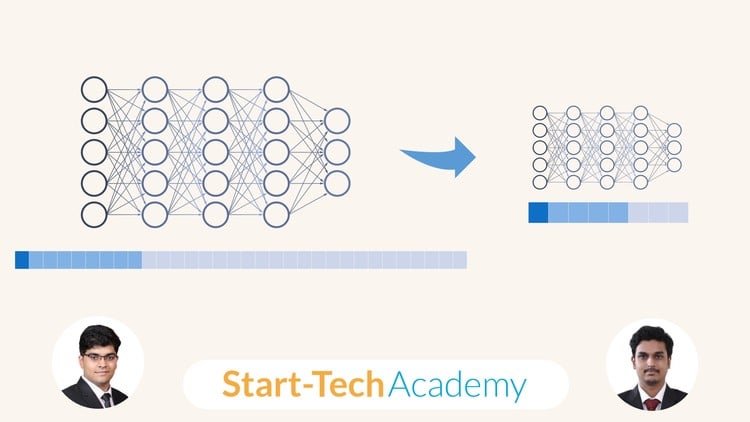
Unlock the power of model optimization! Learn how to apply quantization and make your GenAI models efficient with Python
⏱️ Length: 2.7 total hours
⭐ 4.45/5 rating
👥 6,322 students
🔄 October 2025 update
Add-On Information:
Note➛ Make sure your 𝐔𝐝𝐞𝐦𝐲 cart has only this course you're going to enroll it now, Remove all other courses from the 𝐔𝐝𝐞𝐦𝐲 cart before Enrolling!
-
Course Overview
- This course delves into the critical realm of optimizing Generative AI models, specifically addressing the ever-growing computational demands and memory footprints that often hinder their widespread deployment. It goes beyond theoretical discussions to equip learners with actionable strategies for making these powerful models accessible and performant in diverse environments.
- Explore the fundamental paradigm shift necessitated by the scale of modern GenAI, where traditional model pipelines often become bottlenecks. Understand how resource constraints in real-world applications, from mobile devices to edge computing, mandate a strategic approach to model efficiency.
- Gain insight into the core principle of quantization: transforming high-precision neural network weights and activations into lower-precision formats. This process is meticulously explained, highlighting its pivotal role in significantly reducing model size and accelerating inference speeds without substantial degradation in performance.
- Uncover the intrinsic value of making GenAI models not just intelligent, but also lean and agile. The course frames quantization as a key enabler for future-proofing AI applications, ensuring they can operate reliably and cost-effectively in a rapidly evolving technological landscape.
- Position yourself at the forefront of AI deployment by mastering the art of balancing model fidelity with practical operational efficiency. This foundational understanding is crucial for bridging the gap between cutting-edge research and real-world AI productization.
-
Requirements / Prerequisites
- Fundamental Understanding of Python: A working knowledge of Python syntax, data structures, and basic scripting is essential to follow along with the practical implementation sections.
- Familiarity with Machine Learning Concepts: Learners should possess a foundational grasp of machine learning principles, including what neural networks are, how they are trained (conceptually), and basic terminology like weights and activation functions.
- Conceptual Knowledge of Deep Learning Architectures: A general understanding of common deep learning models, particularly generative architectures, would be beneficial, though the course focuses on optimization techniques applicable across various models.
- Basic Math and Linear Algebra: An appreciation for basic mathematical operations related to matrices and vectors will aid in comprehending the underlying mechanics of precision reduction, though complex theory is simplified for practical application.
- Enthusiasm for AI Optimization: The most crucial prerequisite is a keen interest in making AI models more efficient, deployable, and impactful across a wider range of hardware and use cases.
-
Skills Covered / Tools Used
- Practical Model Compression Strategies: Develop expertise in applying state-of-the-art techniques to shrink the memory footprint of large generative models, making them suitable for resource-limited environments.
- Performance Profiling and Benchmarking: Learn to systematically evaluate the efficiency gains and potential accuracy trade-offs of quantized models, measuring improvements in inference speed and memory utilization.
- Deployment Pipeline Integration: Acquire the ability to integrate quantized models seamlessly into existing or new deployment pipelines, ensuring optimized models can be served effectively in production environments.
- Cross-Platform AI Optimization: Understand how quantization facilitates deploying complex AI models on a variety of target hardware, from embedded systems and mobile devices to specialized AI accelerators, broadening your GenAI applications’ reach.
- Leveraging Advanced Python Libraries: Gain hands-on experience with industry-standard Python frameworks designed for deep learning model optimization, enabling efficient manipulation and conversion of model data types for quantization.
- Debugging and Validation of Quantized Models: Develop skills in troubleshooting common issues during the quantization process, ensuring the functional integrity and desired performance characteristics of the optimized models.
-
Benefits / Outcomes
- Unlock Scalable AI Solutions: Empower yourself to build and deploy GenAI applications that are not only powerful but also economically viable and scalable across various computational budgets and hardware specifications.
- Reduce Operational Costs and Energy Consumption: Contribute to more sustainable AI development by significantly lowering computational resources and energy required for running large GenAI models, directly translating into reduced infrastructure expenses.
- Enable Real-Time AI on Edge Devices: Master the techniques necessary to bring sophisticated generative capabilities to resource-constrained environments, fostering new possibilities for on-device AI in robotics, IoT, and mobile applications.
- Become a Sought-After AI Optimization Specialist: Equip yourself with highly relevant and in-demand skills critical for bridging the gap between cutting-edge AI research and practical, deployable solutions in the industry.
- Accelerate Inference and User Experience: Drastically improve the responsiveness of GenAI applications by reducing model latency, leading to a smoother and more interactive user experience, crucial for conversational AI and real-time content generation.
- Future-Proof Your AI Development Career: Gain a competitive edge by understanding essential methodologies for making AI efficient, a skill that will only grow in importance as models continue to increase in size and complexity.
-
PROS
- Highly Practical and Hands-On: The course emphasizes real-world application, ensuring learners gain practical, deployable skills immediately relevant to current industry needs in GenAI.
- Addresses Critical Industry Challenge: Directly tackles the pressing issue of deploying large, resource-intensive GenAI models, making it invaluable for anyone working with or planning to work with these technologies.
- Future-Oriented Skill Set: Equips participants with knowledge that is increasingly vital for the sustainable and scalable future of AI, positioning them as pioneers in efficient AI development.
- Tangible Performance Improvements: Learners will acquire techniques that result in measurable improvements in model speed, size, and energy consumption, offering immediate and quantifiable benefits.
- Broad Applicability: While focused on GenAI, the core principles and techniques of quantization learned are widely applicable across various deep learning domains, enhancing overall ML engineering capabilities.
- Empowers Broader AI Adoption: By making models more accessible and efficient, the course indirectly supports the wider deployment of advanced AI, especially in emerging markets and hardware-constrained scenarios.
-
CONS
- Requires Careful Balancing of Trade-offs: While powerful, quantization inherently involves making compromises between model accuracy and efficiency, demanding careful evaluation and understanding of these trade-offs to achieve optimal results.
Learning Tracks: English,Development,Data Science