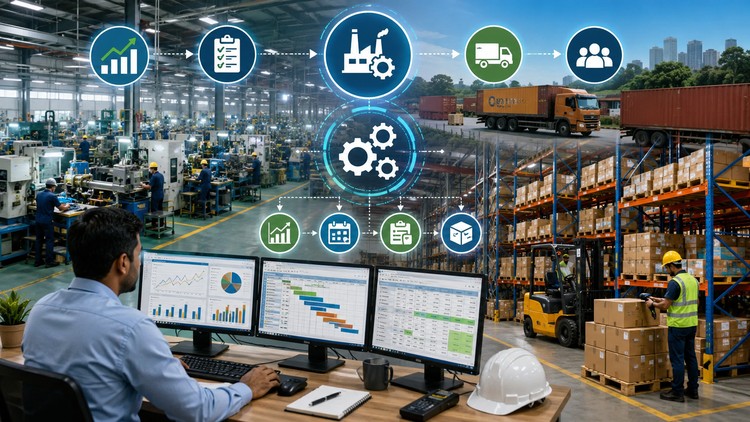
Practical Demand Forecasting, MPS, MRP & WMS for Indian Factory Efficiency.
What You Will Learn:
- Implement effective demand forecasting techniques, including quantitative and qualitative methods, for varied product lifecycles.
- Develop a robust Master Production Schedule (MPS) that balances customer demand with production capacity efficiently.
- Master Material Requirements Planning (MRP) to ensure timely material availability and optimize inventory levels.
- Analyze and resolve capacity bottlenecks using Rough-Cut Capacity Planning (RCCP) and Capacity Requirements Planning (CRP).
- Optimize inventory control strategies, including ABC analysis and economic order quantity (EOQ), specific to manufacturing.
- Integrate Production Planning & Control (PPC) with modern Warehouse Management Systems (WMS) and ERP platforms.
- Show more
The Reality of the Shop Floor: Why This Course Hits Different
If you’ve ever spent time in a high-stakes manufacturing environment, you know that the distance between a theoretical textbook and a chaotic shop floor is about a thousand miles. Most PPC courses I’ve seen are dry, academic, and frankly, a bit disconnected from the ground reality of supply chain volatility. However, “Production Planning & Control: Master Manufacturing & Supply” feels like it was built by someone who has actually survived a month-end production rush.
What caught my eye wasn’t just the technical jargon, but the specific focus on Indian factory efficiency. Let’s be real: managing a plant in a developing economy involves unique challenges—erratic lead times, local vendor management, and the constant pressure to optimize with limited resources. This course skips the fluff and dives straight into the mechanics of keeping the machines running without drowning in excess stock. It’s less about “ideal scenarios” and more about job-ready skills that help you navigate the daily fire-fighting of manufacturing operations.
Whether you’re looking for certification prep or just need to stop your inventory from becoming a liability, this curriculum acts as a tactical manual. It moves from beginner to advanced concepts with a logical flow that respects the learner’s time, focusing heavily on the “how” rather than just the “what.”
Prerequisites
You don’t need to be a math genius or a coding wizard to get value out of this. Here’s what you should bring to the table:
- A foundational understanding of how a factory or warehouse generally functions.
- Basic proficiency in Microsoft Excel (you’ll be crunching numbers, so knowing your way around a spreadsheet is non-negotiable).
- A logical, process-oriented mindset—if you enjoy solving puzzles, you’ll love the MRP and MPS modules.
- No prior experience with specific ERP software is required, as the course teaches the underlying logic used by industry-standard tools.
Skills & Tools You’ll Actually Use
This isn’t just a series of lectures; it’s a deep dive into the toolkit of a modern Supply Chain professional. By the end of the hands-on labs, you’ll be comfortable with:
- Quantitative Forecasting Models: Moving beyond guesswork to data-driven demand planning.
- ERP Logic: Understanding the “brain” behind platforms like SAP, Oracle, and Microsoft Dynamics.
- Inventory Optimization: Using ABC Analysis and EOQ to balance holding costs against stockout risks.
- Capacity Mapping: Running RCCP and CRP to ensure you aren’t over-promising to clients while under-utilizing your workforce.
- WMS Integration: Learning how modern Warehouse Management Systems talk to the production line to prevent data silos.
Career Benefits & Job Roles
In today’s market, “knowing how things are made” isn’t enough. Companies are looking for professionals who can optimize the flow of making things. Completing this course and applying the real-world projects to your portfolio can significantly accelerate your career growth. You’re moving from being a “worker” to a “planner,” which is where the real salary bumps happen.
Common job roles this course prepares you for include:
- Production Planner / Scheduler: The person responsible for the heartbeat of the factory.
- Supply Chain Analyst: A role focused on data, efficiency, and cost-reduction.
- Inventory Manager: Balancing the fine line between “too much” and “not enough.”
- Operations Manager: Overseeing the entire lifecycle from raw materials to finished goods.
- ERP Consultant: Helping firms implement the very systems you’ll master in these modules.
The Pros
- Highly Practical Context: The emphasis on Indian manufacturing nuances makes this incredibly relevant for professionals in the region (or those working with global vendors). It addresses the “messiness” of real-world supply chains.
- End-to-End Visibility: It doesn’t just stop at production. By integrating WMS and MRP, it gives you a holistic view of the entire value chain, which is essential for high-level management roles.
- Logical Progression: The transition from beginner to advanced topics is smooth. It builds your confidence with demand forecasting before throwing you into the complexities of Rough-Cut Capacity Planning.
- Focus on Job-Ready Skills: The course is clearly designed to help you pass technical interviews and handle industry-standard tools from day one on the job.
The Cons
- Excel-Heavy: While the logic is sound, I would have liked to see a bit more direct interaction with a live “sandbox” ERP environment. If you aren’t a fan of spreadsheets, the middle sections might feel a bit tedious, though the knowledge is absolutely vital for career growth in this field.