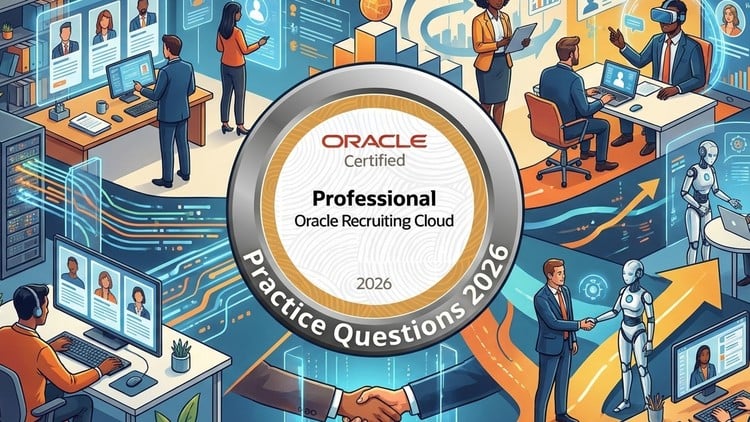
Pass the Oracle Recruiting Cloud 2026 Certification with Realistic Practice Exams and Detailed Explanations
What You Will Learn:
- Set up and configure the Oracle Recruiting Cloud offering from scratch.
- Create and manage job requisitions with approval workflows and compliance.
- Apply sourcing strategies and improve the candidate experience on career sites.
- Track candidates, manage applications, and handle interview feedback smoothly.
- Understand AI/ML features and the Redwood interface for smarter recruiting.
Overview: Beyond the Standard Certification Hype
Let’s be real for a second: the Oracle ecosystem is shifting faster than most consultants can keep up with. If you’ve been tracking the Oracle Recruiting Cloud (ORC) roadmap, you know that the 2026 update (1Z0-1069-26) isn’t just a minor patch. It’s a full-on embrace of the Redwood interface and heavy-hitting AI integrations. When I first looked into this practice test set, I was skeptical. Most “certification prep” materials are just recycled dumps from three years ago. However, this set of Oracle Recruiting Cloud 2026 Practice Tests actually feels like it was written by someone who has spent late nights troubleshooting requisition workflows and candidate pools.
What stands out here isn’t just the question bank; it’s the logic behind the “why.” Oracle has moved away from simple “where is this button” questions and toward complex, scenario-based hurdles. These practice exams mirror that shift. They push you to think like a Functional Consultant rather than a script reader. Whether you’re dealing with industry-standard tools or trying to figure out why an approval rule is looping indefinitely, these tests force you to apply knowledge rather than just memorize it. It’s a beginner to advanced journey that assumes you want to actually do the job, not just hang a certificate on your LinkedIn profile.
Prerequisites
You don’t need to be a coding wizard, but you shouldn’t be walking in totally cold either. To get the most out of these certification prep materials, I’d recommend the following:
- A fundamental understanding of Oracle HCM Cloud architecture (Global Human Resources).
- Basic familiarity with the Redwood UX philosophy—Oracle is moving everything here, so if you’re still stuck in the classic UI, you’re already behind.
- An conceptual grasp of the recruitment lifecycle, from “help wanted” to “you’re hired.”
- Access to an Oracle Vision instance or a sandbox for hands-on labs is highly recommended so you can test the scenarios described in the explanations.
Skills & Tools Covered
This isn’t just a list of questions; it’s a breakdown of the modern recruiter’s toolkit. The course focuses heavily on job-ready skills that translate to billable hours. Key areas include:
- Redwood Toolset: Mastering the new, responsive pages that are becoming the standard for the 2026 exam cycle.
- Oracle Transactional Business Intelligence (OTBI): Learning how to pull real-time data to prove your recruiting ROI.
- AI & Machine Learning: Understanding how the “Best Fit” candidate algorithms actually work under the hood.
- Candidate Experience (CX): Designing career sites that don’t look like they were built in 1998.
- Workflow Automation: Configuring complex approval chains that satisfy both HR and Finance.
Career Benefits & Job Roles
If you’re looking for career growth, the ORC certification is currently one of the highest-value credentials in the SaaS HR space. Companies are desperate for consultants who can migrate them away from legacy systems like Taleo or Workday and into the Oracle Cloud. By mastering these tests, you’re positioning yourself for roles such as:
- Oracle HCM Functional Consultant: The person who designs the blueprint for global enterprises.
- HR Technology Analyst: Helping internal teams optimize their real-world projects and hiring pipelines.
- Talent Acquisition Operations Manager: Bridging the gap between “we need people” and “how does the system track them?”
- Implementation Lead: Managing the heavy lifting of a fresh “from scratch” ORC rollout.
Pros
- Extreme Realism: The scenarios don’t just ask about features; they ask about “The client wants X, but the system does Y, how do you fix it?” This is the exact kind of thinking required for real-world projects.
- Deep-Dive Explanations: Instead of just saying “Option C is correct,” the course explains why A, B, and D are wrong. This is where the actual learning happens.
- Focus on the 2026 Delta: It specifically highlights the new AI/ML and Redwood features, which are the biggest “gotchas” on the new 1Z0-1069-26 exam.
- Time Management: The timed environment helps you get used to the pressure of the actual Oracle testing center, which is half the battle.
Cons
If I have one gripe, it’s that these are practice tests and not a full video-based walkthrough. If you are a complete novice who has never seen the inside of an Oracle environment, you might find the learning curve a bit steep. It’s designed to complement hands-on labs, not replace them. You’ll need to do some independent digging into the Oracle documentation to fully grasp some of the more obscure configuration steps mentioned in the answers.
Bottom line: If you want to stop guessing and start passing, this is the most current and honest resource for the 1Z0-1069-26 certification out there right now.