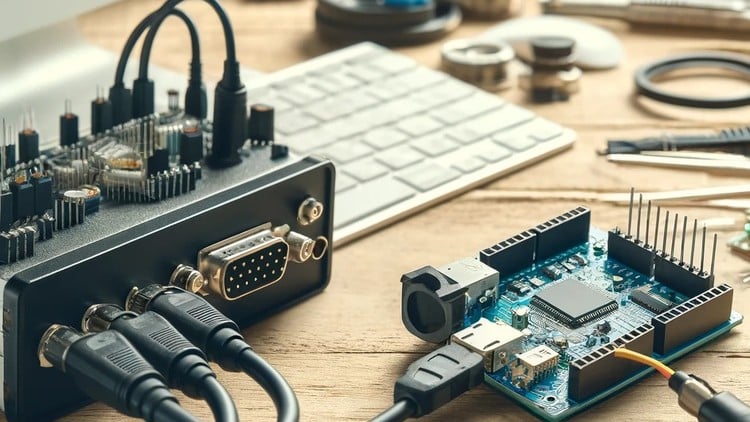
Interface PIC Microcontroller and Arduino using Serial Communication RS232 and Visual Interface
⏱️ Length: 1.8 total hours
⭐ 3.63/5 rating
👥 7,878 students
🔄 June 2025 update
Add-On Information:
Note➛ Make sure your 𝐔𝐝𝐞𝐦𝐲 cart has only this course you're going to enroll it now, Remove all other courses from the 𝐔𝐝𝐞𝐦𝐲 cart before Enrolling!
- Course Overview
- Delve into the foundational concepts of serial communication protocols, specifically focusing on RS232, to understand how data is transmitted bit by bit between devices.
- Explore the architectural nuances of PIC Microcontrollers and Arduino boards, identifying their respective capabilities and suitable applications in embedded systems.
- Grasp the critical role of UART (Universal Asynchronous Receiver-Transmitter) modules within microcontrollers for managing serial data streams, including configuration of baud rates, data bits, parity, and stop bits.
- Understand the practical implications of voltage level shifting when connecting different hardware platforms, ensuring compatibility and preventing damage between TTL/CMOS logic and RS232 standards.
- Establish a clear conceptual framework for data flow and handshaking mechanisms that ensure reliable and ordered exchange of information across serial links.
- Examine typical real-world scenarios where serial communication forms the backbone of data acquisition, industrial control, and interactive embedded projects.
- Uncover the advantages and limitations of serial communication in comparison to other interfacing methods like I2C, SPI, or USB for specific application requirements.
- Requirements / Prerequisites
- Possess a foundational understanding of basic electronics principles, including voltage, current, resistance, and common electronic components.
- Familiarity with C/C++ programming syntax is highly recommended, as microcontroller programming often utilizes these languages for firmware development.
- Prior exposure to microcontroller programming concepts, such as I/O manipulation, timers, and interrupts, will be beneficial but not strictly essential.
- Basic proficiency in computer operation and software installation, including IDEs and drivers, is expected to set up the development environment effectively.
- Access to common hardware components such as a PIC Microcontroller (e.g., PIC16F877A), an Arduino board (e.g., Arduino Uno), USB-to-serial converters, breadboards, jumper wires, and basic electronic components will be necessary for practical exercises.
- Skills Covered / Tools Used
- Configure UART registers on PIC microcontrollers to initiate and control serial data transmission and reception.
- Program Arduino boards to send and receive serial data using the built-in Serial library, mastering functions like
Serial.begin(),Serial.print(), andSerial.read(). - Develop firmware logic for handling incoming serial commands and transmitting sensor data or status updates from embedded devices.
- Implement data packetization and parsing techniques to reliably transmit structured data, including delimiters, checksums, and error detection, over serial channels.
- Utilize Visual Studio or Python-based IDEs (e.g., PyCharm, VS Code) for developing desktop applications that interact with the serial port.
- Employ PySerial library in Python for establishing robust serial communication between a personal computer and a connected microcontroller.
- Design and develop Graphical User Interfaces (GUIs) using libraries like Tkinter, PyQt, or Windows Forms to provide an intuitive control panel for your microcontroller projects.
- Integrate visual elements and controls within the GUI for tasks such as displaying real-time sensor readings, sending command strings, and toggling digital outputs on the microcontroller.
- Master event-driven programming paradigms for GUI applications, responding to user inputs and incoming serial data dynamically.
- Practice effective debugging strategies for both hardware and software aspects of serial communication, including using serial monitors and logic analyzers.
- Understand device driver installation and COM port management on different operating systems to ensure proper recognition and access to serial devices.
- Explore methods for multi-threaded serial communication in desktop applications to prevent UI freezing while waiting for data.
- Benefits / Outcomes
- Gain the ability to develop customized monitoring and control systems for a wide array of embedded applications, from home automation to industrial prototyping.
- Enhance your project development capabilities by seamlessly integrating physical hardware with sophisticated software interfaces for better user experience and functionality.
- Acquire valuable skills highly sought after in fields such as IoT development, embedded systems engineering, robotics, and automation.
- Build a strong foundation for understanding more complex device-to-device and device-to-cloud communication protocols.
- Develop a practical understanding of how low-level hardware interacts with high-level software, bridging the gap between hardware and software engineering disciplines.
- Cultivate problem-solving expertise in troubleshooting connectivity issues, data integrity problems, and hardware-software synchronization challenges.
- Open doors to creating professional-grade tools for testing, calibration, and data logging of custom electronic devices.
- Empower yourself to embark on more ambitious projects requiring interactive dashboards and remote control functionalities for embedded hardware.
- PROS
- Highly practical and project-oriented, focusing on direct application of concepts.
- Covers a fundamental communication method essential for many embedded systems.
- Teaches a valuable skill set for creating custom user interfaces for hardware projects.
- Utilizes widely available and cost-effective hardware platforms (PIC, Arduino).
- CONS
- The relatively short total length of 1.8 hours may mean a high pace or limited in-depth exploration of advanced topics.
Learning Tracks: English,IT & Software,Other IT & Software